For a one-off recipe
You’d rather buy a single bar than a multipack. Its net weight helps you measure out the amount your recipe calls for, while labels such as ‘baking’ or ‘dessert’ indicate how the manufacturer or retailer presents it.


For a mousse, cake or ganache, start with a bar of dark chocolate labelled ‘baking’ or ‘dessert’ if you only want to buy one for your recipe. Then choose the cocoa percentage to suit the flavour you’re after, and check the net weight, ingredients and allergens. A bar intended for eating, especially one with added ingredients, may not be suitable for the same recipe.
You’d rather buy a single bar than a multipack. Its net weight helps you measure out the amount your recipe calls for, while labels such as ‘baking’ or ‘dessert’ indicate how the manufacturer or retailer presents it.
You’re comparing bars intended for baking, including those labelled 70% cocoa, for a ganache, fondant or cream with a more intense flavour.
You want to use some of the bar in a recipe and enjoy the rest. Check that its flavour, any added ingredients and format are also suitable for the recipe.
| What to consider | What to check | Who is it for? |
|---|---|---|
| Format and quantity | Whether it’s sold individually and how its net weight compares with the amount your recipe calls for. | When I’m making just one dessert, I want to buy a bar I can measure out without having to get a multipack. Around 33% of consumers put this need for the right format first. |
| Cocoa intensity | The stated cocoa percentage and the flavour profile you want for your recipe. | For a fondant or ganache, I want to choose the chocolate’s intensity rather than grab the first bar I see. This is the main priority for around 27% of consumers. |
| Ingredients | Ingredients, allergens and nutritional information, particularly the sugars per 100 g. | Before cooking for people whose needs I have to consider, I want to check the ingredients of the product I’ve chosen. Around 20% of consumers put this information first. |
| Suitable for baking and eating | Whether the bar contains added ingredients or a filling, and whether it’s labelled for baking. | If I’m keeping a few squares after making the recipe, I want a bar that works for both without changing the dessert I had planned. Around 20% of consumers put this dual use first. |
Weights vary by product: the bars listed by Lindt, Carrefour and Auchan don’t all contain the same amount. Using the whole bar could therefore change the proportions in your recipe.
Check the net weight and measure out the amount you need rather than relying on the number of bars.
Hazelnuts, fruit or a filling can change the texture and flavour of a mousse, ganache or cake.
If your recipe calls for plain dark chocolate, check the ingredients before choosing a bar intended for eating.
According to Santé publique France, displaying the Nutri-Score is voluntary. Its absence alone doesn’t tell you what’s in a bar.
Compare the ingredients and nutritional information for the products you’re considering, and take the Nutri-Score into account when it appears on the packaging.
The levy described by the Ministry of the Economy applies to sugary drinks, not bars of dark chocolate. It doesn’t tell you what’s in the bar you’re buying.
To compare sugar levels, check the amount per 100 g on each bar’s packaging.
The Dessert range includes a 200 g Noir Intense 70% bar, which Lindt France describes as suitable for baking and eating.
Auchan lists a 205 g Nestlé Dessert dark chocolate bar intended for baking.
Carrefour lists a 200 g dessert dark chocolate bar, sold individually.
E.Leclerc lists 200 g bars of dark baking chocolate, including a more intense variety.
Carrefour and Auchan list a 200 g Menier dark chocolate bar intended for baking.
These two dark chocolates are presented as suitable for baking. Compare their weight with the amount your recipe calls for, and check how the product is sold if you want to buy just one bar.
 Image unavailable
A dark chocolate bar to consider if your recipe calls for around 200 g and you’d like to keep a few squares for later. Check the ingredients and allergens on the packaging, taking into account who’ll be eating the dessert.
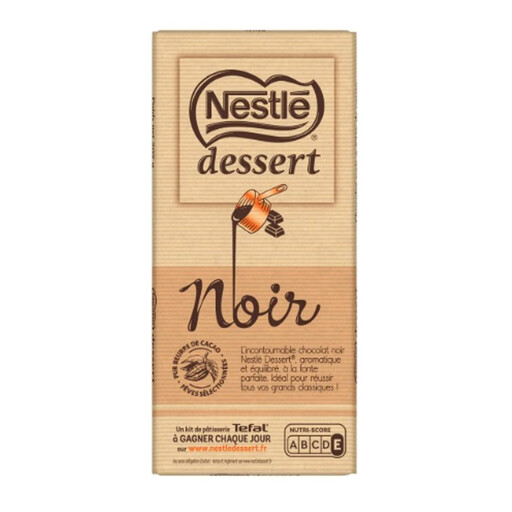 Image unavailable
This 205 g dessert dark chocolate is worth considering for a recipe that involves melting chocolate. If you’re looking for a specific cocoa intensity or just one bar, check the cocoa percentage and how it’s sold before buying. Also check the allergens on the packaging.
Yes, as long as its ingredients work for your recipe. For a plain ganache, check in particular that it doesn’t contain added ingredients or a filling that the recipe doesn’t call for, and make sure you have the right amount of chocolate.
No. Santé publique France says producers display Nutri-Score voluntarily. You can compare the nutritional information and ingredients of two bars even if one of them doesn’t carry the logo.
No: the levy described by the Ministry of the Economy applies to sugary drinks. To find out how much sugar a bar contains, check its nutritional information per 100 g.
First, check how much the recipe calls for and the bar’s net weight. Then check the cocoa percentage, ingredients and allergens for the product you’ve chosen. A 205 g bar isn’t an exact match for a recipe calling for 200 g of chocolate.
Follow the storage instructions on your bar. For the 200 g Menier bar listed by Auchan, the retailer recommends storing it in a dry place away from light, at between 15 and 18 °C.