For a cake to share, first choose dark chocolate labelled for baking or desserts, in an amount that matches the recipe. A multipack of bars gives you several easy-to-measure portions. Don’t automatically swap these bars for a sharing bag without checking its ingredients, any fillings or inclusions, and the recommended use on the packaging. Then choose the cocoa content to suit the flavour you want, and check the sugars and allergens in the product you pick.
Who is this guide for?
Anyone making a cake with baking chocolate
For a cake, mousse or chocolate fondant, look for a product described as suitable for desserts and with a cocoa content that will give you the result you want. Nestlé Dessert and Lindt DESSERT product pages offer examples of bars intended for this use.
Anyone cooking for a group
You’ll need to have the amount of chocolate required by the recipe, plus perhaps a little extra for decoration. A multipack of bars, such as the one described by Carrefour, makes it easy to work out how many portions you’ll have before you buy.
Anyone checking ingredients carefully
Before sharing the cake, you’ll want to check the sugars, ingredients list and allergen information for the exact chocolate you plan to use.
What should you check?
For a cake to share, start with how you plan to use the chocolate and how much the recipe calls for. Then consider the flavour you want and check the ingredients.
| What to consider |
What to check |
Who it matters to |
| Suitable for baking |
Look for wording such as “baking” or “dessert” and read the ingredients, especially if the product has a filling. |
I want to choose chocolate for my cake without adding an unexpected filling; around 33% of consumers would put suitability for baking first. |
| Quantity and format |
Work out how much you need and compare it with the net weight of the bag, bar or multipack. |
If I’m cooking for a group, I need enough chocolate to follow the recipe; around 27% of consumers would put quantity first. |
| Cocoa content |
Compare the percentage on the packaging with the amount specified in the recipe or the flavour you want for the cake. |
For a fondant with a pronounced chocolate flavour, I choose my chocolate based on its cocoa content; around 20% of consumers would put this first. |
| Ingredients |
Check the sugars per 100 g, the ingredients list, allergens and any “may contain” statements. |
Before sharing the cake, I want to know what’s in it and check the allergen information; around 20% of consumers would make ingredients their priority. |
Mistakes to avoid
-
Assuming a sharing bag is the same as baking chocolate
The format alone doesn’t tell you what the product is intended for or whether it contains a filling. A bag of chocolate bites and Dessert bars aren’t necessarily interchangeable in a recipe.
Check the product description, its ingredients and the amount of chocolate you can use before changing your shopping list.
-
Relying on Nutri-Score alone
According to Santé publique France, displaying Nutri-Score is voluntary. If it’s not shown, you should still check the nutrition information and ingredients.
If it appears on the packaging, consider it alongside the values per 100 g, cocoa content and ingredients of the exact product.
-
Assuming all dark chocolate contains the same allergens
The Carrefour product page for a Côte d’Or Noir L’Original bar lists soya and skimmed milk powder, among other ingredients. Ingredients and “may contain” statements vary between products.
Check the label on the chocolate you buy, including any “may contain” statements, if allergens matter to the people who’ll be eating the cake.
Brands and ranges to know
Nestlé Dessert
The range includes dark chocolate products described as suitable for baking. A Carrefour product page describes the 200 g Dessert Corsé bar.
- The ingredients list for this product states that it contains at least 65% cocoa.
- The description on the same page says 64%: check the cocoa content on the packaging of the bar you choose. Don’t confuse this 200 g product with another Nestlé Dessert format.
Lindt
Lindt France describes its 200 g DESSERT Noir Intense bar, with 70% cocoa, as chocolate for desserts.
- The format and cocoa content are specified for this particular product.
- If the recipe calls for a different amount or cocoa profile, check both before using this in place of the chocolate specified.
Carrefour Original / Carrefour
Carrefour offers, among other products, a Dessert multipack of three 200 g bars, weighing 600 g in total.
- Separate bars make it easy to measure out the amount you need for one recipe or several bakes.
- The multipack product page states that it contains at least 52% cocoa; check this if your recipe calls for a different percentage.
Côte d’Or
The 200 g Noir L’Original bar described by Carrefour is dark chocolate, but its product page doesn’t specify that it’s intended for baking.
- Its ingredients list lets you check what it contains before using it in a recipe.
- This product lists skimmed milk powder and soya lecithins; check the label and don’t assume it’s equivalent to a Dessert bar.
Dark chocolate bars on Joybuy
These options include a multipack and individual bars to consider for a cake. Choose according to the amount required by your recipe and check the ingredients for each product; these are not sharing bags.
 Image unavailable
POULAIN Extra Dark, 3 × 100 g
If your recipe calls for several portions of chocolate, this multipack contains three 100 g bars, giving you 300 g in total. Check the cocoa content, ingredients and allergen information on the product you choose.
View on Joybuy
 Image unavailable
POULAIN Extra Dark, 200 g
This individual bar is worth considering if your recipe calls for 200 g of chocolate. If the cake needs more, work out how much you’ll need to buy in total. Also check the ingredients and allergen information on the packaging.
View on Joybuy
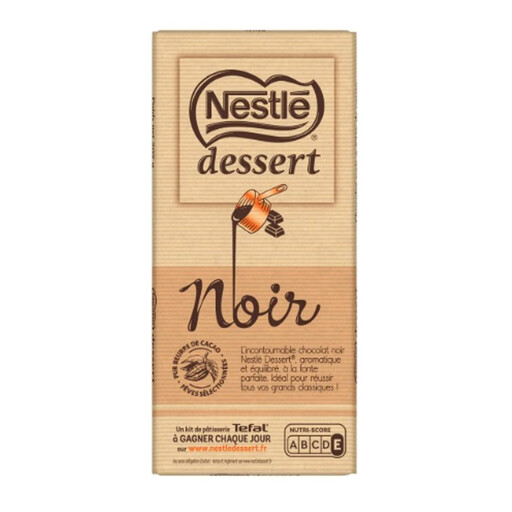 Image unavailable
Nestle Dark Dessert, 205 g
This 205 g Dessert product is worth considering if its format suits your recipe. Check the cocoa content and allergen information on the packaging before using it in place of a specific chocolate named in the recipe.
View on Joybuy
Frequently asked questions
Does the so-called “soda tax” apply to solid dark chocolate?
No. According to Légifrance, the charge set out in Article 1613 ter of the French General Tax Code applies to drinks and liquid preparations for drinks that meet the conditions in that article, not to a bar or bag of solid chocolate. For your recipe, check the amount of sugars shown in the chocolate’s nutrition information instead.
Is Nutri-Score compulsory on dark chocolate in France?
No. Santé publique France says that producers display Nutri-Score voluntarily. The European Commission states that a nutrition declaration is required for the vast majority of prepacked foods, so compare the values per 100 g even if there’s no Nutri-Score logo.
Which allergens should you check before making a dark chocolate cake?
Read the ingredients list and any “may contain” statements for the product you choose, especially for milk, soya and nuts. The European Commission states that allergens present as ingredients must be emphasised in the list. Don’t assume what a chocolate contains based on the word “dark” alone.
Can you check the ingredients before buying chocolate online?
Yes. The European Commission states that the mandatory food information for products sold at a distance must be available before you complete your purchase. Check the information for the exact product, then read its packaging again before using it, especially if allergens are a concern for your guests.


