
Livraison le jour même ou le lendemain

Qualité garantie

Débloquez vos offres de bienvenue: Livraison GRATUITE | Jusqu'à -80 % | 30 jours d'essai gratuits à JoyPlus
Téléchargez l'application
Choosing a baby walker is about more than comparing colours, a few toys and a promise of first steps. Wheeled walkers, push-along walkers and activity centres serve completely different purposes. A poorly chosen product may end up in the cupboard after a few weeks, take up unnecessary space at home or lack stability on certain floors.
Before placing your order, three mistakes are particularly common:
The age recommended by the manufacturer is a useful starting point, but it does not replace observing your child. A baby walker from 9 months may suit a baby who can sit confidently and is already interested in moving around. A baby walker from 12 months is generally intended for a child who is closer to standing independently.
Always check:
A push-along walker should not be chosen solely because it is described as adaptable. The handle must be at a suitable height for the child, and the frame must remain stable when they lean on it.
The width of the base, the weight of the frame and the design of the wheels all have a direct impact on stability. On a push-along model, wheels that move too freely can cause a sudden start. A speed setting, brake or suitable resistance helps your child control their first movements.
At home, wooden floors, tiles, carpet and rugs do not provide the same level of grip. The rubberised wheels on a wooden baby walker can reduce noise and help prevent slipping, but the product should always be used on a flat, clear surface.
Before each use, check the screws, wheels, handle and any locking mechanisms. Keep the walker away from stairs, steps, open doors and all areas where there is a risk of falling.
Plastic is generally easy to clean and makes it possible to include an interactive console. Wood offers a more understated structure and may appeal to families looking for durable equipment. In both cases, carefully check:
If you are looking for equipment that can be used at different stages, an adaptable baby high chair can complement or replace a walker. It supports mealtimes and your child’s growth, but it is not intended to help them move around. It is therefore better to compare the function you need rather than assume that all adaptable equipment is interchangeable.
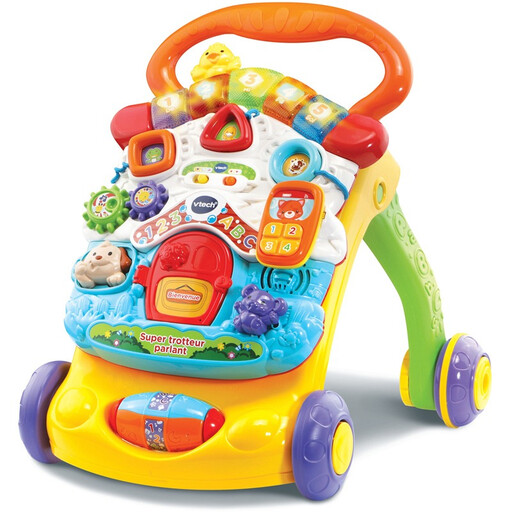
Why this choice suits this profile : This model is designed for families who want to combine an activity centre and a push-along walker in one product, from 9 months according to the information provided.
Its 2-in-1 design means you do not need to buy an activity panel and a push-along baby walker separately. The adjustable wheel resistance helps support your child’s movement as they progress.
Removable panel with buttons, cogs, light-up keys and a shape sorter. Voice function, sounds and melodies. Stated for use from 9 months.
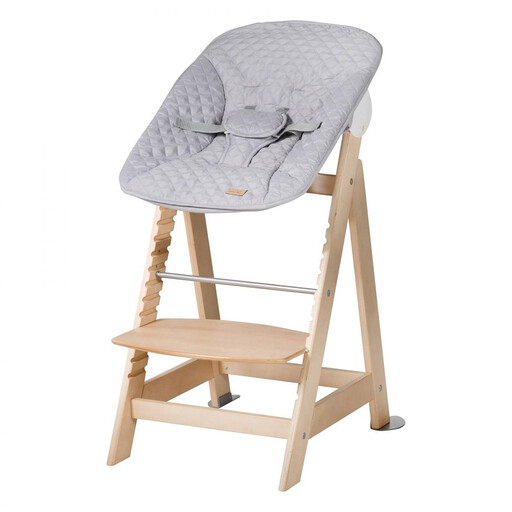
Why this choice suits this profile : This set is designed for households that prioritise adaptable equipment for mealtimes and seating, rather than a traditional walker for getting around.
It helps distinguish between an activity product and a walking aid: its primary function is adaptable seating, with a reclining bouncer for newborns and a chair that can be used at different stages.
Adjustable seat and footrest from 42 to 55 cm, 5-point harness on the newborn module and 3-point harness on the chair. Stated load capacity of up to 70 kg for the chair without the reclining module.
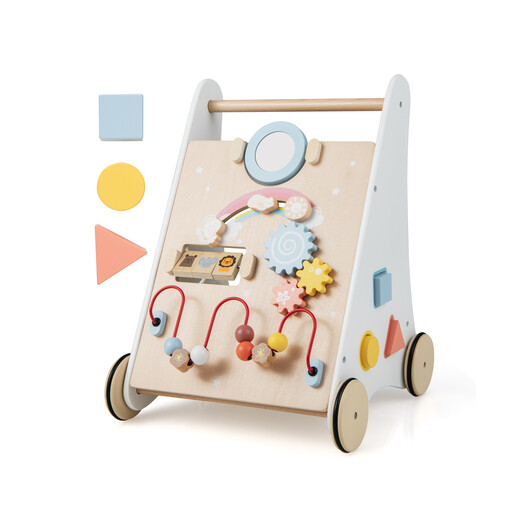
Why this choice suits this profile : This wooden baby walker is ideal for families looking for a push-along aid without a seat, with an integrated activity centre to keep their child entertained between bouts of movement.
Its push-along design suits a child who is already pulling themselves up. The rubber-rimmed wheels are designed to reduce noise and slipping, unlike completely smooth wheels.
Seven advertised activities, wooden handle, storage basket and dimensions of 34,5 × 32,5 × 45 cm. Suitable from 12 months according to the information provided.
We have brought together a complete, real-time updated selection of products that meet these demanding criteria and European safety regulations.
After buying the product, assemble it according to the instructions, then check every fastening before using it for the first time. Place it on a flat floor with enough clear space for your child to move freely. Cables, tablecloths, small objects and furniture edges must remain out of reach.
With a musical walker, also check the battery compartment and remove the batteries before storing it for a long period. Sounds can stimulate your child, but keeping the volume moderate is preferable in a shared living space.
An adult must remain present throughout use. Never leave your child near stairs, a swimming pool, an open patio door or any surface that could cause the walker to tip over. Regularly inspect the wheels, stitching, removable parts and adjustment mechanisms.
It depends on the type of product and your child’s abilities. Some models are suitable from 9 months, while others are intended from 12 months. Follow the minimum age, permitted weight and manufacturer’s instructions. With a push-along walker, your child should already be able to pull themselves up and support their weight with sufficient stability.
How long it can be used depends on your child’s build, their progress and the maximum permitted load. A model with activities can remain useful as long as your child uses it without pushing it roughly or trying to climb on it. Stop using it as soon as the product becomes too small, unstable or damaged.
Most models only need regular cleaning with a slightly damp cloth, together with checks of the wheels, screws and removable parts. For the textile elements of an adaptable chair, refer to the care label. This does not replace adult supervision or compliance with the age and weight limits.