
Livraison le jour même ou le lendemain

Qualité garantie

Débloquez vos offres de bienvenue: Livraison GRATUITE | Jusqu'à -80 % | 30 jours d'essai gratuits à JoyPlus
Téléchargez l'application
Potty training does not follow the same stages in every family. Some children start with a baby potty, while others quickly prefer using the toilet with a children’s toilet seat reducer. Between bulky models, accessories that are difficult to clean and comfort claims that are rarely backed up, a few checks are all it takes to avoid buying something that ends up gathering dust in a cupboard.
A foldable potty-training seat can be very practical at grandparents’ homes, when travelling or in a small bathroom. Once unfolded, however, it must remain completely stable. Check the quality of the base, the folding mechanism and the amount of space the product takes up when open.
A seat that is too lightweight or poorly adjusted may also move on the toilet bowl. If you choose a toilet seat reducer with handles, check that it is compatible with the shape of your toilet and look for non-slip surfaces or pads in the product details.
Comfort depends on several tangible elements: the shape of the seat, its width, height, padding and lateral support. A children’s toilet seat with cushion can be pleasant to use, provided that the cushion is easy to clean and securely attached.
Be wary of descriptions that promise a comfortable seat without specifying the materials, dimensions or care requirements. For a young child, a seat that is too wide can feel unstable, while an opening with unsuitable proportions may make it uncomfortable to use.
A potty used several times a day must be quick to empty, rinse and dry. Recesses, hard-to-reach joins and porous surfaces can quickly make cleaning more difficult. Before placing your order, look for a removable bowl or a design that provides easy access to every surface that comes into contact with your child.
Also check the stated age range and maximum weight where provided. Equipment advertised for children aged 1 to 8 years will not necessarily suit every body shape in the same way, so dimensions remain a key consideration.
For a standalone potty, measure the available space in your bathroom and check the seat height. For a toilet seat reducer, note the width and length of the toilet bowl, particularly if your toilet has an unusual shape.
Handles can make fitting easier and reassure your child, but they are no substitute for a stable position. During the first few uses, an adult should remain nearby to help the child sit down and stand up.
Choose a smooth, non-porous surface designed to withstand frequent cleaning. Check the manufacturer’s recommendations regarding washing, approved cleaning products and drying before first use.
Regulatory information also deserves careful attention on the product page or packaging. For an item intended for a child, check the instructions for use, warnings, recommended age and, where applicable, the CE marking. This marking does not remove the need to follow the manufacturer’s instructions.
Ask yourself three simple questions:
This final distinction is particularly important. A doll potty with accessories supports pretend play, but does not replace equipment designed for a child’s everyday use.
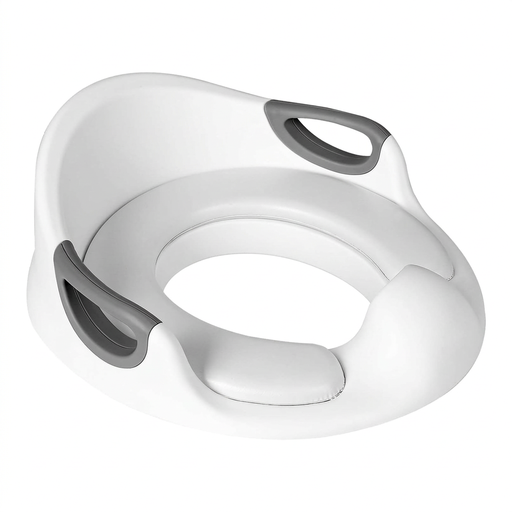
Why this choice suits this profile : This seat combines several useful features for a first purchase: a soft cushion, splash guard, two handles and a foldable design. It may suit families who want to support the transition to using the toilet without accumulating lots of accessories.
The product details clearly state that it folds and is portable. You can therefore check these features before buying, rather than relying on a vague promise of convenience.
The soft cushion, splash guard, handles and foldable design are all stated in the product name.
Why this choice suits this profile : Families looking for several functions in one piece of equipment can consider this model and compare its features with their requirements for comfort and portability.
The features are listed separately: soft seat, handles, splash guard and folding design. This makes it easier to compare the model objectively with its competitors.
Portable design, with a cushion, handles and splash guard stated as included features.
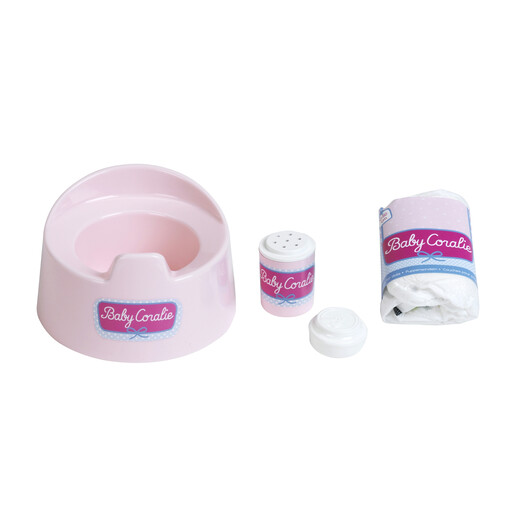
Why this choice suits this profile : This product is intended for children aged 3 and over who enjoy pretending to care for their doll. It supports hygiene routines through play, but should not be confused with a potty intended for real use.
Its name and contents clearly identify it as a toy accessory. This set must therefore not replace potty-training equipment intended for a child.
Potty, nappy, talcum powder box and cream box included: a set designed for pretend play from the age of 3. Small parts should be taken into account.
The Alphynix ‘WORK MADE US Coworkers…’ decorative plaque, featuring a leafy design and supplied with a wooden stand, is instead a humorous gift for a colleague. It is neither a potty-training product nor a child’s potty-training accessory. This distinction helps prevent confusion between everyday products and purely decorative items.
We have put together a complete, real-time updated selection of products that meet these demanding criteria and European safety requirements.
It depends on the child, their ability to understand instructions, sit correctly and signal when they need to go. Always follow the recommended age shown on the product page. Equipment may cover a wide age range, but its fit should be checked according to the child’s size and independence.
A standalone potty is generally easy to set up in the bathroom and may reassure a child who is just starting out. A toilet seat reducer supports learning directly on the family toilet and frees up floor space. The right choice depends on the space available, your child’s preferences and how you organise your daily routine.
Clean the equipment according to the instructions, dry it before storing it and regularly inspect the handles, hinges, non-slip pads and fastenings. Replace it as soon as you notice a crack, deformation or instability. Regular care cannot, however, compensate for a model that has become too small or unsuitable for your child’s body shape.