
Livraison le jour même ou le lendemain

Qualité garantie

Débloquez vos offres de bienvenue: Livraison GRATUITE | Jusqu'à -80 % | 30 jours d'essai gratuits à JoyPlus
Téléchargez l'application
Choosing a baby play mat might seem simple, but the market is flooded with models making all sorts of promises. Between marketing claims and the reality of daily life, it's easy to end up with buyer's remorse. As the Head of Product Curation at Joybuy, my mission is to help you see things more clearly. Let's break down the pitfalls to avoid and the criteria that truly matter to find the perfect mat for your family and your home.
Before you even start comparing models, let's review the most common disappointments new parents face. The goal? To not make the same mistakes.
To avoid these setbacks, here are the technical features you should focus on.
This is THE number one criterion. XPE (cross-linked polyethylene) foam is the benchmark today. It ticks all the right boxes: lightweight, durable, and, most importantly, guaranteed free of BPA, phthalates, and formamide. It provides excellent cushioning while being completely non-toxic. EVA foam is another common option, especially for interlocking tile mats. In any case, the key is to choose a non-porous surface, which ensures simple and hygienic cleaning.
Thickness directly impacts comfort and the level of protection.
Also, think about day-to-day practicality. A foldable play mat can be stored in a cupboard or behind a piece of furniture in seconds. A reversible kids' floor mat extends its lifespan by offering two different designs. Finally, an ultra-lightweight portable play mat will be perfect for trips to the park or visits to the grandparents.
A large foam play mat provides a fantastic play area for your child. The most common dimensions are around 200?x?150?cm. The pre-purchase reflex? Get out your tape measure and check the available space, leaving a margin to walk around easily. For rooms with complex shapes or evolving needs, interlocking tiles remain the most flexible solution.
Rather than aiming for the "perfect" mat that doesn't exist, the idea is to find the one that truly fits your daily life.
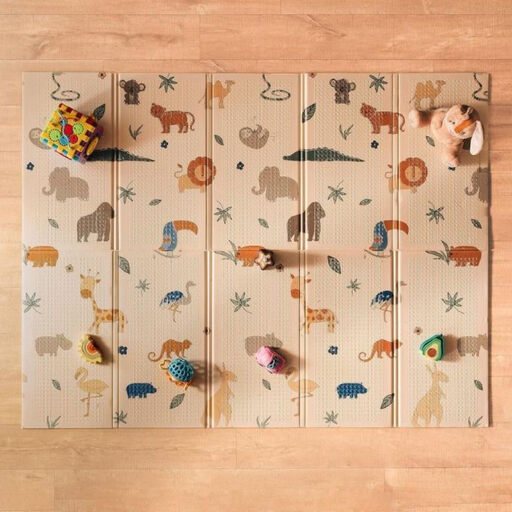
Why we chose it: Ideal for families in apartments, where the living room needs to transform back into an adult space after the kids are in bed. Its accordion fold and light weight also make it a perfect companion for weekends at the grandparents' or friends' houses.
It checks the practicality box with its accordion fold, which solves the storage problem. Its smooth surface can be cleaned with a single wipe, saying goodbye to the trap of dirt-collecting grooves.
Versatility: a large play surface (200 x 150 cm), a comfortable 1 cm thickness, a reversible design, and an ultra-compact fold. It's the Swiss Army knife of play mats.
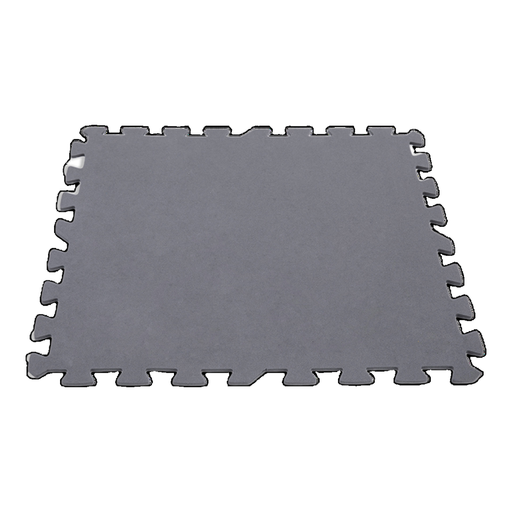
Why we chose it: The perfect solution for childminders, dedicated playrooms, or simply for creating a safe corner in a large living area. The tile system allows you to adjust the surface area precisely and expand it over time.
It offers a flexibility that a one-piece mat can't match. Is a tile damaged? Just replace it. The smooth surface guarantees easy maintenance, and the secure interlocking pieces ensure the entire setup is safe.
Total flexibility: the puzzle system allows you to create a custom-sized play area (each set of 8 tiles covers about 2 m?) and adapt it as your needs change.
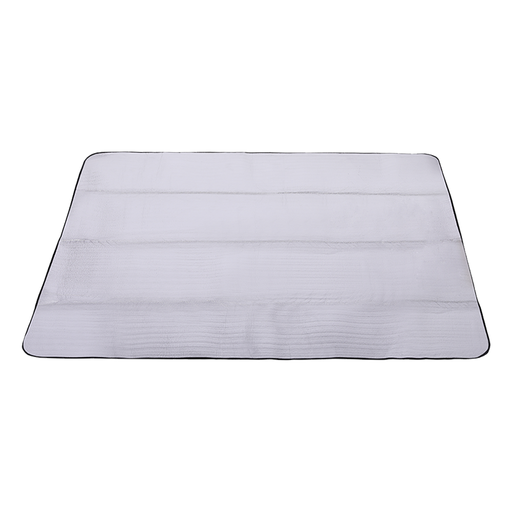
Why we chose it: Be aware, this isn't a play mat in the strictest sense, but a remarkably effective backup solution. Ideal for an impromptu picnic in the park or a day at the beach, it creates a clean, insulating barrier against damp and cold ground.
It's honest enough not to promise the cushioning of a true foam mat. Its mission is clear and focused: to serve as a lightweight, waterproof, and portable ground cover. It thus avoids the "jack-of-all-trades, master of none" syndrome.
Ultra-lightweight and compact: weighing in at just 300 grams and rolling up tightly, it slips into any backpack or stroller basket without a second thought.
We've curated a complete selection of products that meet our demanding selection criteria and current safety standards.
A thickness of 1?cm is the gold standard for use on hard floors (tile, wood). It's the perfect balance for cushioning the small falls and inevitable bumps that come with learning to crawl or taking first steps. If you plan to place it on a thick carpet, a slightly thinner mat may suffice.
The vast majority of quality XPE or EVA foam mats have a waterproof surface. A simple wipe with a sponge and soapy water is enough for daily maintenance. Above all, avoid harsh cleaning products or abrasive sponges that could damage the surface and patterns. One last tip: let it air dry completely before folding it up to prevent any mould growth.
Absolutely. Comfort doesn't depend on the storage system, but on the thickness and density of the foam. A foldable play mat that is 1?cm thick will be just as comfortable and cushioning as an equivalent roll-up model. The real advantage of a foldable model is its unbeatable daily convenience: it folds and unfolds in the blink of an eye, freeing up living space in seconds.