
Livraison le jour même ou le lendemain

Qualité garantie

Débloquez vos offres de bienvenue: Livraison GRATUITE | Jusqu'à -80 % | 30 jours d'essai gratuits à JoyPlus
Téléchargez l'application
Choosing a play mat for your baby? It seems like child's play. But this space is central to their development: it's where they will learn to roll over, crawl, and then sit up. Yet, many parents are disappointed by a purchase that doesn't live up to its promises. To avoid turning a good investment into a regret, let's review the most common pitfalls.
The first pitfall is the deceptively "easy to clean" mat. Some models, with their deep textures or porous materials, quickly become breeding grounds for germs, making daily cleaning a real nightmare. Another point to watch for is thickness. A shock-absorbent baby mat isn't just about its thickness in centimetres; low-density foam, even at 2 cm, will never provide the cushioning needed to protect against small tumbles. Finally, don't overestimate durability. A mat that peels, tears, or has patterns that fade after a few months is simply not a cost-effective purchase.
To create a baby play area that is both safe and practical, you need to focus on a few objective technical features. These criteria will help you make an informed choice, beyond the sometimes misleading marketing claims.
The material is the primary guarantee of safety and comfort. Foam mats, particularly those made of XPE (cross-linked polyethylene) foam, are often recommended for good reason. This type of foam baby mat is known for its closed-cell structure. The result? It's not only waterproof and easy to clean, but it also offers excellent shock absorption.
Rather than relying solely on the advertised thickness, look for information on foam density. Dense foam, even at a moderate thickness (1 to 1.5?cm, for example), will protect your child far more effectively during their first tumbles than a thicker but "squishy" mat. Also, verify that the product is certified free of controversial substances (phthalates, BPA, formamide, etc.).
Parenting is a marathon. The play mat should simplify your life, not complicate it. Here are three key points not to overlook:
Because every family is unique, here are a few models we've selected for their quality, keeping our criteria for safety and practicality in mind.
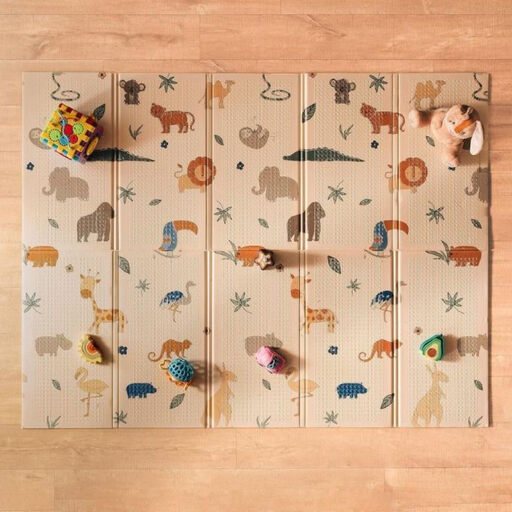
Why we chose it ? Perfect for families who are always on the move. Its foldable design makes it ultra-easy to transport for holidays or weekends, while ensuring a comfortable and safe play area on location.
Its foldable design ends the headache of bulky, hard-to-store mats. The smooth foam surface wipes clean with a simple sponge, avoiding the trap of textures that lock in dirt.
Lightweight and compact when folded, it fits anywhere. Its foam provides excellent cushioning for baby's first explorations.
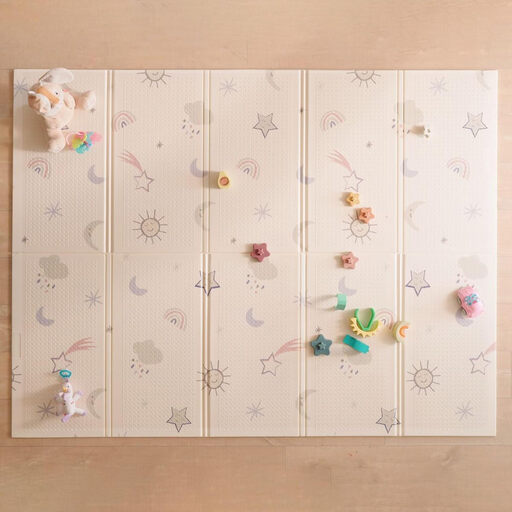
Why we chose it ? Ideal for creating a large play space that grows with the child. The colourful side stimulates little ones, while the more neutral reverse side blends discreetly into your living room decor.
Its dual-sided design prevents boredom and extends its relevance. Its generous dimensions (200 x 150 cm) make it a durable investment that will accompany your child from their first rolls to their first block towers.
Two designs in one for maximum versatility. Its XXL play surface offers complete freedom of movement for the child and their parents.

Why we chose it ? For older children (ages 3 and up), this decorative rug adds a touch of style and comfort to a bedroom or playroom. It's perfect for sitting and playing on, but note: it is not designed for the developmental needs and safety of infants.
By clearly positioning itself as a decorative rug for older kids, it avoids any confusion with a shock-absorbent developmental mat. Its mission: style and floor comfort, not cushioning falls.
Its bohemian design and woven texture make it a true decorative piece. Being machine washable is a significant plus for a child's room.
Explore our complete, updated selection of products that meet our strict selection criteria and current safety standards.
For daily maintenance, a damp cloth with a little soapy water (using a mild soap) is sufficient. Rinse with a clean, damp cloth, then let it air dry. Above all, avoid harsh chemicals, bleach, or abrasive sponges that could damage the surface and alter the patterns.
There is no universal ideal thickness, as foam density is an equally crucial factor. That said, a thickness between 1 and 1.5?cm for a high-density foam (like XPE) offers an excellent compromise between cushioning, stability for learning to walk, and ease of storage.
Yes, provided you choose a quality model. Modern foldable mats are designed with reinforced creases that can withstand thousands of folds. Their main advantage is that they don't curl at the edges and remain perfectly flat, which eliminates tripping hazards.