
Livraison le jour même ou le lendemain

Qualité garantie

Débloquez vos offres de bienvenue: Livraison GRATUITE | Jusqu'à -80 % | 30 jours d'essai gratuits à JoyPlus
Téléchargez l'application
Choosing nappies for your baby seems simple… until the first leaks, red marks around the thighs or packs that run out sooner than expected. Between disposable nappies, pull-up pants, so-called hypoallergenic models and maxi packs, marketing does not always make comparisons easy.
Here are the main pitfalls to avoid and the criteria that really matter when choosing nappies suited to your child, from birth through to potty training.
The age shown on packaging is only approximate. Two babies of the same age may perfectly well wear different sizes. The most reliable reference remains the weight range, generally expressed in kilograms.
A nappy that is too small can squeeze the tummy and thighs. If it is too large, it leaves more space around the back and legs, which may encourage leaks. Also look out for signs that it is time to move up a size: fastenings getting closer to the edge, persistent marks on the skin or repeated leaks despite regular changes.
A statement such as ‘up to 12 hours’ refers to the advertised capacity under certain conditions, not a recommended interval between changes. A nappy should be changed regularly as soon as it is wet or soiled, particularly to protect skin hygiene and comfort.
For overnight use, focus instead on practical features: an absorbent core, leak guards around the legs, a back pocket and a fit suited to your child’s shape.
A maxi pack of baby nappies is only worthwhile if the size still fits your child. Buying a large quantity in a size they are about to outgrow can quickly become wasteful. Compare the price per nappy or pair of pants, rather than looking only at the price displayed on the pack.
Sizes 1 to 7 do not all correspond to the same weight ranges across manufacturers. For a newborn, size 0 may suit babies weighing less than 3 kg, while size 1 newborn nappies often target weights between 2 and 5 kg.
In particular, check for the following:
Nappies may combine cellulose, superabsorbent polymers and several layers of non-woven materials. The exact composition is generally shown on the packaging or in the product information.
An effective leakproof nappy relies on more than just its absorbent core. The fit, how the nappy is positioned and how often it is changed also play a decisive role. For a child who sleeps for long periods or moves around a lot, side barriers and a back pocket can provide genuine everyday comfort.
If your child has sensitive skin, check whether the product contains fragrance, lotions, colourants or natural latex. Claims such as ‘hypoallergenic’ and ‘dermatologically tested’ provide information about the product’s design and the tests announced by the manufacturer; they do not guarantee that every child will be free from a reaction.
Certifications such as FSC, OEKO-TEX Standard 100 or the EU Ecolabel, where displayed, cover specific criteria. Check the product details and composition before making your choice. If irritation occurs, stop using the product and seek advice from a healthcare professional.
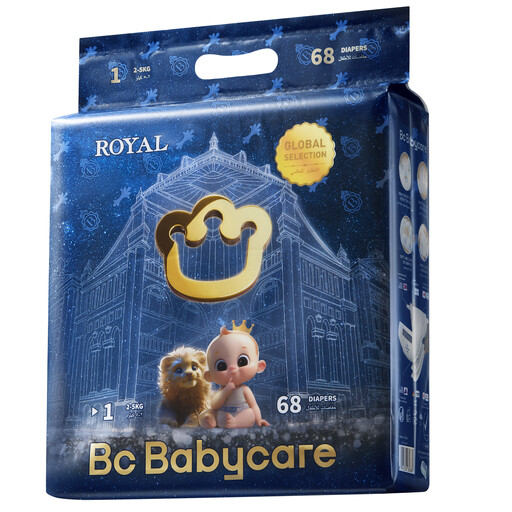
Why this choice suits this profile : This pack of 68 size 1 nappies is a sensible quantity to start with for a baby weighing 2 to 5 kg, without building up excessive stock before you know which fit suits them.
The size is clearly linked to a weight range of 2 to 5 kg. The three advertised wetness indicators make checking easier at change time.
Advertised soft surface, adjustable elastic waistband and 360-degree leak protection, according to the product information.
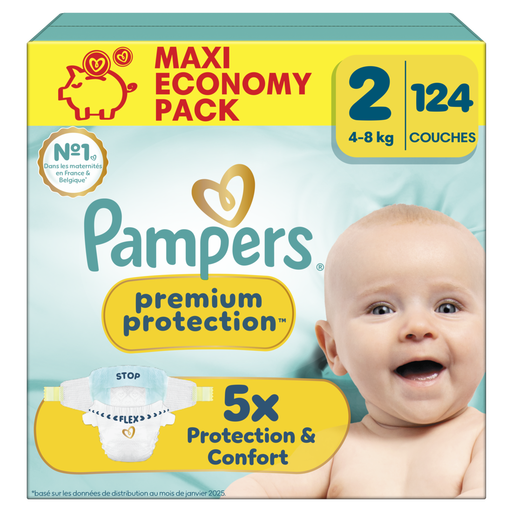
Why this choice suits this profile : The 124-nappy format is ideal for families who want a complete range for babies weighing 4 to 8 kg and wish to reduce the need for frequent top-ups.
The product information specifies the size, weight, number of units and materials. However, with a large format, it is worth calculating and comparing the price per nappy.
Advertised quick-absorption core, Stop & Protect back pocket and Flex & Protect waistband.
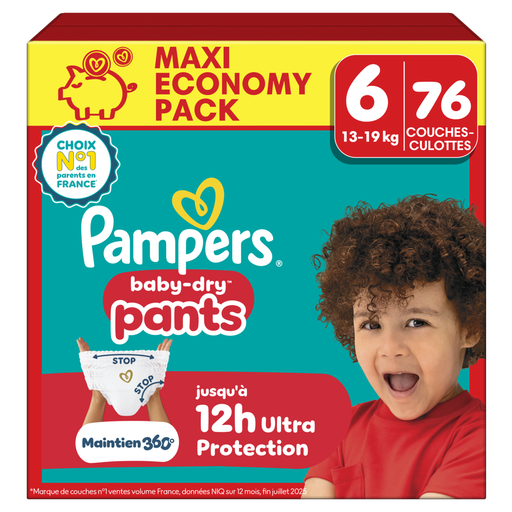
Why this choice suits this profile : Pull-up pants are particularly practical for an active child, when out and about, at nursery or during the early stages of potty training.
The 360-degree stretchy waistband and tear-away sides make dressing and removal easier, without overlooking the importance of choosing the right size.
Pack of 76 pants, leg barriers, back pocket and adhesive strip for rolling up the pants before disposal.
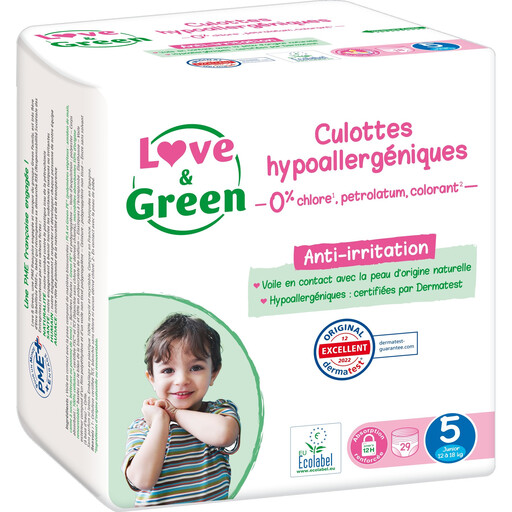
Why this choice suits this profile : This option is aimed at parents looking for hypoallergenic nappies and detailed information about the origin of certain materials, for a child weighing 12 to 18 kg.
The product information states that it contains no lotions, colourants or chlorine, and uses water-based inks. Nevertheless, check how well your child tolerates the product.
Anti-compression waistband, advertised natural-origin materials and protection for up to 12 hours, according to the manufacturer’s product information.
We have put together a complete, real-time updated list of products that meet these demanding selection criteria and European safety standards.
A newborn may need several changes a day, sometimes more than an older child. The amount varies depending on age, feeding, bowel movements and sleep patterns. To estimate your budget, multiply the number of nappies used each day by their unit price, then compare the different pack sizes.
You can switch to pull-up pants when your child becomes more mobile or starts to take part in getting dressed. They pull on like underwear, and the tear-away sides make removal easier. They do not necessarily replace taped nappies at every point during the day: some parents prefer to keep using the latter for changes while their child is lying down.
No. A wetness indicator makes visual checking easier, especially during the first few weeks, but it does not replace regular checks. The weight of the nappy, its condition and your baby’s comfort are also useful indicators.