
Livraison le jour même ou le lendemain

Qualité garantie

Débloquez vos offres de bienvenue: Livraison GRATUITE | Jusqu'à -80 % | 30 jours d'essai gratuits à JoyPlus
Téléchargez l'application
Choosing baby nappies and pull-up pants isn’t just about comparing the number of nappies in a pack. A deal might look tempting, but it can end up costing you more if the size isn’t right, if leaks mean you have to change your baby several times during the night, or if the material irritates sensitive skin.
The same precautions apply to incontinence products and night-time pull-ups for children. Here are the key factors to consider before you buy, along with a selection tailored to different needs.
Age is just a general guide: weight is the best indicator. A 7 kg baby might be perfectly comfortable in a size 3 nappy, while another baby with a different build might prefer the size above or below. If a nappy is too big, it leaves gaps around the thighs and back. If it’s too small, it compresses the tummy and reaches its absorbency limit more quickly.
Before ordering baby nappies in all sizes, always check the weight range stated on the packaging: newborn nappies, size 2, size 3, size 4, size 5 or size 6.
Claims like “up to 12 hours” or “100% protection” are part of the manufacturer’s marketing. The actual result depends on many factors: your child’s build, the amount of liquid, how often you change them, and their sleeping position.
A leak-proof baby nappy must fit the body well, have properly deployed leg cuffs, and offer a wide enough absorbent core. For night-time, children’s night-time pull-ups are designed for this specific use, but they don’t mean you can skip changing your child when the protection is saturated.
The softness of a material isn’t enough to judge a nappy’s quality. You should also look at its composition, whether it’s fragrance-free or lotion-free, whether it has a wetness indicator, and how flexible the fastenings are. Products described as hypoallergenic or designed for sensitive skin should be compared based on detailed information, not just a marketing claim.
The size must match the weight range on the pack. Once fitted, the nappy should sit close to the body without leaving lasting marks. Slide a finger between the elastic and the skin, then check that the leg cuffs are properly turned outwards.
For active children, nappy pants for babies make dressing easier. Their stretchy waistband moves with them, while the tear-away sides make changing simpler.
An absorbent core made from cellulose and a superabsorbent material helps lock moisture away. Some models add a back pocket, reinforced leg barriers, or a wetness indicator. These features are especially useful at night, but they don’t replace a check when your child wakes up.
For adult use, also check the stated leak protection level. The TENA Pants pull-ups shown below are designed for moderate to heavy urine leaks and have a unisex fit.
If skin is reactive, look for mentions of fragrance-free and natural latex-free, no lotion, and any dermatological tests listed on the product page. A certification like OEKO-TEX Standard 100 confirms that certain unwanted substances have been tested, within the scope of the certification. It is not a medical guarantee.
Eco-friendly nappies may contain FSC-certified cellulose, components from renewable resources, or be sold in recycled packaging. However, check the actual proportion: the term “eco-friendly” doesn’t necessarily describe the entire product.
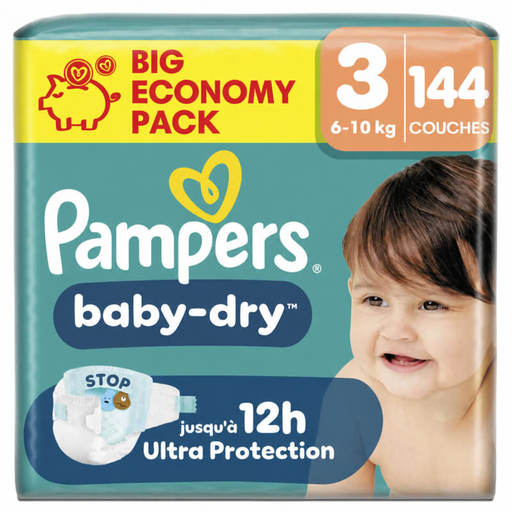
Why this choice suits this profile: This large pack is ideal for daily changes for a baby weighing 6 to 10 kg, provided the size is already well established.
The Stop & Protect back pocket and wetness indicator target two common problems: back leaks and late changes.
A pack of 144 nappies, a wetness indicator, and a fast-absorbing core for babies weighing 6 to 10 kg.
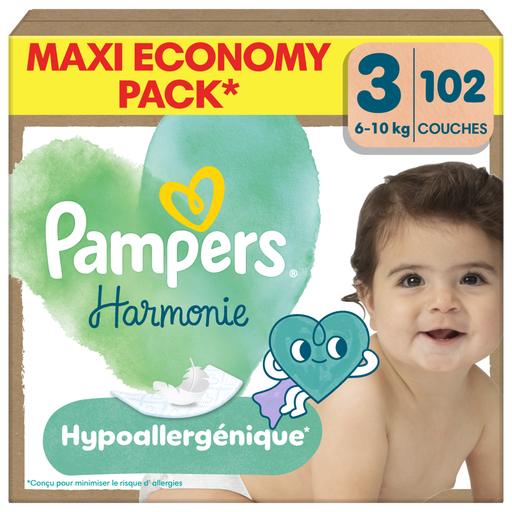
Why this choice suits this profile: This product is aimed at parents who care about the materials that touch their baby’s skin and the traceability of ingredients.
The product page states it is fragrance-free, dermatologically tested, OEKO-TEX Standard 100 certified, and uses cellulose from FSC-certified sources.
A top sheet claimed to contain 50% plant-based ingredients, a wetness indicator, and a Stop & Protect back pocket.
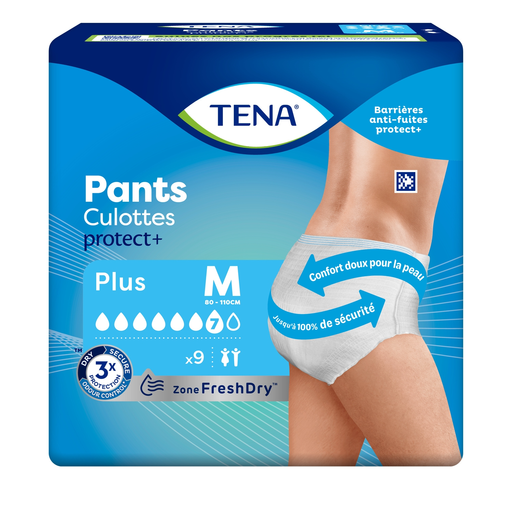
Why this choice suits this profile: This disposable protection is designed for adults and carers dealing with moderate to heavy urine leaks.
The close-to-body fit, leak barriers, and underwear-style design avoid the bulky feel of some other products.
A unisex model in size M, claimed FreshDry technology, and odour control according to the manufacturer’s product page.
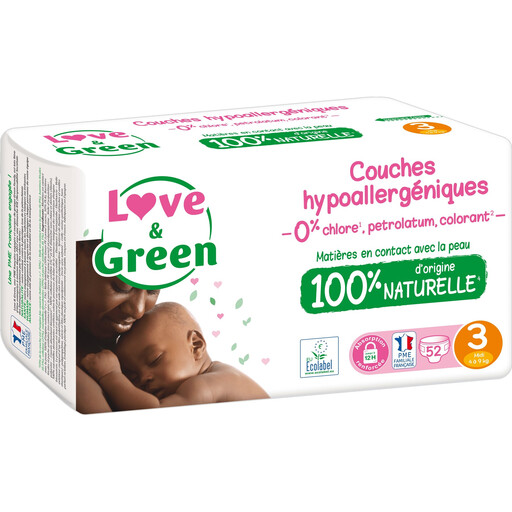
Why this choice suits this profile: This product lets parents examine the proportion of renewable materials and the certifications that are actually listed.
The product page specifies the use of FSC and TCF cellulose, a fragrance-free and lotion-free design, and packaging made from recycled and recyclable plastic.
Size 3 fits babies weighing 4 to 9 kg. The pack contains 52 nappies, with a composition claimed to be 68% bio-based and dermatologically tested.
We’ve put together a complete, real-time updated selection of products that meet these demanding criteria, as well as European safety regulations.
Go by weight rather than age. Size 0 may suit a baby under 3 kg, while some newborn nappies in size 1 cover a range of around 2 to 5 kg. A cut-out for the belly button can be handy during the first few days.
It all depends on the absorbency of the model and the amount of liquid. Check the nappy when your child wakes up and change it as soon as it’s soiled or saturated. The “up to 12 hours” claim is a manufacturer’s figure, not a time you should stick to without checking.
They can be a good option when the product page mentions a fragrance-free, lotion-free design or dermatological tests. However, every skin reacts differently. If you notice persistent redness or irritation, stop using the product and seek advice from a healthcare professional.