
Livraison le jour même ou le lendemain

Qualité garantie

Débloquez vos offres de bienvenue: Livraison GRATUITE | Jusqu'à -80 % | 30 jours d'essai gratuits à JoyPlus
Téléchargez l'application
Choosing baby nappies isn't simply about comparing the price of packs. A poorly fitted nappy can cause leaks, while a large stock bought too early may no longer suit your child's shape. And claims like "ultra-absorbent", "hypoallergenic" or "eco-friendly" deserve a closer look.
Here are the criteria to check before you order, along with a selection suited to different needs and budgets.
The age sometimes shown on packs is only a guide. To choose the right size, go by your child's weight first, then their shape and how the nappy sits.
In this selection, the typical weight ranges are as follows:
A nappy that is too large will gape at the legs or back. One that is too small will press into the skin, restrict movement and reach its absorbency limit more quickly.
"All-night protection" does not mean no leaks will occur, whatever the circumstances. The result depends on the size chosen, the volume of liquid, your child's position and how often you change them.
It is better to look at the product's concrete features:
Anti-leak nappies give the best results when the barriers are properly unfolded and the nappy fits snugly around the hips.
A pack of 168 nappies may look like a bargain, but the real measure is the price per nappy, not the total amount shown. With a newborn, their shape changes quickly: a large stock of baby nappies size 1 can become unusable before you have even finished it.
For more long-lasting sizes, such as sizes 4 and 5, family packs and monthly formats can offer better value. Store them in a dry place, away from heat and moisture.
A good nappy should stay in place without being tight. After putting it on, check:
Repeated leaks at the back may mean the size is too small or the nappy is poorly positioned. If red marks persist, the fit may be too tight or your child's skin may be particularly sensitive.
The absorbent core usually combines cellulose with SAP, a superabsorbent polymer. This combination holds liquids effectively, but it does not mean you can skip regular changes.
Baby nappies with a wetness indicator are especially handy for newborns and when you are out and about. Depending on the model, one or more lines become more visible when wet. This signal tells you it is probably time to check the nappy; it does not replace a direct check.
For nappies for sensitive skin, check whether they contain any perfume, lotion or natural latex. Also look at the information about dermatological testing if the manufacturer provides it.
Hypoallergenic nappies aim to limit certain irritants, but no formula suits every child. If redness persists, stop using the product and ask a healthcare professional for advice.
Eco-friendly nappies may contain FSC-certified cellulose, renewable raw materials or be sold in recycled packaging. However, these features should not be confused with a general guarantee of lower environmental impact: a nappy is still a disposable product.
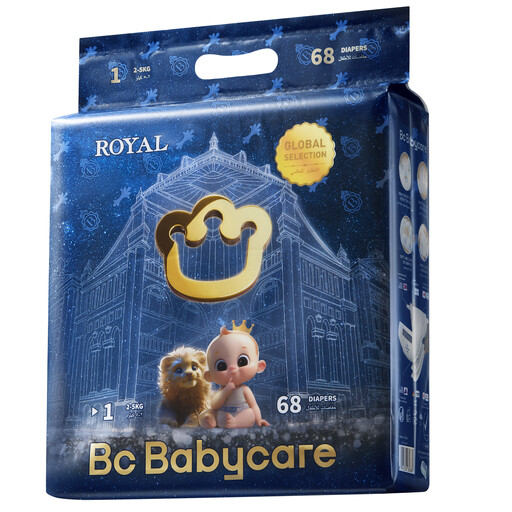
Why this choice fits this profile: With 68 baby nappies size 1, this pack lets you try them out with a newborn weighing 2 to 5 kg without ending up with a huge stock.
The weight range is clearly stated and the three indicator lines make it easier to track changes, without relying solely on how many nappies are left in the pack.
Stated pH of 5.5 on the surface, thin absorbent core, elastic waistband and claimed 360-degree protection.
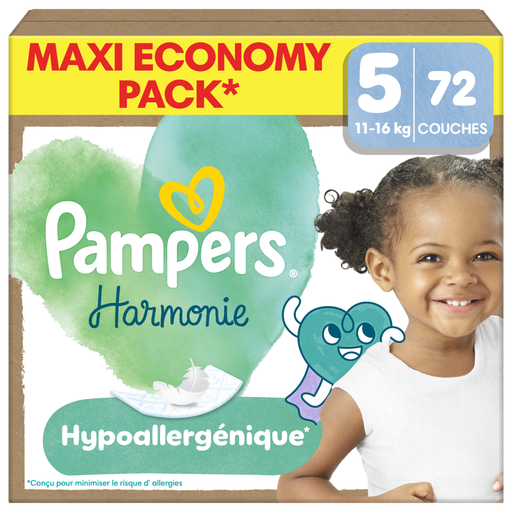
Why this choice fits this profile: This product is for parents who want a Pampers size 5 nappy, with a detailed composition and a pack of 72 units.
The product page states it is free from lotions and colourants, and that the top sheet is made from 50% plant-based ingredients.
Wetness indicator, rear Stop & Protect pocket as per the manufacturer, cellulose from FSC-certified forests and claimed OEKO-TEX Standard 100 certification.
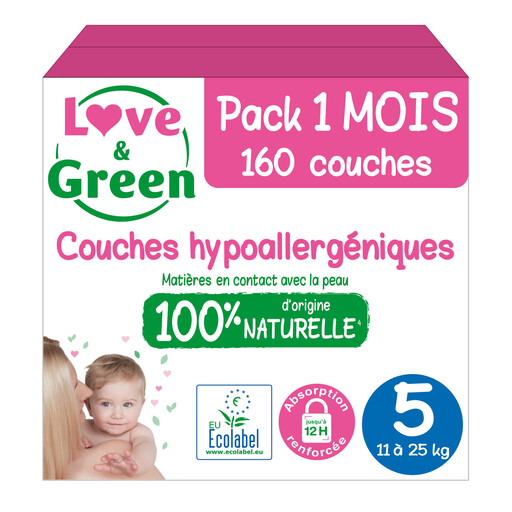
Why this choice fits this profile: Its four packs of 40 nappies suit families who regularly use size 5 for a child weighing 11 to 25 kg.
The total number of nappies and the weight range are shown separately, which helps you calculate the unit price and avoid poorly suited formats.
71% organic ingredients claimed, absorbent pad made from FSC and TCF cellulose, free from lotion and perfume according to the product page.
We have put together a comprehensive, real-time selection of products that meet these demanding criteria, while also taking European safety regulations into account.
For the first few days, compare baby nappies size 1 that feature a umbilical cut-out and a wetness indicator. As your child grows, baby nappies size 3, then size 4, become the most common. Size 5 is often the go-to for buying in bulk.
Children who are starting to move around may be more comfortable with baby nappy pants, especially during potty training or for standing changes. The Pampers Baby-Dry Pants and Love & Green models in size 5 have a stretchy waistband and are easier to pull on and off than a traditional taped nappy.
For sizes 6 and 7, pay particular attention to the width of the waistband, the roominess around the legs and whether the pack size covers your child's actual needs. A larger size is not necessarily more absorbent if it is not fitted properly.
Keep nappies in their packaging, in a clean, dry place away from heat sources. Check any batch or storage information on the pack. A nappy that is misshapen, torn or has visible absorbent material should not be used.
Move up to the next size when the fasteners are at their limit, the elastics leave marks on the skin, or leaks become frequent despite correct positioning. Start by going by weight, then check how the nappy sits on your child.
They can reduce the presence of certain ingredients that may irritate the skin, but they are not a universal guarantee. Check the composition, change your child regularly and stop using the product if irritation appears or persists.