
Livraison le jour même ou le lendemain

Qualité garantie

Débloquez vos offres de bienvenue: Livraison GRATUITE | Jusqu'à -80 % | 30 jours d'essai gratuits à JoyPlus
Téléchargez l'application
Choosing baby nappies isn’t simply a matter of counting how many are in the pack. Your child’s weight, their build, how often you change them and the sensitivity of their skin all play a part in their day-to-day comfort. A poorly fitted nappy can cause leaks, leave red marks or lead to waste from changing too frequently.
Marketing claims also deserve a closer look. The phrase “all-night protection” is a brand promise, but it doesn’t guarantee the same result for every baby. Likewise, “hypoallergenic” doesn’t mean a skin reaction is impossible. And a large pack is only truly economical if the size and fit are right for your child.
Manufacturers usually give a weight guide, which is far more useful than age. Two babies of the same age can have very different builds. A size 3 nappy often suits children weighing 6 to 10 kg, but some ranges cover 4 to 9 kg or 6 to 11 kg instead.
If the fastenings sit too close to the centre, if the elastic leaves deep marks or if the nappy presses on the tummy, it’s probably time to move up a size. On the other hand, a nappy that’s too big can leave gaps around the thighs and encourage leaks.
A highly absorbent baby nappy holds liquid effectively, but it still needs to be changed regularly. The maximum wear times claimed by some brands don’t replace checking the nappy or your child’s skin. After a bowel movement, you should change the nappy promptly. The same goes when the nappy feels damp.
Large packs of baby nappies can sometimes lower the cost per nappy. But buying several hundred before you’ve tried a brand can prove impractical. For a first order, a pack of 30 to 50 nappies lets you check the fit, flexibility and skin tolerance before moving to a more economical size.
Start by checking your baby’s current weight, then look at the nappy’s shape. A good fit should stay snug without being tight. After each change, make sure the leg barriers are flipped outwards. They play a key role in leak-proof nappies, especially when your baby is moving around a lot.
For size 3 baby nappies, compare the stated weight ranges carefully:
The size shown on the pack isn’t enough to compare two products.
The absorbent core usually contains cellulose and a superabsorbent polymer, often called SAP. This material captures liquid and holds it within the nappy’s structure. A thin nappy can be comfortable to wear, but its performance depends on how the absorbent material is distributed, the capture zone and the quality of the barriers.
A back pocket, a double barrier or an elastic waistband can help prevent leaks up the back. However, these are design choices, not a universal guarantee against leaks.
For nappies for sensitive skin, check the ingredients and any verifiable claims: no perfume, lotion or natural latex, dermatologically tested, textile certification or an environmental label. A nappy described as hypoallergenic is designed to reduce the risk of a reaction, but tolerance is still individual to each child.
If you see persistent redness, itching or irritation, stop using the product and ask a healthcare professional for advice. Used nappies should be disposed of with household waste, never down the toilet.
The options below are based on the products’ stated features, their weight range and their pack size. They are not a medical guarantee or an absolute comparison between brands.
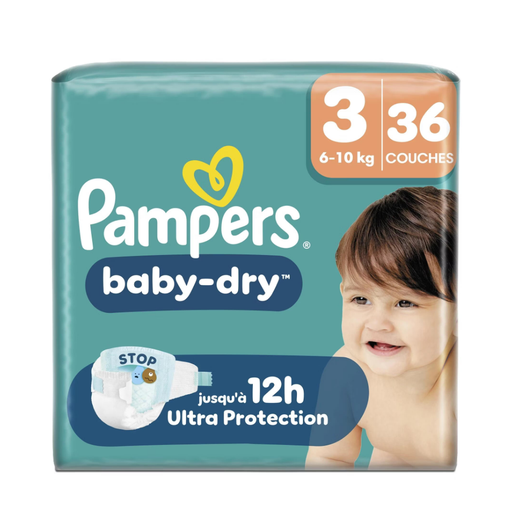
Why this choice suits this profile: This pack lets you try a popular size 3 option before moving to a larger pack. It’s suitable for babies weighing 6 to 10 kg.
The stated weight and 36-nappy pack size reduce the risk of building up a stock that doesn’t fit. The wetness indicator helps you know when to change.
Fast-absorbing core, Stop & Protect pocket at the back, ComfortTouch outer surface and wetness indicator.
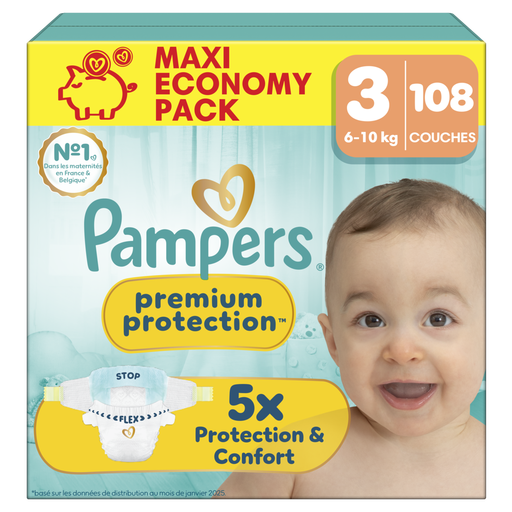
Why this choice suits this profile: This option is for parents who want a soft surface, fast absorption and a large pack for everyday changes.
The product page mentions dermatological testing and 0% of perfume allergens listed by the European Union. This doesn’t mean all skin risk is eliminated, however.
Over 1,000 absorbent micro-cells are claimed, with a Stop & Protect pocket and a Flex & Protect waistband.
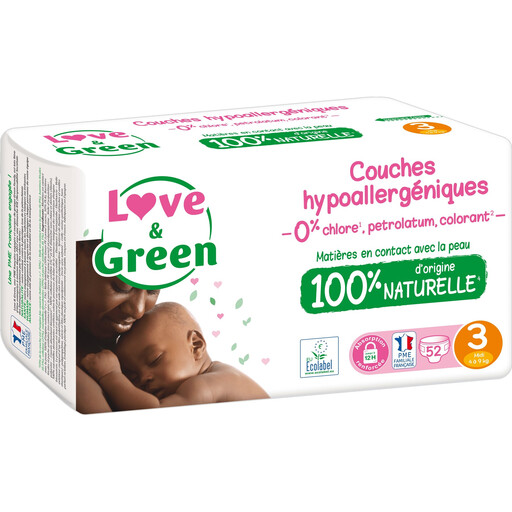
Why this choice suits this profile: This option is for families who want to know where the materials come from and prefer a product with environmental certifications.
The stated composition mentions 68% bio-based ingredients, no perfume or lotion, and recycled and recyclable packaging.
Weight range of 4 to 9 kg, FSC-certified cellulose and a European label stated on the product page.
We’ve put together a full selection, updated in real time, of products that meet these strict selection criteria and European safety requirements.
Size 3 is often designed for this weight range. However, do check the fit, the brand’s own recommendations and any signs of a poor fit: repeated leaks, gaps around the thighs or fastenings that are too tight.
How often depends on your child’s age, their diet and how much they drink. Check the nappy regularly and change it as soon as it’s damp or soiled. Bowel movements should be removed promptly to limit contact with the skin.
The price varies depending on the materials, certifications, pack size and number of nappies per pack. To compare properly, work out the cost per nappy and make sure the size matches your child’s weight. A large pack is only good value if the fit works and you’ll use them all before moving up a size.