A dedicated baby food maker may be a good fit if you often prepare purées and want to combine cooking and blending, particularly when making several portions. If your existing appliances already handle the cooking and can blend small quantities to the texture you want, first consider whether the extra handling and cleaning are really a problem for you. Either way, you’ll need to give the same care to cleaning utensils and storing prepared food.
Who are these options for?
Parents who often make homemade purées
If you cook several times a week, an appliance that handles both cooking and blending, or lets you prepare several portions, may appeal to you. However, compare its capacity with how you actually use it, rather than relying on the stated maximum volume alone.
Households already equipped with kitchen appliances
A cooking appliance and a blender can take care of both steps without the need for another dedicated appliance. What matters most is the result when blending a small quantity, along with how many transfers and parts you’re happy to wash.
Parents who cook in small batches
If you make one or a few portions at a time, check the smallest quantity the appliance can blend, how many parts need cleaning and how much space it takes to store. A large capacity won’t necessarily be an advantage for this kind of use.
Which criteria matter when choosing?
When making homemade purées, start by checking what your existing appliances can already do with small portions. A dedicated baby food maker is more worthwhile if the way it handles cooking, blending and cleaning better suits your routine.
Dedicated baby food maker
Worth considering if: you regularly make purées and want to move from steaming to blending in an appliance designed for the job.
Bear in mind: it’s another appliance to store and clean, and the sequence of steps varies by model.
Separate cooking and blending
Worth considering if: you already have a way to cook food and a blender that gives you the texture you want with small quantities.
Bear in mind: you’ll need to transfer food between appliances and clean the parts you use.
| Criterion |
What to check |
Consumers concerned |
| Avoiding a duplicate appliance |
Check your cooking appliance and see how your existing blender handles a small portion. |
If my appliances already give me the texture I want, I’d rather not add another food maker to store. Avoiding a duplicate appliance would be the priority for around 31 % of consumers concerned. |
| Preparing several portions |
Compare the usable capacity, bowls or baskets, and the space available to keep the food chilled. |
To cook several portions at once, I need a capacity that suits the way I organise things. Around 31 % of consumers would make preparing food in advance their priority. |
| Reducing handling |
Look at the steps between cooking and blending, the parts that need removing, and the model’s care instructions. |
When I make purée regularly, the time spent transferring food and then washing utensils matters. Around 23 % of consumers would put everyday convenience first. |
| Serving prepared portions |
Consider how useful defrosting and reheating settings would be with your existing appliances and containers. |
If my portions are already prepared, I’m mainly looking for a convenient way to defrost or reheat them. This would be the top priority for around 15 % of consumers. |
What not to overlook
-
Choosing the biggest bowl without considering small portions
A large capacity can be useful for preparing several meals, but it doesn’t tell you on its own how well the appliance blends a small quantity.
Work out how many portions you usually make, then check the instructions for the minimum blending quantity and the appliance’s dimensions.
-
Buying a food maker without trying your existing appliances
You can cook and blend separately. The main benefits of a dedicated appliance then come down to how it organises the steps and which of its features you’ll actually use.
Try your current set-up with a small portion and assess the texture, the transfers involved and the parts that need cleaning.
-
Relying on a defrost setting to manage food storage
The setting you choose doesn’t replace the need to maintain the cold chain. Anses recommends keeping the temperature at 4 °C in the coldest part of the fridge and not refreezing food once it has thawed.
Follow Anses recommendations when storing and defrosting portions, whatever appliance you use.
-
Taking claims about easy cleaning at face value
Manufacturers’ descriptions don’t always tell you how many parts you’ll need to take apart, wash and dry after each use.
Check the instructions for the version you’re considering to find out which parts are removable and how to care for them.
Brands to compare
Béaba
The Babycook range includes dedicated baby food makers. Béaba presents the Babycook Duo as a way to prepare two recipes or several portions.
- According to Béaba, the Babycook Duo has two 1 100 ml bowls and offers steaming, blending, defrosting and reheating.
- Before choosing this capacity, check that it suits your usual portion sizes and the space you have for storage.
Babymoov
According to Babymoov, the Nutribaby (+) is particularly suited to households that want to cook ingredients in two separate baskets.
- Babymoov states that it has a 1 900 ml cooking capacity, two baskets, three blending speeds, and defrosting and reheating settings.
- The number of portions you can make depends on their size, so compare the stated capacity with the way you cook.
Philips Avent
Philips Avent offers 2-in-1 and 4-in-1 baby food makers, with features that vary by model.
- Philips says the SCF883/01 steams, blends, defrosts and reheats; its bowl can be turned over to blend the food after cooking.
- For this specific model, check the instructions for its capacity and how to care for the parts before buying.
An option for blending with a separate appliance
This hand blender can be paired with a cooking appliance you already own to make purées. It isn’t a dedicated baby food maker, so be sure to check how it handles the small portions you plan to prepare.
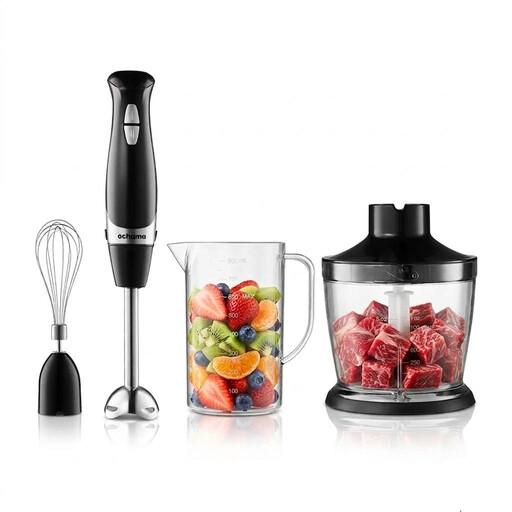 Image unavailable
ochama 600 W 4-in-1 hand blender
Worth considering for blending cooked ingredients if you have a suitable cooking appliance.
Two speeds, a 500 ml chopper bowl and an 800 ml beaker. Before using it for small portions, check the instructions for the minimum quantity it can blend and the texture it produces.
View on Joybuy
Frequently asked questions
Do you need a baby food maker to start making homemade purées?
No. You can cook the ingredients and then blend them using separate appliances, as long as they produce the texture you want with small quantities. A dedicated baby food maker is more suited to you if you want to combine steps or certain functions in one appliance.
What capacity should you choose for one or several portions?
Choose a capacity based on how much you actually prepare, and check the smallest quantity the model can blend too. If you want to cook several portions in advance, consider the number of bowls or baskets and whether you have space to keep the food chilled.
How should you store homemade food?
Anses recommends keeping the temperature at 4 °C in the coldest part of the fridge and limiting how long perishable dishes are left at room temperature. For home freezing, it advises a temperature of −18 °C. It recommends defrosting food in the fridge, in the microwave using the defrost setting, or quickly by cooking or reheating. Do not refreeze food once it has thawed.
What should you check when it comes to cleaning a baby food maker?
Check the instructions for the exact model to find out which food-contact parts can be removed and how to wash or descale them. Anses notes that cleaning equipment and utensils helps limit the spread of micro-organisms in the kitchen.


