
Livraison le jour même ou le lendemain

Qualité garantie

Débloquez vos offres de bienvenue: Livraison GRATUITE | Jusqu'à -80 % | 30 jours d'essai gratuits à JoyPlus
Téléchargez l'application
The arrival of a baby turns the whole house upside down, right down to the kitchen sink. The mountain of bottles, nipples, and teething rings that piles up seems endless, and with it comes a simple but stressful question: what product can I use to clean everything without any risk?
As parents, we are a constant target for marketing. But behind the reassuring labels and pastel packaging, the reality is often much less rosy. Before making your choice, it's essential to know the common pitfalls that can compromise your child's safety or simply cause you to waste money.
eco-friendly dish soap is designed to minimise its environmental impact, which is an excellent thing. However, this in no way guarantees that it is formulated to minimise allergy risks. These are two essential concepts, but they should not be confused.Choosing the right baby dish soap isn't a matter of price, but of knowing how to decipher labels.
To make an informed choice, you just need to focus on a few simple checkpoints. These factual benchmarks will allow you to outsmart the marketing and select a genuinely suitable product.
The ingredients list (INCI) is your best ally. A hypoallergenic dish soap worthy of the name must tick several non-negotiable boxes.
fragrance-free dish soap eliminates this unnecessary risk.Labels and certifications are reliable benchmarks that validate a brand's claims.
eco-friendly dish soap that is also safer for your health.A good bottle cleaner must be tough on milk residue, which is greasy and promotes bacterial growth, but it must also rinse off very easily. A formula that doesn't produce excessive foam is often simpler to remove completely, ensuring no substances remain in contact with the baby's milk.
Rather than drowning you in an endless list, our editorial team has selected products that excel on these criteria, each meeting a specific need.
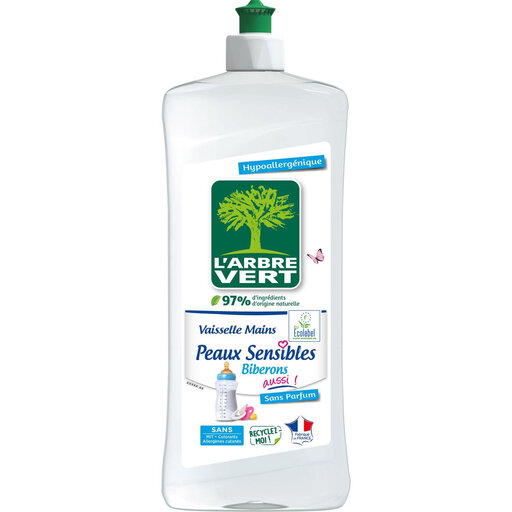
Why we recommend it: This product is explicitly designed for baby's dishes. It meets all the safety criteria for parents who want to clean bottles, nipples, and other accessories with complete peace of mind.
Its formula is fragrance-free, dye-free, and free of listed skin allergens. It goes beyond simple "gentle" marketing by offering a transparent and streamlined formula.
Certified with the European Ecolabel, it combines safety for your baby with respect for the environment. Its formula is made of 97% ingredients of natural origin.
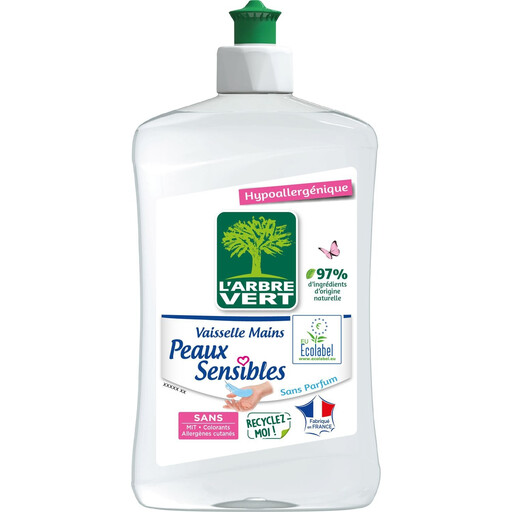
Why we recommend it: Perfect for households where multiple people, adults and children alike, have sensitive skin. It's a versatile product that is gentle on the whole family's hands while being perfectly safe for baby bottles.
This product is an excellent example of a dish soap for sensitive skin. Its hypoallergenic and fragrance-free formula is designed for daily use without irritating the skin, and it rinses off very easily.
Also certified with the European Ecolabel, it offers an excellent balance between effectiveness, skin-friendliness, and ecological commitment. One product for the whole family.
For a healthier home all around, discover our selection of cleaning products, approved by our experts for their effectiveness and impeccable formulas.
It's primarily a precautionary measure. A product specifically formulated for baby's dishes offers peace of mind: it guarantees a fragrance-free, dye-free, and hypoallergenic formula, designed to minimise any risk to infants, whose immune systems and skin are still developing.
It's possible in a pinch, but it should be avoided for daily use. Standard dish soaps often contain powerful fragrances and dyes that can leave residue, even after a thorough rinse. These substances are undesirable on an object your baby puts in their mouth several times a day.
For effective and safe cleaning, follow these simple steps:
baby dish soap. Use a bottle brush for the inside of the bottle and a small brush for the nipple.