
Livraison le jour même ou le lendemain

Qualité garantie

Débloquez vos offres de bienvenue: Livraison GRATUITE | Jusqu'à -80 % | 30 jours d'essai gratuits à JoyPlus
Téléchargez l'application
Choosing the ideal baby diaper? It's a real headache for new parents. Between the constantly changing sizes, promises of XXL absorption, and vague ingredient lists, it's hard to know where to start. Your mission: to find the perfect match that will keep your baby's bottom dry, prevent leaks, and protect their delicate skin—all without sacrificing your eco-friendly values or your budget.
To help you make sense of it all, our editorial team has scrutinized the market. This guide provides practical advice and a selection of reliable, tested, and approved diapers to help you make the right choice with complete peace of mind. We've analyzed everything: ingredients, effectiveness, comfort, and environmental impact.
Before diving into our selection, let's review the essential points for making an informed choice that's perfectly suited to your child's needs.
An ill-fitting diaper is a guaranteed leak. Manufacturers provide weight ranges on the packages, which serve as a good starting point. A diaper is the right size if:
If leaks become frequent or the diaper seems too snug, don't hesitate: it's time to move up to the next size. The most common sizes, like size 3 diapers, size 4, or size 5, correspond to key stages in your baby's growth.
A baby's skin is extremely thin and sensitive. To minimize the risk of irritation, allergies, or the dreaded diaper rash, taking a look at the ingredients is a must. Hypoallergenic diapers are specifically formulated for this purpose.
More and more brands are focusing on diapers for sensitive skin with plant-based top sheets, guaranteed to be free of fragrances, lotions, and chlorine bleaching. These plant-based diapers use materials like sugarcane or wood cellulose from sustainably managed forests (FSC), a much gentler alternative for the skin.
For parents concerned about their carbon footprint, eco-friendly diapers are an increasingly popular option. They stand out for:
After comparing dozens of products, our editorial team has selected three models that excel in their category. Each meets specific needs, but all share a high standard of quality and safety.
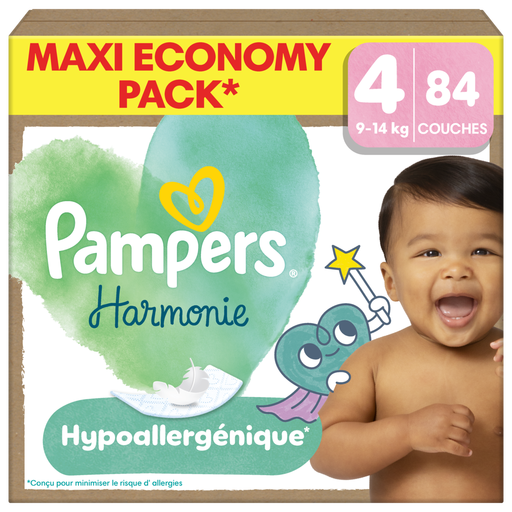
The Choice for Peace of Mind
Pampers Harmonie diapers successfully combine the brand's renowned performance with a gentler formula for delicate skin. They feature a Stop & Protect pocket at the back, a real game-changer for preventing leaks, especially at night. Their soft top sheet contains 50% plant-based ingredients, and the absorbent core is made of cellulose from responsible sources (FSC certified).
What We Love
Who is it for? For parents who trust a major brand but demand a formula suitable for sensitive skin, without compromising on leak-proof effectiveness.
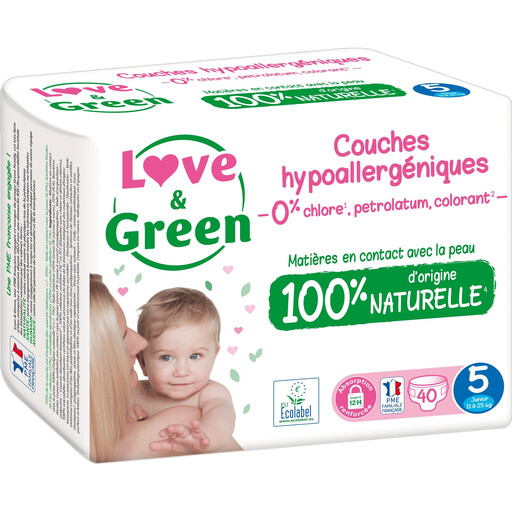
The Transparent, Eco-Friendly Alternative
Love & Green is the go-to brand for eco-friendly diapers. This model stands out with 71% natural ingredients, a figure well above the market average. The absorbent core is 100% plant-based, and the top sheet in contact with the skin is guaranteed free of lotions and fragrances. The brand highlights a 36% reduction in carbon emissions for its absorbent core (compared to 2018), a figure validated by a 2024 life cycle analysis.
What We Love
Who is it for? For parents who place ecology and naturalness at the heart of their concerns. An ideal choice for those seeking eco-friendly and hypoallergenic diapers with solid guarantees.
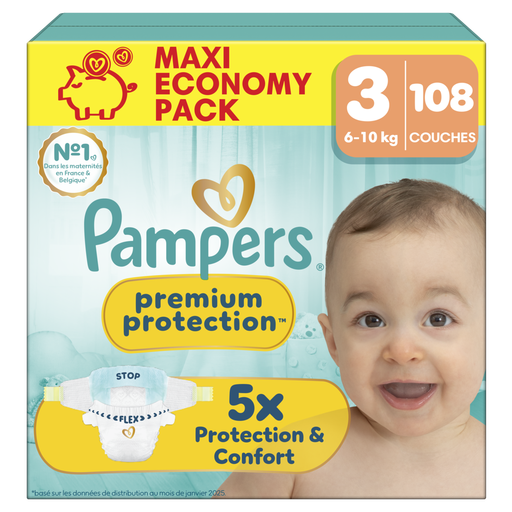
The Ultimate in Comfort and Absorption
The Premium Protection line from Pampers is all about comfort and lightning-fast absorption. It features over 1,000 micro-sensors that instantly absorb moisture and runny stools, drawing them away from the baby's skin. Its Flex & Protect waistband gently adjusts to the baby's tummy, while its ultra-soft materials provide a cocoon-like feel.
What We Love
Who is it for? For parents, especially new ones, who are looking for maximum absorption and absolute softness for their newborn's skin. Size 3 is perfect for babies from 6 to 10 kg.
Our selection highlights three excellent choices, but every baby is different. Didn't find what you were looking for? Want to compare other models? Feel free to explore our complete catalog.
Explore our full range of baby diapers on Joybuy and find the perfect model for you.
How often should you change a baby's diaper? For impeccable hygiene and to prevent diaper rash, it's recommended to change the diaper every 2 to 3 hours, and of course, as soon as it's soiled. The wetness indicator, found on many models, is a valuable tool for knowing when it's time for a change.
How do I know if a diaper is the right size? A well-fitting diaper should not gap or leave red marks on the skin. Check that you can slip two fingers between the diaper and their tummy. If leaks around the thighs or back become recurrent, it's a sign that you need to move up to the next size.
What's the difference between eco-friendly and conventional diapers?Eco-friendly diapers are distinguished by their ingredients and manufacturing process. They prioritize renewable and plant-based materials (cellulose not bleached with chlorine, bioplastic from sugarcane, etc.) and often carry environmental labels. Conventional diapers, while highly effective, make greater use of synthetic materials derived from petrochemicals.