
Livraison le jour même ou le lendemain

Qualité garantie

Débloquez vos offres de bienvenue: Livraison GRATUITE | Jusqu'à -80 % | 30 jours d'essai gratuits à JoyPlus
Téléchargez l'application
The start of weaning often comes with a shopping list: plates, cups, bibs and baby cutlery. Yet a poorly chosen set can quickly end up at the back of a drawer. Handles that are too thick, spoons that are hard to fill, or forks with rigid prongs – certain details can make learning to eat independently much harder.
Before you place an order, it’s worth separating the marketing claims from the features that genuinely make a difference day to day. Here are the points to consider, along with a selection suited to different needs, from first meals to professional catering.
Attractive colours alone don’t guarantee comfortable use. For a baby from 6 months, the handle needs to be short and wide enough to fit in a small hand. A slightly textured or soft surface can also help prevent slipping when fingers are damp.
A utensil that is too long or too thin is likely to twist in the hand. The result? More food spilled and a child who may quickly lose the desire to eat on their own.
A very deep spoon isn’t necessarily ideal for those first mouthfuls. It can make it harder to get the food off. On the other hand, a shallow bowl usually makes the movement from plate to mouth easier.
For a baby spoon and fork, also check the shape of the prongs. Models designed for young children may have rounded tips, but this is no substitute for adult supervision. A baby utensil is not a toy and should not be chewed on without supervision.
The phrase “BPA-free” tells you nothing about how easy the product is to clean or how durable it is. You need to look at the manufacturer’s recommendations: hand wash only, dishwasher safe, heat resistance, or whether it needs to be dried thoroughly.
BPA-free baby cutlery can be made from silicone, polypropylene or other food-contact-safe materials. However, each product has its own usage precautions. Inspect spoons and forks regularly, and replace them at the first sign of cracks, warping or loose parts.
For those first self-fed meals, go for a handle that is easy to grasp, with no sharp edges and proportionate to your child’s hand. A soft coating can make the grip more comfortable, as long as it stays firmly attached to the base.
Learning cutlery is designed to help your child coordinate the movement from plate to mouth. It does not remove the need for an adult to be present: your child should remain seated and supervised throughout the meal.
A small two-piece set is enough for discovering those first movements or for keeping a pair in the changing bag. At home, a baby meal set of four pieces can be more practical if several utensils are used throughout the day.
Check the contents of the box carefully: some sets include a spoon and fork, while others add extra utensils. A travel case can be useful for keeping cutlery clean on the go, provided you store them completely dry inside.
Polypropylene, often shortened to PP, is a plastic commonly used for mealtime accessories. Food-grade silicone, on the other hand, feels soft to the touch. In both cases, this information should come with precise usage instructions.
Don’t assume a product can go in the microwave, dishwasher or boiling water. If the manufacturer gives no indication, the safest option is to wash it in warm water with a mild detergent, rinse thoroughly and leave to air dry.

Why this choice suits this profile: this duo is aimed at parents who want to start simply with a spoon and fork from 6 months, without accumulating extra accessories.
The textured silicone handle is described as non-slip and the fork prongs are rounded. The travel case also limits contact with other items in the bag.
Two-piece duo in food-grade silicone and PP, BPA-free claim and case included. Washing in warm water with a mild detergent is recommended.
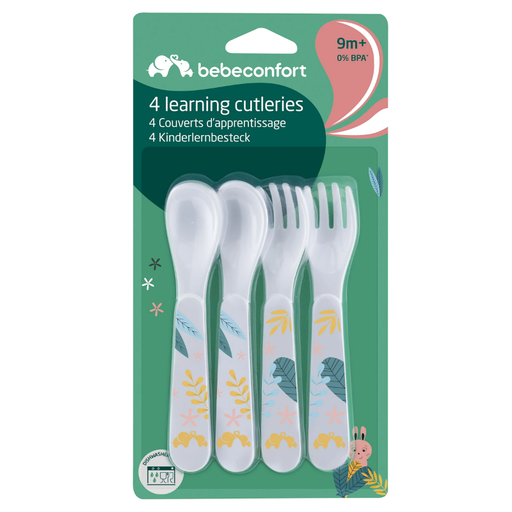
Why this choice suits this profile: its four-piece format suits households looking for a coordinated set for daily meals and learning to eat independently.
The four-piece composition avoids buying several utensils separately at the start of weaning. The manufacturer recommends hand washing.
Four plastic pieces, handles designed for small hands and use stated from the start of weaning. Do not use in the microwave or dishwasher unless stated otherwise.
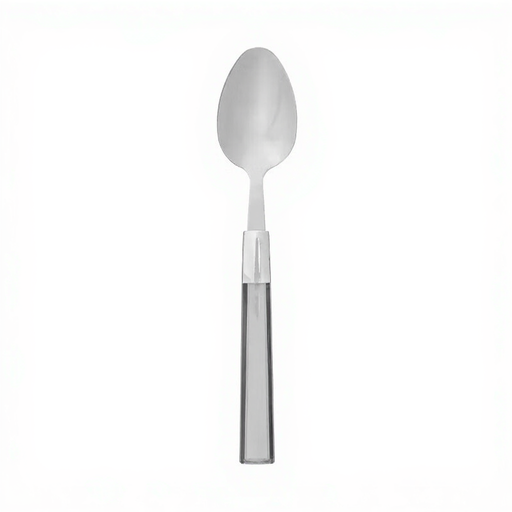
Why this choice suits this profile: this set is aimed at restaurants, cafeterias and catering services that need a large volume of plastic cutlery.
The 24 pieces allow you to build up a stock for service. However, the instructions exclude very hot foods, boiling water and uses that require high mechanical strength.
24-piece set, stated weight of 780 g and lightweight design. Hand washing recommended, without abrasive products or exposure to high heat.
We have put together a comprehensive, real-time updated selection of products that meet these demanding criteria and European safety regulations.
The lifespan of cutlery depends on how often it is used, how it is washed and the condition of the material. To keep a baby cutlery set in good condition:
For professional use, also check the specific requirements of your establishment before choosing plastic cutlery. A set designed for cold or lukewarm foods should not be used with very hot dishes.
Some models are suitable from 6 months, at the start of weaning. The recommended age on the packaging is the reference to follow. In all cases, an adult must supervise the child throughout use.
The spoon is generally used for purées and blended foods. The fork can be introduced gradually when your child starts to spear or pick up soft foods. A duo allows you to adapt to different textures and stages of learning.
There is no universal timeframe. Replace the cutlery as soon as it shows damage, warping, cracks or visible wear. Care that follows the manufacturer’s recommendations helps keep it in good condition, but should not lead you to use it beyond its material lifespan.