
Livraison le jour même ou le lendemain

Qualité garantie

Débloquez vos offres de bienvenue: Livraison GRATUITE | Jusqu'à -80 % | 30 jours d'essai gratuits à JoyPlus
Téléchargez l'application
Maintaining a car, motorbike or van isn’t just about piling spanners into a toolbox. A poorly chosen tool can round off a nut, prove impossible to use in a tight space, or wear out after just a few jobs. To put together equipment that’s right for your garage, workshop or DIY projects, take a close look at what’s inside the sets, the sizes, the mechanisms and the storage solutions.
A 108- or 172-piece set can immediately feel comprehensive. However, that number often includes a multitude of bits, adaptors or accessories you’ll rarely use. Instead, look at the metric sizes that are actually useful, and check for the presence of deep sockets, extension bars and universal joints.
A polished or chrome-plated surface makes cleaning easier and helps protect the tool against corrosion. But it doesn’t tell you much about its strength. The quality of the steel, the heat treatment, the precision of the assembly and the reliability of the mechanism are far more revealing.
In an engine bay, under a vehicle or near a brake pipe, a standard spanner may not have enough clearance. Offset ring spanners, flexible ratchet spanners, extension bars and articulated sockets each address different constraints. The right approach, therefore, is to choose the tool based on access, not just the size of the nut.
Chrome vanadium steel tools are very common for spanners, sockets and ratchet handles. This term refers to a family of alloy steels designed for tools that undergo significant mechanical stress. Also check for heat treatment and an anti-corrosion coating. For bits, S2 steel is frequently used when high hardness is required.
The material isn’t everything: you also need to use each tool within its intended limits. A ratchet spanner cannot replace a torque wrench when a manufacturer specifies a precise tightening torque.
For common vehicles in the UK, go for a consistent metric coverage. A set of open-end and combination spanners from 8 to 19 mm is enough for many routine jobs. For sockets, a versatile set might offer several drive sizes, for example 1/4, 3/8 and 1/2 inch.
Deep sockets are particularly handy for nuts mounted on a long threaded rod. 12-point sockets engage more easily in certain positions, while a 6-point model generally distributes force better on a nut in good condition. It’s up to you to match the drive type to your needs.
A ratchet head with 72 or 90 teeth reduces the angle needed to re-engage the movement. A real advantage when working in a tight space. A flexible head offers even more freedom, but it should be used with care and in line with the manufacturer’s recommendations.
Storage also matters in day-to-day use. A roll-up tool pouch slips easily into a car boot or a mobile toolbox. A moulded case protects a larger assortment better and lets you quickly spot a missing tool. For cutting tools, such as a cable cutter or a compact bolt cutter, choose a model with a safety lock and always respect the stated cutting capacity.
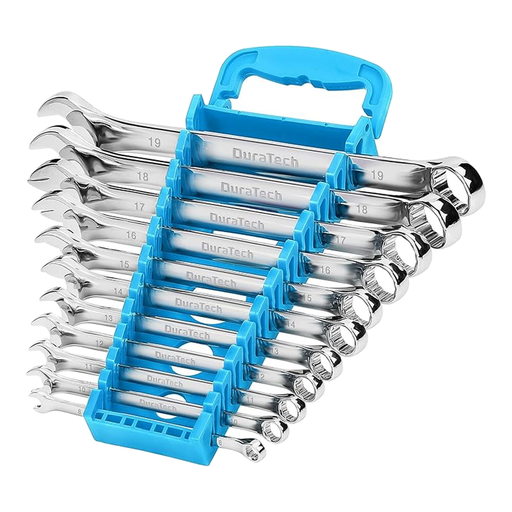
Why this choice suits this profile: This set covers sizes from 8 to 19 mm and is ideal for small car repairs, routine maintenance and DIY jobs around the house.
The 11 sizes are clearly marked on the handles – no risk of ending up with a bulky set full of rarely-used duplicates.
Chrome vanadium steel, 12-point polygonal end and compact storage holder.
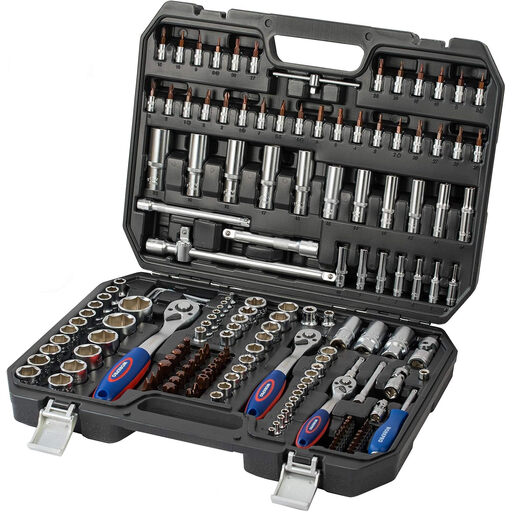
Why this choice suits this profile: This mechanic’s set brings together sockets, bits, extension bars and three ratchet sizes in a single case.
The detailed contents list lets you check the sizes and accessories included, rather than being swayed by the piece count alone.
Chrome vanadium sockets, S2 bits, 72-tooth ratchets and a moulded case with a dedicated slot for every tool.
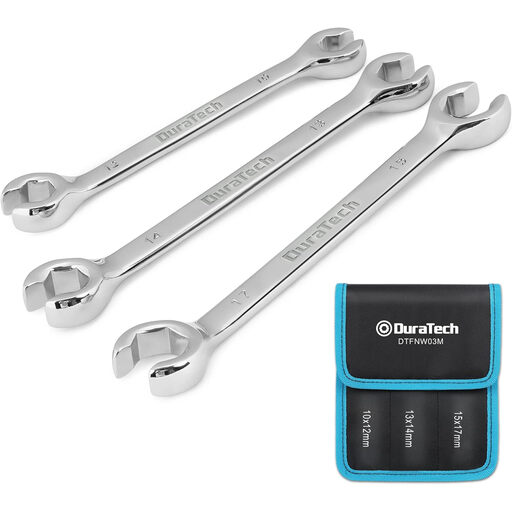
Why this choice suits this profile: These flare nut spanners are designed for targeted work on pipe fittings, particularly in automotive and maintenance applications.
The open profile wraps around pipe nuts, where a standard open-end spanner might slip or damage the nut.
Three spanners covering sizes from 10 to 17 mm, chrome vanadium steel and a 15-degree offset.
A socket set forms a versatile foundation for dismantling and reassembly work. Then, round out your equipment with tools suited to your tasks:
A metric set that includes several drive sizes, short and deep sockets, extension bars and a reversible ratchet makes an excellent starting point. For occasional use, gradually add a set of open-end and combination spanners.
A ratchet spanner lets you turn a nut without removing the tool after each movement. It saves valuable time when space is tight. However, a standard spanner is still preferable for applying steady force or accessing certain nut shapes.
Wipe your tools after each use, remove grease and moisture, then store them in a dry place. Lubricate the mechanism and joints of ratchets from time to time. Check the condition of cutting tools before each use and never use a socket or spanner beyond the function for which it was designed.