
Livraison le jour même ou le lendemain

Qualité garantie

Débloquez vos offres de bienvenue: Livraison GRATUITE | Jusqu'à -80 % | 30 jours d'essai gratuits à JoyPlus
Téléchargez l'application
Repairing a car, motorbike or bicycle at home isn't just about opening a toolbox. A socket in the wrong size, a spanner that slips or a ratchet that's too bulky can turn a routine job into a real waste of time. To choose the right automotive mechanics tools, it's worth carefully examining the set's contents, the sizes available, the materials used and the conditions in which you plan to use them.
A set that boasts an impressive number of pieces isn't necessarily the most practical. Some manufacturers count bits, adapters and extensions separately, while the sizes you'll actually use remain few. For routine maintenance, check above all for metric sockets, extensions, a universal joint and several drive square sizes.
A socket set in 1/4, 3/8 and 1/2 inch will generally cover more needs than a large case limited to a single size. On European vehicles, metric combination spanners and sockets expressed in millimetres are the most suitable.
A shiny finish isn't enough to judge a tool's strength. You also need to look at the material and the treatment applied to it. Chrome vanadium steel is commonly used for spanners and mechanic's sockets, particularly for its strength and good corrosion resistance when properly maintained.
That doesn't mean a tool can be used beyond its limits. A spanner designed for hand tightening cannot replace a torque wrench. Similarly, a compact bolt cutter shouldn't be used to cut material thicker than the diameter specified by the manufacturer.
In an engine bay, space is often desperately tight. A fixed spanner may offer too little swing, while a handle that's too long will be difficult to position. A reversible ratchet spanner with a low ratcheting angle makes movement easier when space is limited.
For nuts located near an obstruction, a flex-head spanner or an offset ring spanner can offer better alignment. The right profile therefore depends as much on the vehicle's geometry as on the size of the fastener.
Before placing an order, look for the following information in particular:
After each use, wipe off grease and moisture, then store the tools in a dry place. A light lubrication of the pivot is also useful for cutting pliers and moving mechanisms.
A 72-tooth mechanism generally requires a small movement to re-engage the rotation. Models claiming a 5° working arc are particularly handy in tight spaces. Some ratchets go up to 90 teeth, with a claimed angle of 4°. These values correspond to the rotation needed before the mechanism re-engages; they don't on their own guarantee the tool's strength or lifespan.
Also check for a quick-release button and a left-right reverser. These small details make changing sockets easier and avoid having to remove the handle mid-job.
A brake line spanner has a partial opening that allows it to pass around the pipe while maintaining several contact points on the nut. It's better suited to brake fittings than a standard open-end spanner, which can damage the corners if poorly positioned.
For cables, be sure to distinguish between cable cutters and a bolt cutter. A 190 mm pair of pliers designed for cables can handle bicycle brake cables, steel cables or certain metal wires, depending on the stated capacity. A compact bolt cutter of 210 mm is more intended for wires, chains and small metal items, within the diameter limit specified by the manufacturer. Wear suitable safety glasses and gloves to protect yourself from flying debris.
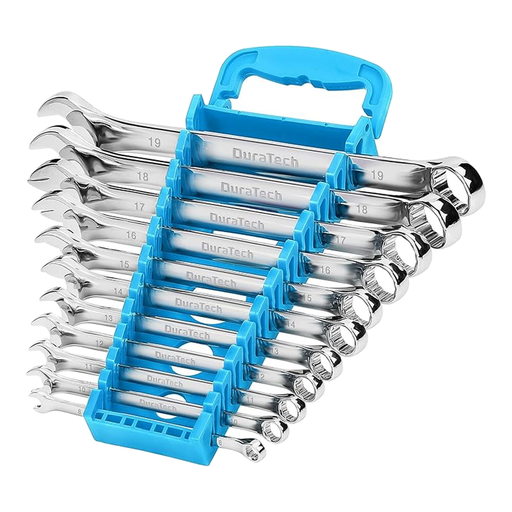
Why this choice suits this profile: This set covers the most common metric sizes for home maintenance, DIY and basic car repairs.
The 11 sizes are clearly marked and stored on a rail. This helps you avoid buying a bulky case filled with sizes you'll rarely use.
Treated chrome vanadium steel, 12-point ring end and 15-degree offset.
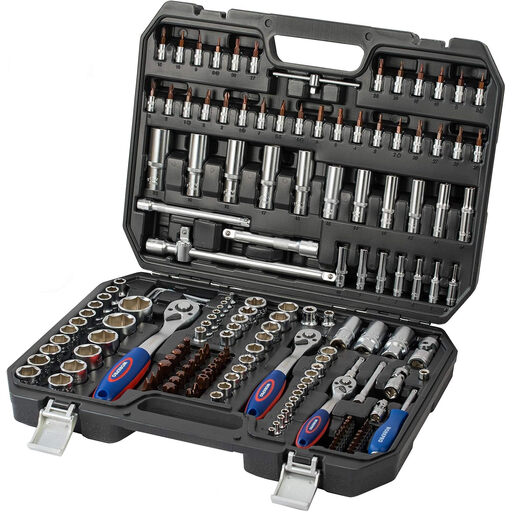
Why this choice suits this profile: Those who want to consolidate their tools for the car, motorbike, bicycle and general maintenance will find several socket formats and bits here.
The detailed contents list lets you check the sizes before buying, rather than relying solely on the stated piece count.
172 pieces stated, Cr-V sockets, S2 bits, three ratchet handles and a moulded case.
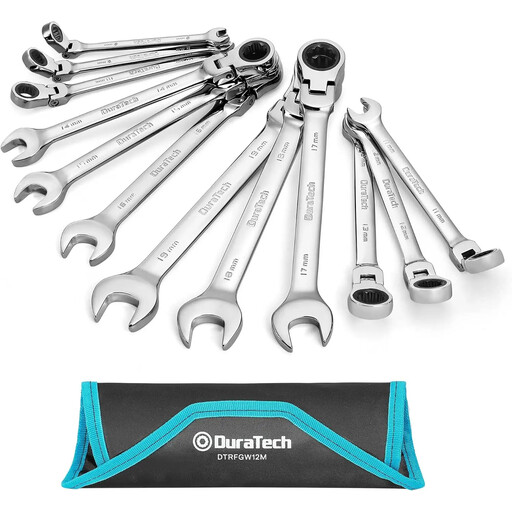
Why this choice suits this profile: People who regularly work in hard-to-reach areas will appreciate the pivoting head, which makes positioning the spanner easier.
The 180-degree flex head and the claimed 5-degree ratcheting arc are well suited to the constraints of tight spaces.
12 sizes from 8 to 19 mm, 72-tooth mechanism, Cr-V steel and storage pouch.
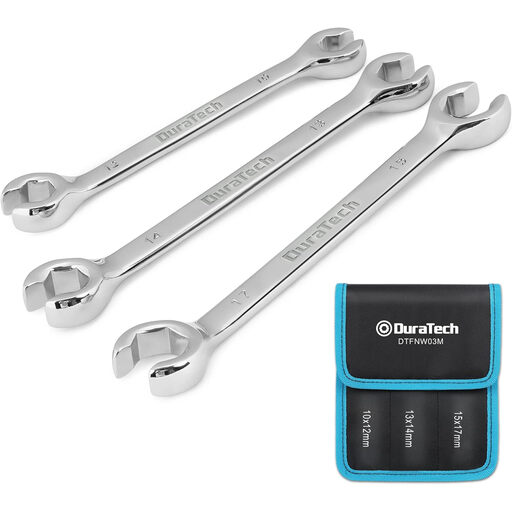
Why this choice suits this profile: This format is suitable for targeted work on brake fittings and some plumbing jobs.
The flared opening is designed to pass around the pipe, unlike a standard closed spanner.
Three spanners covering sizes 10 × 12, 13 × 14 and 15 × 17 mm, with a 15-degree offset and a pouch.
We've put together a comprehensive, real-time updated selection of products that meet these demanding criteria as well as European safety standards.
A socket set offering 1/4, 3/8 and 1/2 inch drives makes a good versatile base. Complement it with a set of ratchet spanners or metric combination spanners, plus a few extensions. Always check the sizes actually included and look for a well-organised case.
A ratchet spanner allows you to turn a fastener without fully removing the tool. This reduces the movement needed in tight spaces. A standard spanner remains preferable when access is clear or when precise alignment control is needed. For very tight fasteners, respect the limits stated by the manufacturer and use a tool suited to the required torque.
Clean off oil and dust after each job, dry the pieces before storing them and avoid striking a spanner if it's not designed for that. Regularly inspect the ratchet teeth, the jaws of pliers and the contact surfaces. Replace any tool that shows a crack, deformation or wear that could compromise its proper function.