
Livraison le jour même ou le lendemain

Qualité garantie

Débloquez vos offres de bienvenue: Livraison GRATUITE | Jusqu'à -80 % | 30 jours d'essai gratuits à JoyPlus
Téléchargez l'application
A constantly blowing fuse? An accessory that refuses to turn on? Electrical faults in a vehicle can quickly turn into a headache. In this kind of situation, a good automotive electrical circuit tester is essential. The problem is that the market is flooded with options, and it's easy to end up with an unsuitable tool or, worse, one that's dangerous for your car's electronics.
As a Product Expert at Joybuy, my role is to help you see things more clearly. Let's forget the marketing jargon and focus on the criteria that really matter so you don't regret your purchase. Here are the common pitfalls to avoid and the essential features to check.
Before you decide, be aware of these common mistakes that can be costly in both time and money.
To make an informed choice, focus on these three essential points. A good automotive electrical diagnostic tool must meet these requirements.
A high-performance device must go far beyond a simple continuity test. Look for a model that integrates several essential functions:
An electrical fault is often a broken wire or a short circuit hidden in a harness. A simple multimeter is powerless here. This is where a built-in car short circuit detector or automotive cable tracer becomes invaluable. These systems typically work with a transmitter and a receiver. The receiver follows the signal along the wire and alerts you with a sound that changes or stops at the exact location of the break or short circuit, without you having to strip the entire wiring.
Safety is paramount. Ensure the tester has short-circuit and overload protection. An internal, self-resetting circuit breaker is a major asset. Also, check the supported voltage range; 6V to 42V compatibility ensures it can be used on a wide range of vehicles, from older models to the latest ones, including mild-hybrid systems. Finally, a long main cable (at least 6 meters / 20 feet) or the inclusion of an extension cord guarantees practicality in the field.
Rather than accumulating multiple tools, a versatile device is often a smarter choice for savvy DIYers and professionals. Here is an option that meets all our criteria for versatility and safety.
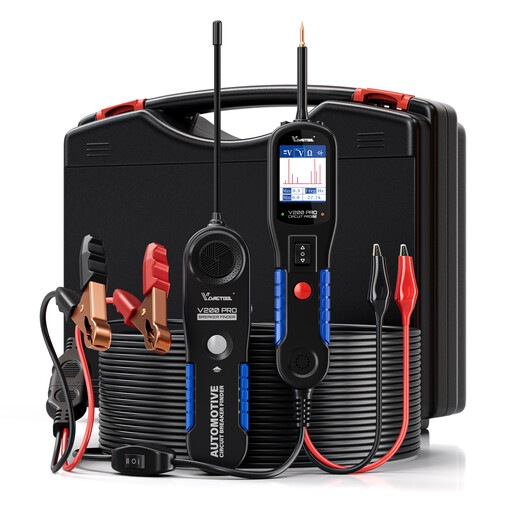
Ideal for the mechanic or seasoned DIYer looking for a single, all-in-one tool. It combines a complete circuit tester and a short circuit finder, preventing a cluttered toolbox and the need to juggle multiple devices to diagnose a single fault.
This tool directly addresses the common pitfalls: it's a multifunction device (not a gadget), it includes overload protection to safeguard the vehicle's electronics, and it comes with a 20-foot extension cable (approx. 6m), eliminating the problem of a short cable.
2-in-1 Tool: Switch between "power probe" mode and "circuit tracer" mode with a single click. Broad Compatibility: Works on 6V to 42V DC systems, covering nearly all light and heavy-duty vehicles.
We have compiled a complete and updated list of products that meet these strict selection criteria and safety regulations.
Can a circuit tester damage my car's electronics? Yes, a low-quality model without adequate protection can. That's why it's crucial to choose a device with overload protection. A good tester, like the V200 Pro, is equipped with an internal circuit breaker that trips in case of an overload, protecting both the tool and the vehicle's expensive ECUs.
Do I need a separate battery to power a circuit tester? It depends on the model and function. Most power probes draw power directly from the vehicle's battery or through the cigarette lighter socket, which is very convenient. However, for the automotive cable tracer function, the transmitter module often requires its own power source, typically a 9V battery, to send a signal through a circuit even when it's not powered.
What is the difference between a standard multimeter and an automotive circuit tester? A multimeter is a passive measurement tool: it reads voltage, current, and resistance. An automotive circuit tester is an active diagnostic tool. In addition to taking these measurements, it can inject current to activate components, indicate polarity instantly, and, on advanced models, help trace wires and locate breaks. It is a much more specialized and effective tool for automotive troubleshooting.