
Livraison le jour même ou le lendemain

Qualité garantie

Débloquez vos offres de bienvenue: Livraison GRATUITE | Jusqu'à -80 % | 30 jours d'essai gratuits à JoyPlus
Téléchargez l'application
An automatic self-cleaning cat litter tray can save you from daily scooping, but it still needs regular maintenance and a few checks. Between promises of hands-free operation, “smart” sensors and feature-packed apps, certain details can quickly turn a convenient purchase into a bulky or frustrating appliance.
Before comparing models, here are the most common pitfalls and the key criteria to examine.
A large internal volume does not necessarily mean that the tray can go several weeks without maintenance. You need to distinguish between:
The stated autonomy for one animal can quickly decrease in a multi-cat household. Also check whether the stated duration depends on a particular bag, consumable or type of litter.
An automatic litter tray designed for large cats should have a sufficiently wide opening and enough interior space for them to turn around easily. However, a large appliance can prove impractical if the entrance is narrow or positioned too high.
For an older, heavy or short-legged cat, a low entrance and a ramp can make it easier to use. Also measure the space available in your home: some appliances are over 75 cm high or require additional clearance to remove the waste drawer.
A connected litter tray with an app can track your cat’s weight, frequency of use and the length of each visit. This data is mainly useful for identifying unusual changes. It is not a diagnosis and can never replace advice from a vet.
The presence of a camera also raises privacy concerns. Check whether a private mode is available, what data is recorded and whether the connection is compatible with your home Wi-Fi network.
In a multi-cat household, choose a large-capacity litter tray with a sufficiently spacious waste drawer. The models featured below offer internal volumes of between 60 and 106 litres, but their weight limits and formats vary considerably.
Also check compatibility with your usual litter. Several appliances accept clumping litter made from bentonite or tofu, as well as certain blends. Non-clumping litter and silica crystals are not always supported.
A litter tray with safety sensors should stop or delay its cycle when a cat is detected nearby. Weight, infrared, radar and anti-pinch sensors all contribute to this monitoring, provided they are installed correctly.
Always place the appliance on a hard, flat, stable and non-slip floor. A thick mat or carpet can distort weight measurements. Very light kittens may also not be detected correctly. In this case, use manual cycles and supervise the first few uses carefully.
An odour-control litter tray generally relies on a sealed drawer, a gasket, a filter or a deodorising system. None of these features removes the need to empty the waste regularly or clean the removable parts.
The stated noise level should also be taken with a pinch of salt: noise varies depending on the surface, the amount of litter and the selected cycle. A quiet litter tray is particularly useful in a flat, but above all it should provide predictable operation and stop reliably whenever a cat is present.
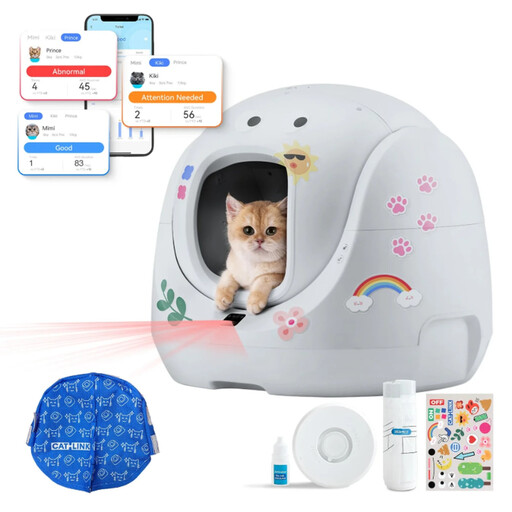
Why this choice suits this profile : Its four cleaning modes, 2.4 GHz Wi-Fi connection and 70 litre capacity make it a good introduction to using an automatic litter tray.
The limitations are clearly stated: recommended weight from 1.59 to 9.98 kg, installation on a stable floor and regular sensor cleaning.
70 L capacity, eight stated protection features and compatibility with clumping litter.
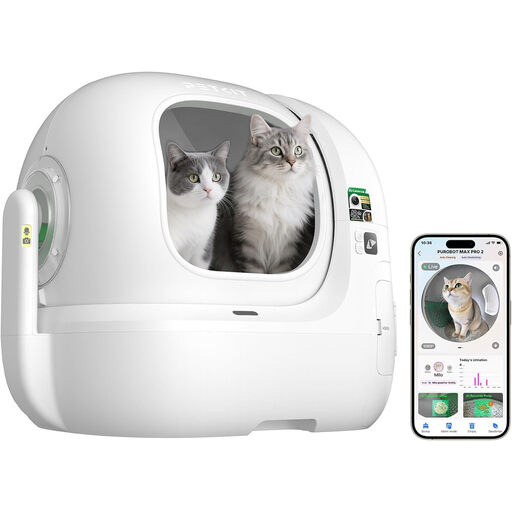
Why this choice suits this profile : Its wide-angle camera, multi-cat recognition and in-app tracking are ideal for households that want to keep usage data in one place.
The camera’s private mode helps limit visual monitoring. However, the 267 mm entrance and 76 L volume should be checked against your cat’s size and build.
210° adjustable camera, 8 L waste drawer and stated noise level of 35 dB.
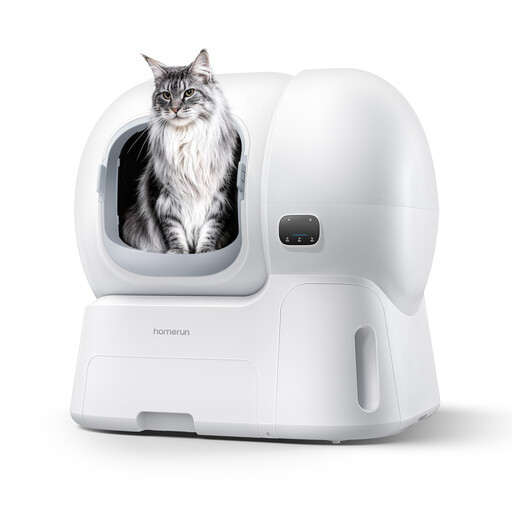
Why this choice suits this profile : Its 106 L volume and automatic refill system suit large cats as well as households with several cats.
The large tray does not remove the need to check for blockages, inspect the waste compartment and monitor the litter level.
Stated capacity of up to four cats, 8 L litter reservoir and automatic refill.
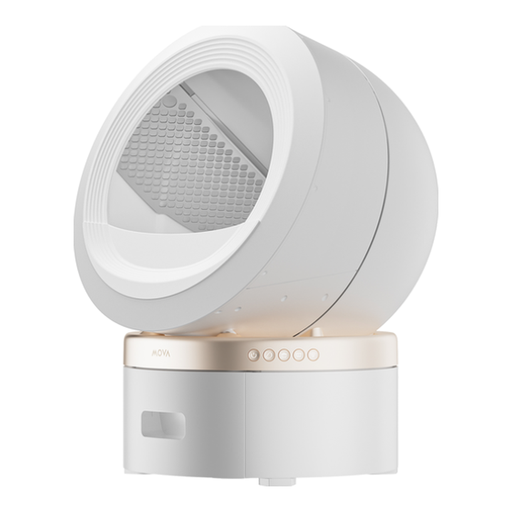
Why this choice suits this profile : Its semi-open design, remote monitoring and dual-chamber deodorising system are suited to homes where the living area is close to the litter tray.
The appliance still needs to be emptied and cleaned according to how often it is used: deodorising does not replace daily hygiene.
11 L drawer, stated autonomy of up to 15 days and twelve protection levels.
We have put together a comprehensive, real-time updated selection of products that meet these demanding criteria and European safety standards.
To make the transition easier, initially leave the automatic tray switched off or use it in manual mode for a few days. If possible, keep the old litter tray nearby until your cat has accepted the new appliance.
Then take the following precautions:
Yes, some models are designed as a self-cleaning litter tray for multiple cats, with a large tray and individual recognition. However, you should check the waste drawer capacity and weight limit. In a larger household, the drawer will still need emptying more frequently.
The budget is not limited to the purchase price. You will need to allow for clumping litter, bags, compatible filters or deodorisers, as well as a small amount of electricity. Before placing your order, compare the price and availability of consumables.
It depends on the build quality, frequency of use and maintenance. Regular cleaning, avoiding overloading and using the supplied adaptor reduce the strain placed on the motor and sensors. Always consult the instructions and the warranty conditions for your chosen model.