
Livraison le jour même ou le lendemain

Qualité garantie

Débloquez vos offres de bienvenue: Livraison GRATUITE | Jusqu'à -80 % | 30 jours d'essai gratuits à JoyPlus
Téléchargez l'application
An automatic cat food dispenser can simplify mealtimes when you're working, arriving home late, or away for a weekend. However, commercial promises don't always guarantee practical day-to-day use. Announced capacity, mobile app functionality and food preservation all deserve careful consideration before you buy.
A multi-litre tank doesn't necessarily mean it will last for several weeks. Autonomy depends on the number of meals, portion settings and the size of the kibble. A cat fed small amounts several times a day will naturally empty the tank more quickly.
Also check exactly what the stated capacity covers. Does it refer only to kibble, or to several separate compartments? Some dispensers are designed for dry food, whereas a wet food automatic dispenser for cats needs suitable compartments and, in some cases, a cooling function.
Controlling from an app lets you schedule meals, adjust portions or trigger a remote feed. However, an unstable Wi-Fi connection, low battery or power cut can interrupt operation. A connected model should therefore offer a clearly indicated backup solution: mains power, batteries or offline operation.
A connected cat feeder with camera provides more information, but remote observation doesn't replace checking in person if there's a fault or unusual behaviour from your pet.
Greasy kibble, freeze-dried foods and small treats can clump together in a dispenser opening that's too narrow. To avoid blockages, check the maximum kibble diameter accepted and whether there's an anti-jamming system.
Proper food preservation also depends on the lid's airtightness, whether a desiccant sachet is included, and the closure mechanism. These features limit exposure to moisture, but they don't turn an opened bag of food into an endless supply. Removable parts should be easy to take apart and thoroughly dry before reassembly.
A programmable dispenser should let you set multiple mealtimes and repeat a consistent quantity. Ask yourself whether the adjustment is in grams, portions or seconds of motor operation. A portion doesn't always weigh the same depending on the size and density of the kibble.
For a cat that eats too quickly or follows a strict routine, prioritise:
Compare the different power options: mains, batteries or built-in rechargeable battery. A rechargeable battery makes it easier to place the dispenser away from a socket, but its battery life varies depending on the volume dispensed and connectivity. For extended absences, a backup power source can be useful, provided you check that the device continues to dispense meals without a network connection.
For a dog and cat food dispenser, also check the portion sizes and bowl height. A device suitable for a small dog may work for a cat, but each animal's dietary needs remain specific to them.
A standard automatic kibble dispenser is generally suitable for dry food, sometimes for freeze-dried or air-dried foods. A model with compartments and a cooling system will be better suited to wet food, but you must follow the manufacturer's instructions regarding storage time and cleaning.
Never pour liquid into a device designed only for dry food. To keep your pet safe, store unused food in its sealed packaging and regularly check for any smell, moisture or residue.
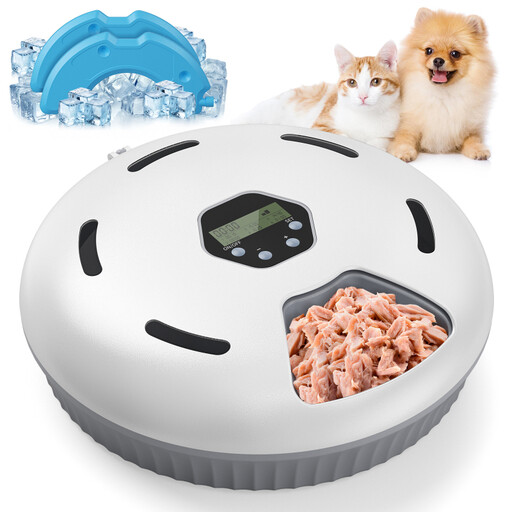
Why this choice suits this profile: Battery-powered, this model has six compartments and is aimed at people who want to automate wet food meals without installing an app.
The cooling function and six compartments prevent wet food from sitting at room temperature for hours. Batteries are not included.
Six programmable meals, battery operation and a design made for wet food.

Why this choice suits this profile: Owners who want to combine remote feeding with video monitoring benefit from a 1080p camera, two-way audio and app control.
It is clearly intended for dry, freeze-dried or air-dried food, which prevents unsuitable use with wet food or liquids.
1080p camera with night vision, two-way audio, mains power and backup batteries.
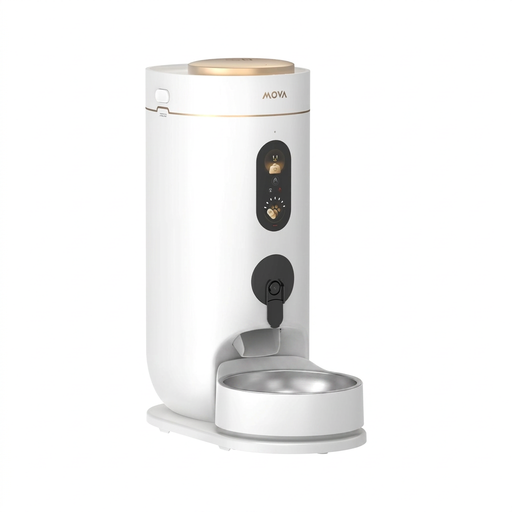
Why this choice suits this profile: Its 4-litre capacity, seven-day supplement compartment and camera suit households planning varied meals or going away for several days.
The food level display and low-stock alerts help prevent forgetfulness. The dual-opening auger accepts kibble up to 12 mm, but confirm this with your food.
Wide-angle 1080p camera with night vision, 4.2-inch screen and custom, manual or app-assisted modes.
Place the device on a stable, dry surface, somewhere your cat can't easily knock it over. Start by programming a small portion while you're present, so you can observe your pet's behaviour and check that the food dispenses correctly.
Clean the bowl and removable parts regularly, following the instructions in the manual. Never immerse the electronic unit, camera or battery compartment in water. If you plan to feed remotely, also test the alerts, offline mode and backup solution before you leave.
We've put together a comprehensive, real-time updated list of products that fully meet these strict selection criteria as well as European safety requirements.
It all depends on the model, the tank capacity and the settings you choose. Some devices offer six compartments, while others use a large kibble tank. Calculate your pet's daily consumption before relying on the stated autonomy.
Some models continue to run saved programmes without a connection, while others need the app to change settings. Check this point in the manual. A backup power source may also be necessary in the event of a power cut.
You'll need to factor in replacing batteries or recharging the battery, as well as the possible purchase of filters, desiccant sachets or spare parts. Regular cleaning and using a compatible food also help reduce blockages and premature wear.