
Livraison le jour même ou le lendemain

Qualité garantie

Débloquez vos offres de bienvenue: Livraison GRATUITE | Jusqu'à -80 % | 30 jours d'essai gratuits à JoyPlus
Téléchargez l'application
Do you work all day, regularly go away, or does your cat demand meals at irregular times? An automatic cat food dispenser can make your life much easier – provided you choose a device that’s genuinely suited to your pet’s diet.
Manufacturers are making all sorts of promises: mobile app, artificial intelligence, long battery life, extended freshness, or a built-in camera. Some features are genuinely useful, while others mainly push up the price without meeting a real need. Here are the main pitfalls to avoid and the criteria to check before you buy.
An automatic kibble dispenser typically works with dry food stored in a hopper. Wet food, on the other hand, needs a different system to limit drying out and, depending on the product design, maintain a suitable temperature.
A device marketed as a food dispenser isn’t necessarily suitable for both types of food. Always check the compatibility stated by the manufacturer. For wet food, choose a wet cat food dispenser with individual compartments and, where this feature is included, a cooling system.
A 4-litre hopper doesn’t guarantee several weeks of autonomy in every situation. The actual duration depends on portion size, the number of meals dispensed each day, and your pet’s appetite.
A bulky device can also quickly become awkward in a small kitchen. Measure the space you have available and check the maximum kibble size the dispenser can handle. Some manufacturers state a 12 mm limit – a detail worth taking seriously to avoid blockages.
A connected cat feeder can be used to schedule meals, check the history, or receive alerts. However, the app shouldn’t replace physical controls or a backup operating mode.
Before you buy, check the following points:
For a cat fed on kibble, choose a programmable pet feeder that can handle multiple times and quantities. Portions should be dispensed consistently, but the device can’t replace veterinary supervision or a proper nutritional management tool.
A dual-opening system or an anti-jam mechanism can be useful when kibble sizes vary. If the manufacturer states a quantity per serving, compare it with the recommended ration on the food packaging or from your vet.
Keeping food fresh depends on the type of food, how airtight the lid is, ambient humidity, and how often the dispenser is opened. For kibble, look for a sealed hopper that’s protected from moisture. For wet food, compartments with a cooling system are more suitable than a simple tray.
Don’t leave wet food out for longer than recommended on its packaging or in the manufacturer’s instructions. Clean all surfaces that come into contact with food regularly to prevent residue build-up.
A dispenser with a mobile app can be useful if you travel often or work variable hours. Check its compatibility with your phone, the Wi-Fi network required, and what information is actually accessible: meal history, hopper level, alerts, or remote control.
A pet surveillance camera adds a handy feature, but it shouldn’t overshadow the dispenser’s essential characteristics. Also check for instructions in English, the information provided by the manufacturer, applicable markings, and safety instructions. Materials that come into contact with food must be clearly stated – for example, stainless steel or plastic declared suitable for this use.
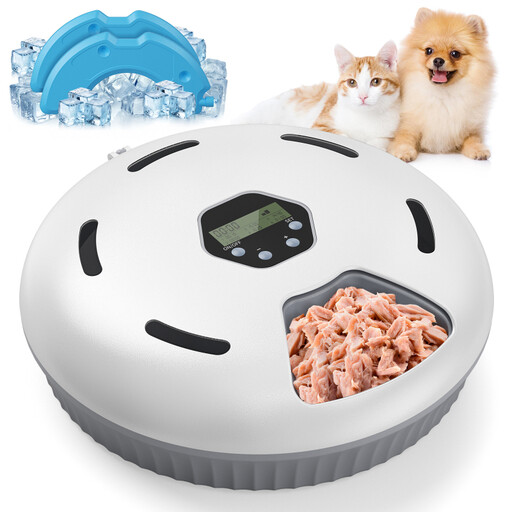
Why this choice suits this profile: Battery-powered, this model offers six compartments for organising wet food meals without requiring a complicated mobile app. Batteries are not included.
Its design is specifically intended for wet food, so you avoid choosing a kibble hopper that’s unsuitable for wet food.
Six programmable meals and a stated cooling function. Remember to buy the batteries separately.
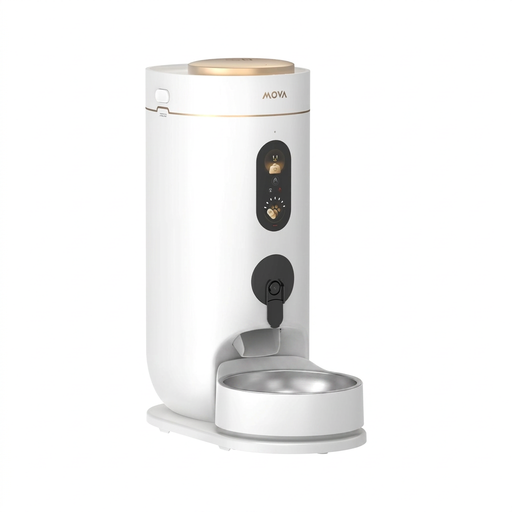
Why this choice suits this profile: Households that want to centralise programming, monitoring, and food level tracking can rely on its 4-litre capacity and app.
It combines customisable settings with a manual mode, rather than relying solely on automatic programming. The 1080p camera and level alerts also give you visual control.
Independent seven-section compartment, wide-angle camera with night vision, and stainless steel bowl. This model is designed for kibble.
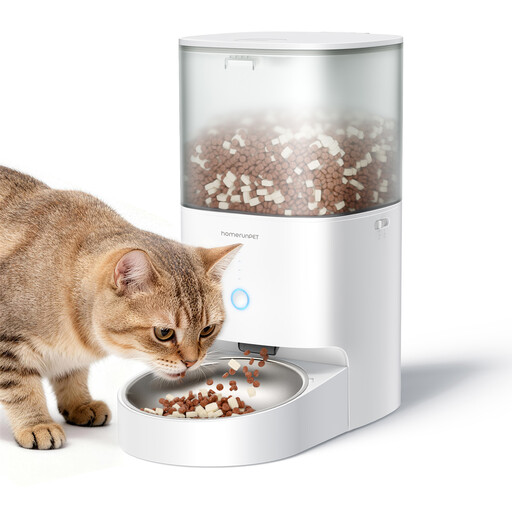
Why this choice suits this profile: People who are often away can schedule meals from the app and check the feeding history remotely.
The stated closure after each serving and the anti-jam system reduce the risks associated with food left exposed or an interrupted portion.
4-litre capacity, stainless steel bowl, and a stated six-month battery life. However, check the battery regularly and clean the base without submerging it.
We’ve put together a comprehensive, real-time updated list of products that fully meet these strict selection criteria and European safety regulations.
When it arrives, place the dispenser on a stable, dry surface that’s hard to knock over. Run several empty cycles before letting your cat use it. This way you can check the portion size, noise level, and whether there are any blockages.
During the first few days:
An automatic dispenser doesn’t replace keeping an eye on your pet. Someone should still check in on them during long absences, especially if your cat is on a special diet or has specific needs.
Some models continue to run saved programmes without a connection, while others need the app to change the schedule. Check this in the specifications. For basic use, a local timer can be perfectly adequate.
The budget isn’t just the purchase price. You may also need to factor in the cost of batteries, filters, a replacement battery, or a storage subscription for camera-related features. Compare these expenses with the features that are genuinely useful for your household.
It depends on the quality of the mechanism, how often it’s used, how well it’s maintained, and whether the manufacturer’s instructions are followed. A model that’s cleaned regularly, kept away from moisture, and used with compatible food reduces the risk of early failure.