
Livraison le jour même ou le lendemain

Qualité garantie

Débloquez vos offres de bienvenue: Livraison GRATUITE | Jusqu'à -80 % | 30 jours d'essai gratuits à JoyPlus
Téléchargez l'application
Do you get home late, go away for the weekend or simply want to spread your cat’s meals more evenly throughout the day? An automatic cat food dispenser can make life easier, provided you choose a model suited to your pet, its diet and your home.
Product listings often promote the app, camera or artificial intelligence. These features cannot make up for a hopper that is awkward to clean, an unreliable power supply or an outlet that becomes blocked by certain types of food. Here are the key points to check before buying, followed by a selection organised by different uses.
A 4-litre capacity does not guarantee several weeks of use. How long it lasts depends on the number of meals programmed, the quantity dispensed and the size of the food. For an adult cat, a large hopper can certainly mean fewer refills, but you should also check that the lid is airtight and that the unit is easy to clean.
A large-capacity food dispenser is particularly useful if you regularly spend time away from home. However, it does not remove the need to check the appliance, food level and freshness of the food periodically.
A 1080p camera, night vision and two-way audio are useful for keeping an eye on your pet from a distance. However, they do not prove that the portion was dispensed correctly. To reduce the risk of blockages, look for an anti-blockage feeder, a low-level alert and a mechanism compatible with the diameter of the food you use.
Manufacturers sometimes specify a maximum size, such as 12 mm. This information should be considered alongside the shape and texture of your pet’s food.
A connected food dispenser generally relies on Wi-Fi and a mobile app. Before buying, check that it is compatible with your home network, particularly if it only works on the 2.4 GHz band. A backup power supply can be invaluable in the event of a power cut, but batteries or a battery pack are not always included.
The app should not be the only way to control the appliance either. Physical buttons or a local operating mode are still useful when the internet goes down. A model that can dispense a portion without an internet connection will remain fully functional.
A good programmable pet feeder should let you schedule several meals a day and adjust the quantity. Check whether settings are made in grams or dispensing units: one unit does not represent the same weight depending on the density of the food.
For cats that eat too quickly, it is often better to dispense several small portions rather than serve one large portion all at once. Owners of small dogs should also make sure that the feeder is suitable for their pet’s size and that the bowl has sufficient capacity.
The models featured here are primarily designed for dry, freeze-dried or air-dried food. A dispenser intended for dry food should not be used with wet food unless the manufacturer explicitly permits it.
On many models, the stainless-steel bowl can be removed easily and is easier to clean than a surface that is difficult to access. The electronic base must never be immersed in water. Before carrying out any maintenance, unplug the appliance, remove the batteries if necessary and wait until every component is completely dry before putting it back together.
Also remember to check:
An automatic food dispenser with a camera can be worthwhile if you want to check that your cat is present, watch it eat or speak to it remotely. However, remember that seeing your pet does not confirm that the food has actually been dispensed. In everyday use, low-level alerts, dispensing history and precise portion settings are often more useful than a camera on its own.
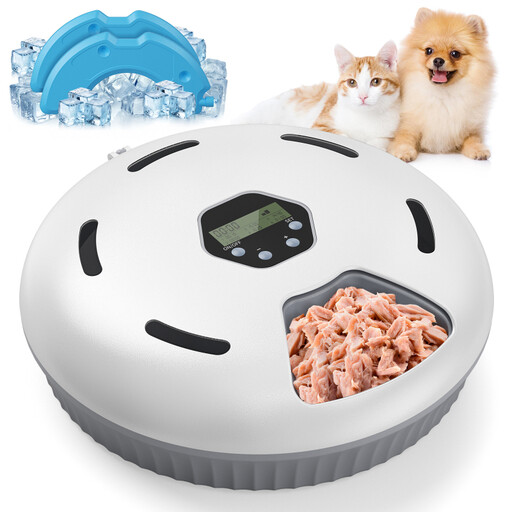
Why this choice suits this profile: Its six-compartment system is ideal for anyone who wants to automate several meals without needing an app or camera.
Its cooling function is designed for wet meals. Nevertheless, check its battery life and plan to purchase the batteries separately, as they are not included.
Six compartments and battery operation. A simple solution for managing short periods away from home.
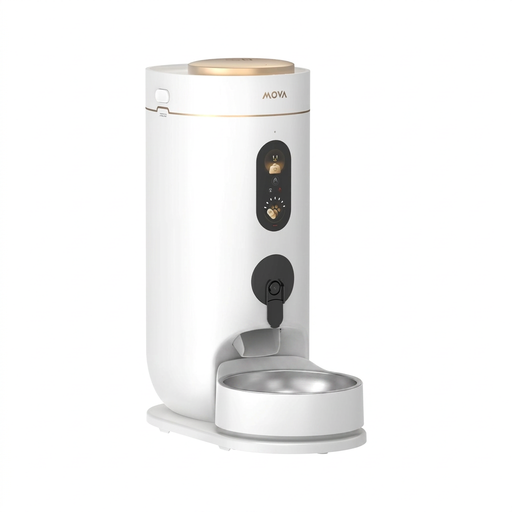
Why this choice suits this profile: People who are often away from home benefit from a 4 litre hopper, an app and a separate compartment for supplements.
The dual-opening turbine is advertised as anti-blockage for food up to 12 mm. A low-level alert helps prevent you from forgetting to refill it.
150° wide-angle 1080p camera, night vision, two-way audio, 4.2 inch LED display and an advertised two-year manufacturer’s warranty.
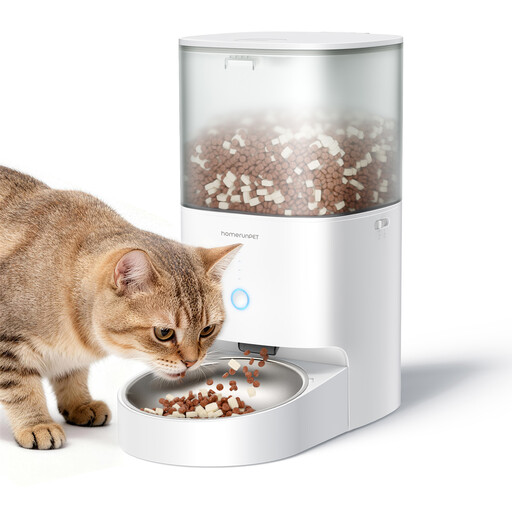
Why this choice suits this profile: Its 4 litre capacity and advertised battery life of up to six months make it suitable for households that want to manage meals regularly while limiting the need for mains connections.
The anti-blockage compartment and the advertised closure after each dispensing cycle reduce the risk of food becoming stuck or exposed to moisture.
Scheduling app, meal tracking, advertised moisture-locking mechanism and a bowl available in stainless steel or ceramic, depending on the version.
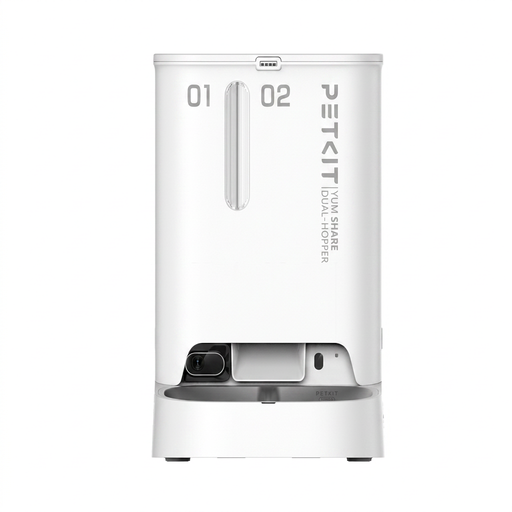
Why this choice suits this profile: This model is designed for households that want to monitor mealtimes and manage two types of food from an app.
The two reservoirs, mixing rotor and automatically closing outlet are suitable for food served separately or mixed together. A 2.4 GHz Wi-Fi network is required.
Wide-angle 1080p camera, two-way audio, AI-assisted food detection, stainless-steel bowl and backup power supplied by five AAA batteries.
We have brought together a complete, real-time-updated selection of products that meet these strict criteria, as well as European safety requirements.
Install it on a stable, dry surface that is heavy enough to prevent it from tipping over. Fill the hopper with your pet’s usual food, programme a small test portion, then check that the amount dispensed matches your expectations. If the model uses an app, connect it to the network specified in the instructions and activate low-level alerts.
Its lifespan varies according to the quality of the mechanism, maintenance, frequency of use and surrounding environment. Clean the bowl and dispensing chute regularly, keep the base away from any source of water and inspect the cable or battery compartment. Introducing it gradually can also help you quickly identify unusual noises or possible blockages.
You should take into account electricity consumption, the possible replacement of batteries, filters or desiccant sachets, and maintenance accessories. Some appliances run mainly from the mains with a backup power supply, while others rely more heavily on batteries. Compare these expenses with the purchase price to estimate the total cost over time.