Anyone making a stir-fry or noodles
You’re looking for notes of curry, ginger and lemon for a stir-fry, noodles or Thai-inspired soup, rather than just a simple stock base.


For a stir-fry or noodles with notes of curry, ginger and lemon, choose a cube with Thai-inspired flavours. For a more subtle base, consider vegetable stock cubes, or a no-salt option if you prefer to control the seasoning yourself. Always check the ingredients, allergens and dosage for the product you choose: Carrefour lists wheat in Maggi Kub Thaï, while Knorr France states that its No Salt Vegetable Stock contains 0.02 g of salt per serving.
You’re looking for notes of curry, ginger and lemon for a stir-fry, noodles or Thai-inspired soup, rather than just a simple stock base.
Your recipe already includes salty sauces or condiments, and you want to decide how to season it after tasting the dish.
You need to check separately for ingredients of animal origin and the allergens listed for the specific stock cube you plan to use.
First, decide what role the cube will play in your dish: adding Thai-inspired flavours or providing a vegetable base. Then check the salt content, ingredients and the amount you’ll actually use.
| What to consider | What to check | Who is it for? |
|---|---|---|
| Flavour profile | The herbs and spices listed in the ingredients and the suggested uses for the dish you’re planning. | For a Thai-inspired stir-fry or noodles, I want notes of curry, ginger and lemon. Around 33% of consumers would make this their main criterion. |
| Salt | The amount of salt per prepared serving and the cube dosage. Don’t rely on the wording on the front of the pack alone. | If my recipe already includes salty condiments, I’d rather stay in control of the final seasoning. Around 27% of consumers would put this control over salt first. |
| Ingredients and allergens | The ingredient list, highlighted allergens and any ‘may contain’ warnings for the exact product. | If a guest avoids animal-based ingredients or has an allergy, I check the cube before cooking. This would be the main criterion for around 27% of consumers. |
| Pack size | The number of cubes, how many you’ll need per recipe, the best-before date and storage instructions. | I may only use a few cubes during the evening, so I want to be able to store the rest as directed. Around 13% of consumers would prioritise this convenient format. |
Not containing ingredients of animal origin doesn’t mean it’s free from all allergens. Maggi Kub Thaï contains wheat and warns that it may contain other allergens.
If you have an allergy, read the ingredients and precautionary warnings on the pack you’re using.
Notes of curry, ginger and lemon may not suit a recipe that relies on other ingredients for its flavour.
Choose this flavour profile when you’re looking for those notes. Otherwise, consider a vegetable stock base and season the dish to suit the recipe.
The number of cubes only matters if the dosage and recipes you have in mind suit that pack size.
Compare the number of cubes, the amount needed per dish and the best-before date before choosing a pack.
The cube isn’t the only ingredient to consider if your recipe also includes salty sauces or condiments.
Use the recommended amount of stock cube, add any other planned seasonings, then taste before adding salt.
The range includes Kub Thaï, vegetable stock cubes and meat-based products.
The range includes a No Salt Vegetable Stock for recipes where you want to control the seasoning.
The ranges include vegetable and chicken stocks, as well as organic products.
These ranges include a variety of cooking stocks, including Bio Village vegetable stock.
This vegetable stock cube could be used as a base for soup or a stir-fry during your evening. If you’re specifically looking for notes of curry, ginger and lemon, check the flavour profile of the product you’re considering.
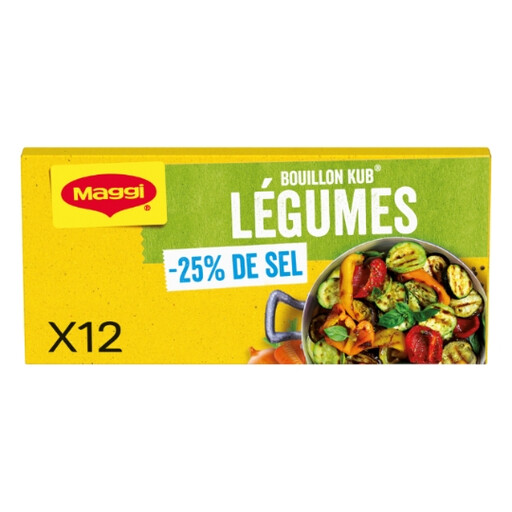 Image unavailable
A vegetable base to consider for soup or a stir-fry when you want to control the seasoning in your dish.
The product listing gives a pack size of 120 g and says the cube can be dissolved in boiling water or added directly to a dish.
MAGGI describes this product as containing 25% less salt than the average standard stock cube. For your recipe, check the amount of salt per serving and the dosage on the pack. The listing also warns that it may contain traces of egg, milk and gluten.
No. ‘Vegetable’ doesn’t mean ‘allergen-free’. Carrefour states that Maggi Kub Thaï contains wheat and may contain celery, eggs, fish, milk and soya, among other allergens. If you have an allergy, check the ingredients and any ‘may contain’ warnings on the pack you’re using.
Follow the dosage instructions for the product you choose. Auchan’s product listing for Maggi Kub Thaï recommends one 10 g cube per half-litre of water. If your noodles are served with salty sauces or condiments, take those into account before adjusting the seasoning.
Follow the instructions on the box and check its best-before date. If the product listing says to store the cubes in a cool, dry place, keep them in those conditions after opening, as directed on the pack.
Not necessarily. Taste the dish after adding the cube and any other planned seasonings. If you want to control how much salt the stock adds, Knorr’s No Salt Vegetable Stock is one option to consider. Knorr France states that this product contains 0.02 g of salt per serving.