
Livraison le jour même ou le lendemain

Qualité garantie

Débloquez vos offres de bienvenue: Livraison GRATUITE | Jusqu'à -80 % | 30 jours d'essai gratuits à JoyPlus
Téléchargez l'application
Planning a ceremony, reception or photo shoot often involves a long shopping list. Artificial wedding flowers let you get your décor ready in advance and reuse it, but not all products are created equal. A garland intended for an arch isn’t chosen the same way as an artificial bridal bouquet or petals for an aisle.
Before you order, it’s best to avoid three classic mistakes: underestimating quantities, being won over by a disappointing visual result, or choosing materials that aren’t well suited to your intended use.
A 2-metre garland won’t necessarily be enough to dress an entire arch. The density of the flowers, their spacing and the method of attachment all significantly change the final result. For a wedding arch, measure the section you want to decorate, then add extra for curves, ties and any overlapping.
On a table, an artificial flower garland can simply be laid down the centre. For a photo backdrop or an arch, you’ll often need several units to avoid sparse-looking areas.
Commercial descriptions like realistic artificial flowers, “natural touch” or “silk flowers” don’t always clearly tell you about the composition. Check the materials used: foam, polyester, satin, plastic, wire or a mix of several elements.
Texture matters too. Soft-touch foam roses work well for DIY bouquets, while satin petals are better suited to table décor, an aisle or a petal toss.
Artificial flowers don’t need water, but they must be kept away from excessive humidity, heat and prolonged sunlight. Some models contain wire or small parts: handle them with care and store them out of reach of young children.
Scattered petals on a smooth floor can also increase the risk of slipping. In a function room, plan a controlled layout and check the venue’s rules.
For artificial roses intended for a bouquet, choose a flower with a well-structured head and a stem that can be shaped. “Real touch” foam models are easy to mould for creating DIY arrangements. Polyester or faux silk options generally offer a soft surface and a consistent decorative finish.
On some product pages, the term “silk” actually refers to a synthetic textile, most often polyester. So don’t take it to mean natural silk composition.
Always compare:
A pack of 20 roses can work for several small arrangements, a centrepiece or a DIY bouquet. A pack of 200 petals will be better suited to decorating an aisle, several tables or different reception areas.
For an arch, pre-assembled compositions save time during setup. Long-stemmed bouquets offer more freedom but need a stand, vase or fixing structure.
An artificial flower is generally cleaned with a dry cloth, soft brush or gentle dusting. Foam models must not be submerged. Fabric elements should be stored in a dry place, away from direct light.
If you regularly organise weddings, baby showers or professional events, choose items that are easy to take apart, transport and reshape. This approach reduces waste and makes reuse simpler for your next event décor.

Why this choice suits this profile: This pack of 20 foam roses lets you create several small arrangements without investing in a full set straight away. It works well for artificial bridal bouquets, centrepieces and DIY projects.
The quantity is clearly stated and the flowers are ready to arrange. This makes it easier to estimate your needs before placing an order.
20 pieces, realistic-touch foam and cleaning recommended with a dry cloth. Several colours are available in this range.
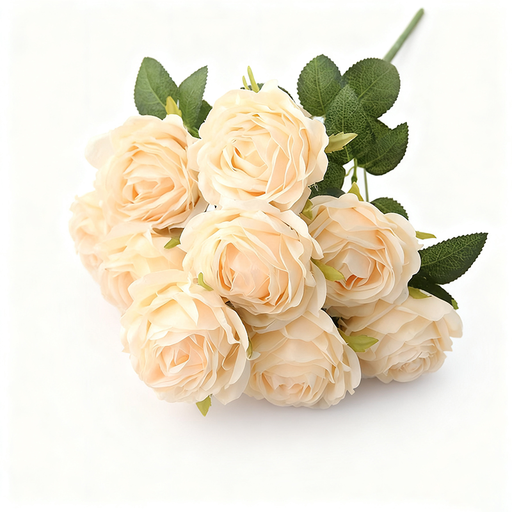
Why this choice suits this profile: At 48 cm tall with 10 flower heads gathered on a single main stem, this bouquet lends itself to a polished display in a vase, a welcome table decoration or a wedding arrangement.
The product page specifies the total height, flower diameter and stem composition. You can therefore check its compatibility with your vase or stand.
One main stem, 10 flower heads, faux silk flowers, plastic and a bendable internal wire.

Why this choice suits this profile: This pack of 200 pieces is aimed at decorators, reception organisers and anyone who needs to dress several tables, an aisle or different spaces.
The number of petals and their diameter of approximately 3.8 cm are stated. This lets you estimate the covered area more accurately and avoid ordering too few.
Polyester satin, 200 pieces, reusable format and care by simply shaking or gentle wiping.
We’ve put together a comprehensive, real-time updated selection of products that meet these exacting criteria, while also taking European safety regulations into account.
For an arch, first spread the compositions across the structure before fixing them permanently. Use suitable ties and, if you need to cut a metal stem, carefully protect its end. For a bouquet, vary the heights and make sure you have a sufficiently strong holding point.
Artificial rose petals can be arranged in small clusters rather than a uniform layer. On a table, pair them with LED candles, containers or a garland, always keeping a safe distance from a real flame. Garlands should be fixed so they don’t fall on guests or block walkways.
Yes, some models can be used outdoors on occasion. However, check the product page for information about UV rays, humidity and wind. For an arch, welcome sign or garden decoration, reinforced fixing is still recommended.
It all depends on the volume you want, the diameter of the flowers and the amount of foliage. A pack of 20 roses can serve as a base for a DIY bouquet or several small arrangements. For a fuller bouquet, add several packs after deciding on the dimensions and style you want.
Carefully remove the ties, dust the elements with a dry cloth, then store them in a clean, dry box. Avoid compressing them and protect them from heat and direct light. Satin petals can be gathered in a soft pouch to minimise creases.