
Livraison le jour même ou le lendemain

Qualité garantie

Débloquez vos offres de bienvenue: Livraison GRATUITE | Jusqu'à -80 % | 30 jours d'essai gratuits à JoyPlus
Téléchargez l'application
Want a wall of greenery without the hassle of watering and maintenance?? The artificial green wall is the ideal solution for adding life to a wall, creating privacy on a balcony, or simply bringing nature indoors. But be warned: the market is flooded with products that look stunning in photos but turn out to be a real disappointment in practice. To help you avoid a purchase you'll regret, we've broken down the common pitfalls and the criteria that truly matter.
Many panels promise a flawless look, but the reality is often quite different after just a few months. Here are the deal-breaking flaws that can turn a beautiful decor purchase into a huge disappointment.
To make an informed choice, there's no secret: you need to focus on the technical specifications that truly impact the quality and lifespan of your artificial vertical garden.
The "UV-resistant" label is essential, but it's not enough on its own. A simple surface coating won't last. Insist on products where the material itself, most often Polyethylene (PE), has UV protection integrated directly into it. With this technique, the protection is part of the plastic's core, guaranteeing colours that won't fade for years, even in direct sunlight. This is the non-negotiable criterion for a UV-resistant privacy panel designed for the outdoors.
The realism of an artificial hedge rests on two pillars: the shape of the leaves and their density.
A good fastening system should, above all, be easy to assemble. The panels should come with sturdy clips to link them together securely and invisibly. This modularity is crucial for covering large areas without unsightly seams or for tailoring the layout to specific dimensions. Check that the system allows for easy and secure attachment to your surface (wall, fence, railing).
To illustrate these criteria in action, here are a few models that meet specific needs and avoid the pitfalls we've just described.
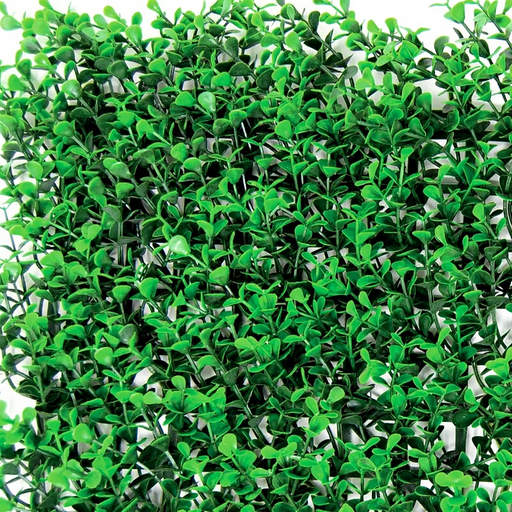
Why we love it : Perfect for a stunning accent wall or a reception area. Its meticulously crafted boxwood imitation is breathtakingly realistic.
Its ultra-high density of 3D leaves completely conceals the backing grid. Say goodbye to the "plasticky" look; the result is lush from every angle.
The polyethylene foliage replicates the texture and deep, rich colour of natural boxwood, delivering a truly premium visual finish.
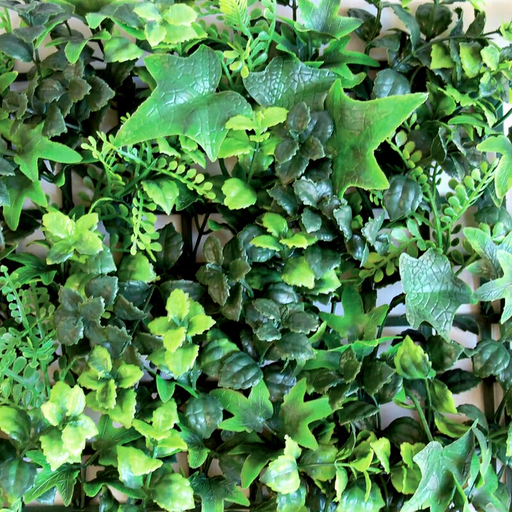
Why we love it : The perfect solution for an effective and long-lasting privacy screen on a balcony or terrace, or for concealing a drab fence.
Its polyethylene, with UV protection integrated into the material, prevents fading and brittleness. The result: reliable screening for years to come.
Its snap-together panel system makes installation a breeze and allows for a perfect fit to any surface, leaving no gaps between modules.
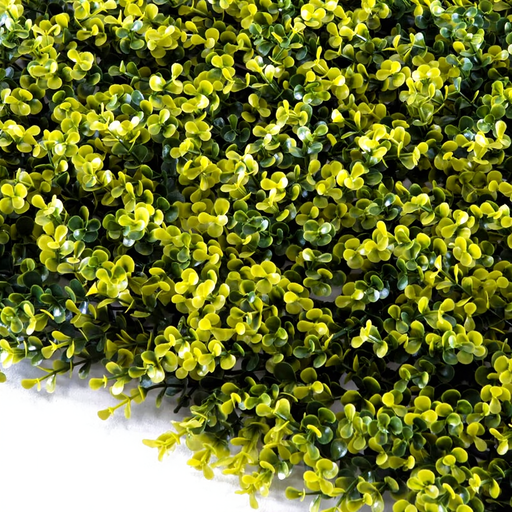
Why we love it : Not a fan of solid green? This model's shades of green and yellow mimic the new growth on a hedge, adding an extra touch of life and naturalism.
The UV treatment protects this subtle gradient, preventing the yellow tones from fading to a dull green. The nuanced effect is therefore preserved over time.
This blend of green and yellow offers a much more dynamic and less monotonous look than solid foliage, enhancing the natural illusion.
We've compiled a complete list of products that meet these strict selection criteria and current safety standards.
It all depends on the quality of the UV treatment. A budget model will barely last one season before fading. In contrast, a high-quality product with UV protection integrated into the material will retain its colour and appearance for 5 to 10 years, depending on its exposure to sun and weather.
Most panels are designed for easy installation. On a fence or balcony railing, simple zip ties are enough to securely fasten the panels. For a solid wall (like concrete or drywall), you'll first need to screw in a support structure, such as a wooden trellis or a metal grid, onto which you will then clip the panels.
Absolutely, but only if you choose wisely. Realism is a combination of several factors: 3D leaves with fine textures and veins, high density that completely hides the backing, and colour variations that mimic nature. The most advanced models are stunningly realistic, to the point where they are difficult to distinguish from a real living wall, even up close.