
Livraison le jour même ou le lendemain

Qualité garantie

Débloquez vos offres de bienvenue: Livraison GRATUITE | Jusqu'à -80 % | 30 jours d'essai gratuits à JoyPlus
Téléchargez l'application
A floral arrangement that needs no watering, no pruning and no clearing up of wilted petals can transform a living room, balcony or reception table. But buying artificial flowers can sometimes spring a few unpleasant surprises: garish colours, stems that are too short, or materials that don’t age well outdoors.
The product description deserves as much attention as the photo. Here are the criteria to check before choosing artificial silk flowers, a bouquet or an artificial plant for your décor.
A blown-up image can hide a very uniform texture or petals that lack detail. To judge how realistic artificial flowers are, check the stated material, the number of heads per stem, the flower diameter and whether leaves are included. Artificial silk or synthetic fabric often gives a softer finish than rigid plastic, but the final look also depends on how the petals are cut and how dense they are.
A 23 cm bouquet won’t have the same impact as a 76 cm branch. Before you order, measure the vase, planter or the space you want to decorate. Also check whether the stated height includes the stem and whether the head diameter is given. Several small bouquets can dress a table, whereas long branches are better suited to a floor-standing vase or a hanging arrangement.
The mention “outdoor” doesn’t guarantee equal resistance to sun, rain and wind. Look for UV resistance indicators, waterproof or washable material, and choose a sheltered spot when the description recommends it. Even artificial flowers designed for outdoors can lose their colour if they’re permanently exposed to direct sunlight.
Arrangements often combine synthetic silk, polyester, plastic and wire. Artificial silk gives the petals a fabric-like texture, while plastic is practical for elements exposed to moisture. A stem reinforced with a metal core bends easily and lets you adapt the arrangement to a vase, wreath or planter.
Handle the stems with care, though: an internal wire can become sharp if it’s cut or snapped. Artificial flowers should also be kept away from flames and heat sources, as synthetic materials can catch fire.
Compare the number of bouquets, branches and flower heads rather than relying on the piece count alone. A set of four bouquets may contain several dozen branches, whereas a single item sold individually might have just one very large head. To achieve a well-filled look, estimate the area you need to cover and the width of the container.
So-called maintenance-free flowers still need some cleaning. A gentle dusting with a soft cloth or soft brush is usually enough. Some outdoor models can be rinsed with water, while others must be kept dry. Avoid submerging them if the description advises against it, and let the flowers dry completely before putting them back in place.
If the arrangement arrives compressed, gently straighten the stems and fluff it out. A hairdryer set to cool air can help reshape the petals: just keep the dryer away from the fabric and never use hot air.
The products below are designed for different uses. The features mentioned correspond to the information available on their product pages.
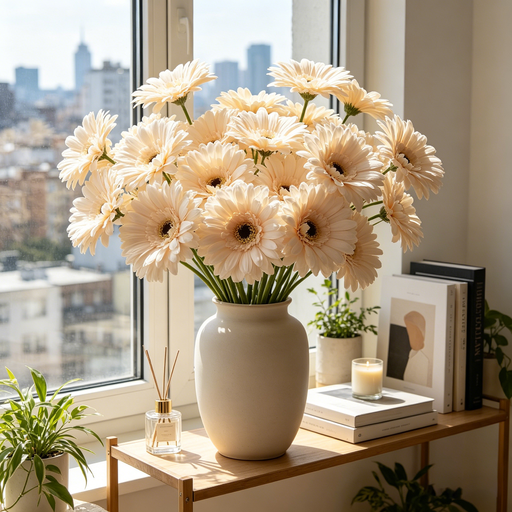
Why this choice suits this profile: This set of three 23 cm gerberas makes a good first arrangement for a small to medium vase. The stems are easy to shape by hand.
The height and quantity are clearly stated. You can therefore estimate the volume you need before buying, without relying solely on the photo.
Synthetic silk petals, stems reinforced with a flexible internal wire, and cleaning with a damp cloth as stated.
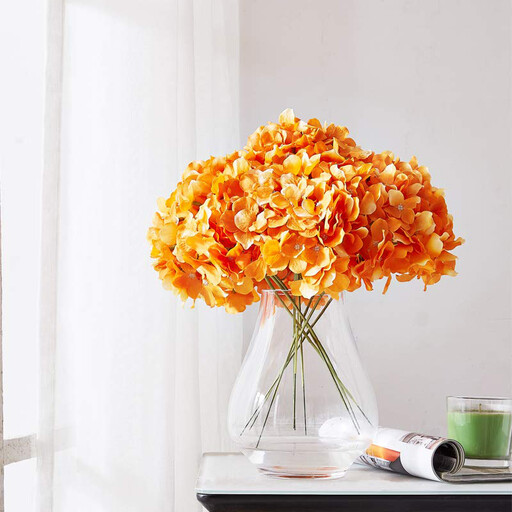
Why this choice suits this profile: Its five orange hydrangea heads mounted on 33 cm stems bring real visual presence to a vase, at a reception or in a living room.
The description specifies the proportion of synthetic silk fabric and plastic, as well as the stem length. The choice is based on concrete data, not just a flattering image.
Five separate heads on stems, adjustable length and the ability to reshape the petals after transport.
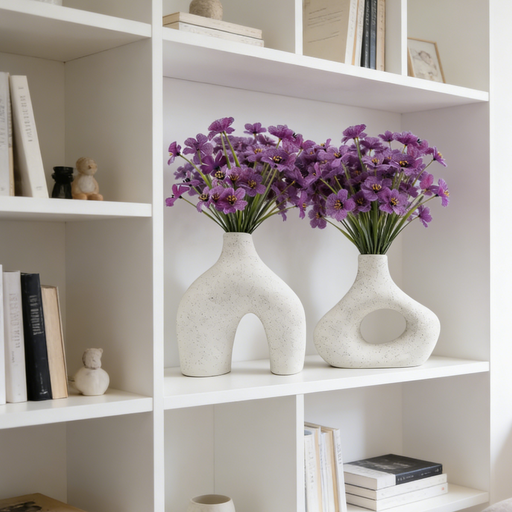
Why this choice suits this profile: The four bouquets total 20 branches and 72 heads, a practical format for a planter, hanging basket, balcony or entranceway.
The description distinguishes the quantities, branch length and flower diameter. It also mentions outdoor use and cleaning with water or a damp cloth.
Flexible branches, a combination of PE and silk fabric, and stated water and UV resistance.
We’ve put together a comprehensive, real-time updated selection of products that meet these demanding criteria and European safety standards.
To achieve a balanced arrangement, start by placing the tallest stems in the centre or at the back of the vase. Then spread out the secondary branches to avoid a bouquet that’s too compact. In a planter, make sure you have a heavy enough base or some ballast to stop it moving in the wind.
For artificial flowers intended for a wedding, check the colour palette, stem length and quantity needed for each table. Models reinforced with wire are well suited to arches, welcome panels and DIY bouquets. Keep them away from candles, heated garlands and any other heat source.
The lifespan depends on the material, how often they’re handled and exposure to UV light. Indoors, regular dusting helps preserve their appearance. Outdoors, models described as UV-resistant can work, but a sheltered spot will reduce fading and wear.
Dust the petals with a soft cloth, soft brush or cool air. If the description allows it, rinse outdoor models with clean water. Don’t submerge the bouquets in water when this method is not recommended, and let them dry completely before putting them back in place.
The price depends mainly on the number of stems, the size of the heads, the material and the intended use. To start with, a set of three or four branches is enough for a small vase. A wedding decoration, an arch or several planters will need multiple sets. Compare them based on the total number of flowers and the stated dimensions.