Buying priorities
Start by comparing the units specific to each category, then consider the volume or capacity you genuinely need and any available information about the appliance’s expected service life.
| Priority |
What to check |
Your needs and respondents’ concerns |
| Prioritise the right appliance |
For refrigeration, compare kWh/year between appliances of the same type and volume. For washing appliances, relate kWh/100 cycles to the number of cycles you actually run. Take continuous or frequent use into account. |
I want to identify which appliance to examine first without assuming that replacing it will automatically pay off. In the 2025 Barometer énergie-info from France’s national energy ombudsman, 87% of the 2,000 households in mainland France surveyed between 10 and 17 September 2025 considered their energy consumption fairly or very significant; 85% felt that their energy bills took up a large part of their budget. |
| Compare useful consumption |
For a dishwasher, check kWh/100 cycles, litres per cycle, place settings, Eco cycle duration and noise. For a washing machine, the reference is the Eco 40-60 programme. |
I want to compare values measured on the same basis, without treating an Eco programme as representative of every programme available. |
| Choose the right size |
Check refrigeration or freezer volume, dishwasher place settings and washing-machine capacity in kilograms. ADEME states that a 7 kg drum is often sufficient for typical loads. |
My appliance must fit the available space and suit my everyday usage, helping me avoid an unnecessarily large capacity or poorly filled cycles. |
| Plan for long-term use |
For the relevant categories, check the durability or reparability score out of 10, spare-parts availability and noise levels. Since April 2025, the durability index has applied to washing machines in France. |
I am looking for controlled consumption, but also an appliance that can be repaired and fits the intended location, particularly near living areas. |
Brand guidance
When comparing brands, focus on the model’s measured energy and water consumption, capacity, noise, repairability information, spare-parts availability and warranty terms. A familiar brand is not automatically the best choice for every home: compare appliances with similar specifications and choose the one that best matches your space and routine.
Appliances available on Joybuy
Joybuy options for comparing 7 kg washing machines and fully integrated dishwashers when replacing a household appliance.
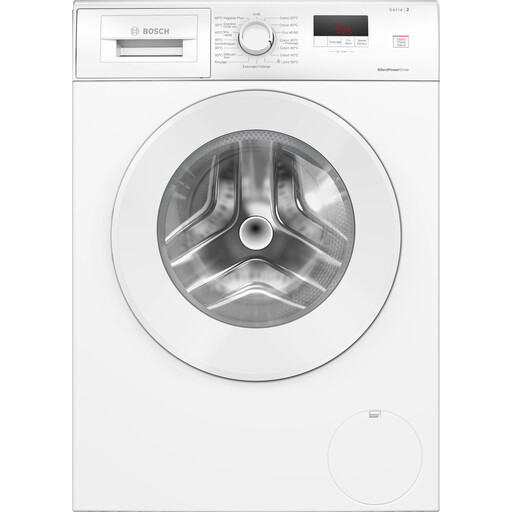 Image unavailable
Bosch WGE02407FR 7 kg front-loading washing machine, 1,400 rpm, class A
An option for comparing a 7 kg capacity with typical loads.
Listed specifications include 40 kWh/100 cycles, 44 L per reference cycle, a spin speed of 1,400 rpm and class A sound performance at 72 dB.
Check the installation and connection requirements, along with the applicable reparability information or spare-parts availability for this model.
Joybuy
 Image unavailable
Haier T Series 7 THASN276TM6-S 7 kg top-loading washing machine, 1,200 rpm, class A
The top-loading design and 405 mm width may suit a narrow space.
Listed specifications include a 7 kg capacity, 40 kWh/100 cycles, 42 L per cycle and an Inverter motor; the spin noise level is stated as 77 dB(A).
Check the clearance required above the machine, the 600 mm depth, the connections and the applicable durability index.
Joybuy
 Image unavailable
AEG FSB34707Z 60 cm fully integrated dishwasher, 14 place settings, class C
Worth considering for regular cycles and medium to large loads in a compatible fitted kitchen.
Listed specifications include 14 place settings, 0.75 kWh and 10.5 L per Eco cycle, an Eco duration of 240 minutes and a noise level of 44 dB.
Check the niche dimensions, compatibility with the furniture door and hinges, as well as the model’s reparability and warranty information.
Joybuy
 Image unavailable
Samsung DW80H72YBB0U1 60 cm fully integrated dishwasher, 13 place settings, class B
This fully integrated model is suitable if your niche, furniture door and planned installation are compatible.
Listed specifications include 13 place settings, adjustable baskets, an Extra Silence programme rated at 42 dBA and a declared noise level of 44 dB(A).
Check the model’s energy label, niche dimensions, fixed-hinge system and any professional installation requirements.
Joybuy
 Image unavailable
Samsung DW70H72WCB0U1 60 cm fully integrated dishwasher, 13 place settings, class C
An option for a fitted kitchen with a compatible sliding door and regular household loads.
Listed specifications include 13 place settings, a height-adjustable centre rack with three levels, AutoRelease automatic opening and a declared noise level of 44 dB(A).
Check the energy label, compatibility between the niche and furniture door and the Kitchen Fit Sliding Door system, as well as the warranty terms.
Joybuy
Frequently asked questions
Which appliance should you replace first to reduce electricity consumption?
Start with the appliance that combines continuous or frequent use, high reference consumption and a replacement that is justified in your home. According to ADEME, refrigeration appliances should be examined first because they run continuously; washing or cooking appliances may take priority depending on how often you actually use them.
How should you compare a dishwasher’s energy label?
Compare the A to G class, kWh/100 cycles, litres per cycle, capacity in place settings, Eco cycle duration and noise, using models with comparable useful specifications. ADEME explains that the reference consumption is linked to the Eco programme, so it does not automatically represent the other programmes.
How can you stop a larger washing machine from using more electricity than necessary?
Choose a capacity that matches your usual loads rather than automatically opting for the maximum. ADEME states that a 7 kg washing machine is often sufficient and recommends comparing energy, water, spin and noise information measured on the Eco 40-60 programme.
Which appliances display reparability or durability information in France?
Since 2025, the durability index has been mandatory for washing machines and replaces their reparability index; it incorporates reliability and reparability criteria in particular. The French Ministry for Ecological Transition states that dishwashers are among the categories covered by the reparability index, with a score displayed out of 10.
Which appliances must display a mandatory energy label?
Sources from the French Ministry for Ecological Transition list fridges and freezers, washing machines, dishwashers, ovens and cooker hoods among the categories subject to mandatory energy labelling. Check the label and the product information for the specific model sold in France before comparing.


