
Livraison le jour même ou le lendemain

Qualité garantie

Débloquez vos offres de bienvenue: Livraison GRATUITE | Jusqu'à -80 % | 30 jours d'essai gratuits à JoyPlus
Téléchargez l'application
By the Editors, 20 July 2026
For endurance athletes, extreme sports enthusiasts, and adventurers, reliable gear isn't a luxury—it's a necessity. A smartwatch must be more than just a gadget?: it's a co-pilot on your wrist, built to withstand the harshest conditions, provide data with surgical precision, and deliver battery life that can keep up with your challenges.
In a market saturated with promises, finding the right device can be overwhelming. This guide breaks down the Apple Watch Ultra 3 GPS + Cellular 49mm, focusing on its technical specifications and real-world applications. Our goal? To help you determine if it's truly the right fit for you.
Before diving into this specific model, let's review the essential criteria that define an excellent watch for high-intensity activities.
For an extreme sports watch, durability is non-negotiable. The case must be able to handle impacts and resist scratches. Titanium is often favoured for its excellent strength-to-weight ratio, offering far more resilience than aluminium without weighing down your wrist. The display is another key point of vulnerability; a sapphire crystal screen provides scratch resistance far superior to standard reinforced glass. This is a major advantage in mountaineering or trail running.
In the great outdoors, reliable location tracking is not an option. A dual-frequency GPS watch (L1 + L5) ensures enhanced accuracy in challenging environments like canyons, dense forests, or urban centres where signals can bounce. Battery life is the other critical factor: a long-battery-life Apple Watch is essential for long outings, ultra-trails, or multi-day expeditions. Be sure to check the stated battery life for normal use, and more importantly, in low-power mode.
Different disciplines have different demands. For a diving smartwatch, a 100-metre water resistance rating and a depth gauge are essential. For trail running, advanced metrics like running power and a barometric altimeter make all the difference. Meanwhile, safety features (Fall Detection, Emergency SOS via satellite) provide invaluable peace of mind when you're off the beaten path.
With these criteria in mind, one model stands out as the current benchmark.
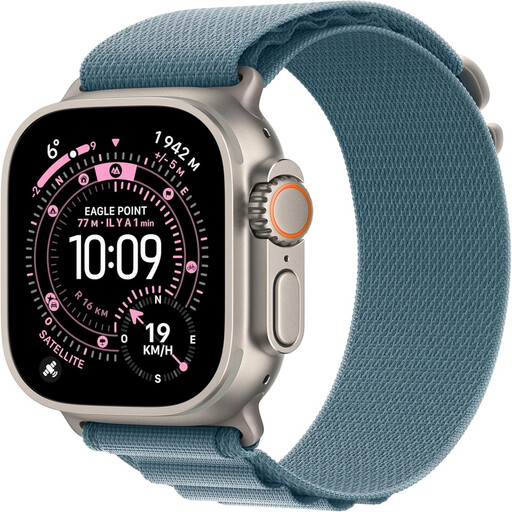
See Price and Details for the Apple Watch Ultra 3
The Apple Watch Ultra 3 is engineered for the most hostile environments. Its 49mm aerospace-grade titanium case offers maximum protection while remaining lightweight. The flat sapphire crystal display is protected by the case's raised edges, and its 3,000-nit peak brightness ensures perfect readability, even in direct sunlight. Certified water-resistant to 100 metres and compliant with EN13319, it's perfectly suited for recreational diving down to 40 metres.
This model is aimed at the most demanding athletes and adventurers, for whom performance, durability, and safety are non-negotiable. It's the ideal tool for marathoners, triathletes, divers, hikers, and anyone who loves to push their limits outdoors. Its premium positioning reflects its exceptional technical specifications, designed for absolute reliability in the field.
The Apple Watch Ultra 3 is a highly specialised model. If you're looking for a watch for more casual daily use, general fitness, or have a different budget, other models may be more suitable. The Apple Watch Series 10, for example, offers a slimmer design and numerous health features in an elegant form factor, perfect for everyday wear.
To discover a wider range of models, with options for every budget and need, feel free to browse our complete category.
? Explore Our Selection of the Best Digital Watches
The price of the Apple Watch Ultra 3 positions it as a premium product, a cost that aligns with its advanced materials (titanium, sapphire) and cutting-edge technologies. To check the current price and any available offers, the easiest way is to visit the product page.
Yes, its battery life is one of its greatest strengths. With up to 72 hours in Low Power Mode, it can cover the duration of most ultra-trails and endurance races. In addition, its dual-frequency GPS ensures precise tracking of distance and pace throughout the event.
The differences come down to three key areas: durability, battery life, and specialised features.