Managers responsible for approving the recipe
You need to distinguish between juice, juice made from concentrate and nectar, to check that the product description and ingredients meet your canteen’s requirements.


For a workplace canteen, first choose between juice and nectar based on the recipe you need. Then check the product description, ingredients and nutritional information: ‘no added sugar’ does not mean ‘sugar-free’. The pack size and guidance for use after opening should also suit your service schedule. Before placing regular orders, confirm supply arrangements with the supplier.
You need to distinguish between juice, juice made from concentrate and nectar, to check that the product description and ingredients meet your canteen’s requirements.
Choose a pack size that suits your chilled storage space and the amount served before the recommended time after opening is up. Auchan’s 1 L Tropicana 100% sweet apple juice, for example, has a product-specific instruction to consume within five days and store at no more than 7 °C.
You need a pack size and delivery arrangement that work for your establishment, with availability confirmed for the volumes and order frequency you have in mind.
Consider it: if your specification calls for fruit juice, whether pressed or made from concentrate, depending on the recipe you accept.
Check: the DGCCRF notes that juice retains the sugars naturally present in fruit. Also check the ingredients list for each product.
Consider it: if a nectar recipe meets your specification better than a product described as juice.
Check: juice and nectar are different product categories. Check the fruit content and ingredients of the product you choose.
Once you’ve chosen a category, check that the recipe suits how your canteen operates, then consider the ordering arrangements.
| Criteria | What to check | Relevant consumers |
|---|---|---|
| Recipe and product description | Product description, ingredients, fruit content in nectar and sugars listed per 100 ml. | If my specification excludes added sugar, I need to distinguish this requirement from the sugars already present in apples. Around 50% of the consumers concerned would make recipe approval their top priority. |
| Pack size and storage | Pack size and product-specific guidance for use after opening. | When several services use the same bottle, I need to be able to keep it chilled and finish it within the stated time. Bottle rotation would be the priority for around 30% of the consumers concerned. |
| Supply | Availability for your site, orderable volumes and delivery frequency. | For a regular service, I’m looking for a product my establishment can order in the quantities it needs. Nearly 20% of the consumers concerned would prioritise supply first. |
Apple juice retains the sugars naturally present in the fruit. Confusing the two claims can make your specification unclear or lead to inaccurate information being given to diners.
Set out the requirement as ‘no added sugar’ and check the ingredients as well as the sugars listed per 100 ml. The DGCCRF specifies that the claim ‘contains naturally occurring sugars’ is reserved for fruit juices.
The product description alone doesn’t guarantee that the recipe is the same: check the ingredients of each product individually.
Before choosing a product, compare its sales description and ingredients list and, for nectar, check the fruit content.
If a shared bottle isn’t finished within the recommended time, it could lead to waste. For its 1 L Tropicana 100% sweet apple juice, Auchan advises storing it at no more than 7 °C and consuming it within five days of opening.
Choose a pack size that matches the amount you actually serve, and follow the instructions on each opened bottle.
An opened bottle that isn’t consumed in time may need to be removed from service.
A product appearing on a product page doesn’t guarantee that you’ll be able to order it for every canteen service.
Before planning repeat orders, confirm with the supplier the pack size, quantities and delivery arrangements your establishment needs.
These products are examples for comparing specific recipes and pack sizes. A brand being featured here doesn’t guarantee it will be available for your canteen.
Joker describes its Le Fruit apple juice as having no added sugar and being made from 100% fruit; Carrefour lists it in a 1 L bottle.
Carrefour describes its apple juice with no added sugar as made from concentrate and containing 100% fruit.
Auchan describes its 1 L carton of apple juice made from concentrate as having no added sugar and containing 100% fruit.
Auchan lists a 1.15 L bottle of Andros pressed apple juice with no added sugar. The ingredients shown are apple juice and vitamin C.
Auchan describes its 1 L Tropicana 100% sweet apple juice as having no added sugar. The ingredients shown include apple juice and ascorbic acid.
These 1 L bottles offer options to consider for a shared service. Before choosing one, check the recipe, sugars listed per 100 ml and guidance for use after opening on the packaging.
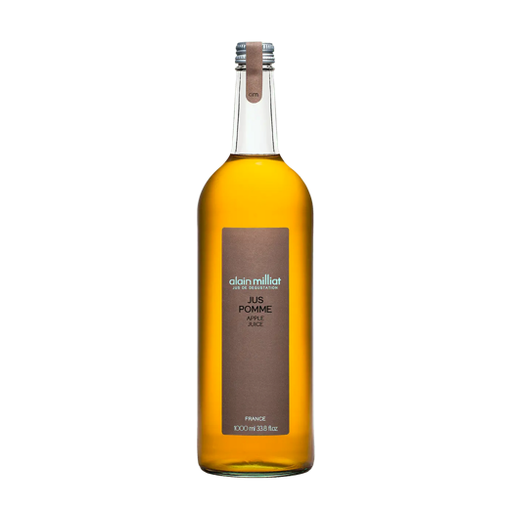 Image unavailable
For a shared-bottle service, compare the stated 1 L volume with how much you serve each day, and check that the recipe meets your no-added-sugar requirement. Plan for chilled storage and a rotation schedule that follows this product’s instruction to consume within three days of opening.
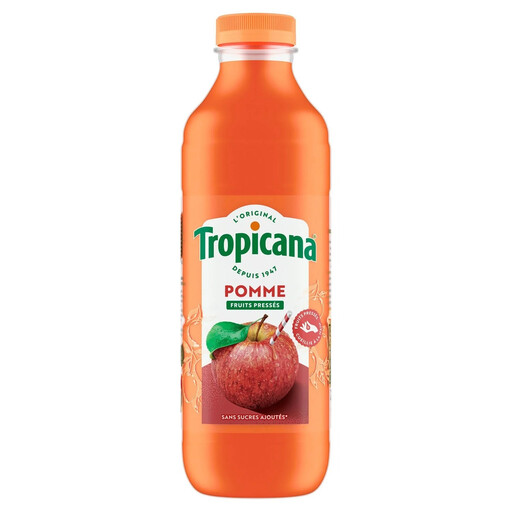 Image unavailable
This 1 L bottle may be suitable if your service can follow the product-specific instructions: store at no more than 7 °C and consume within five days of opening. Check the ingredients and the no-added-sugar information on the packaging you order.
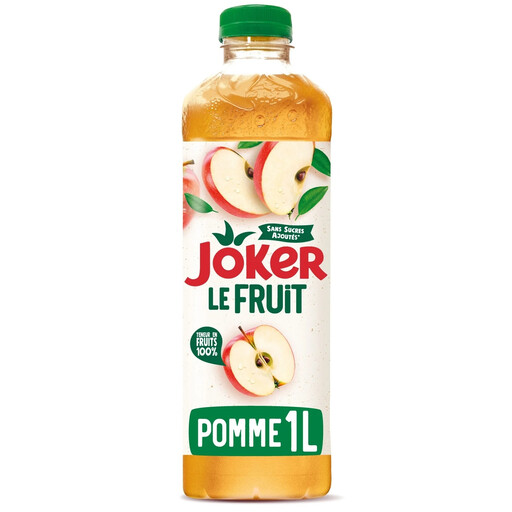 Image unavailable
The 1 L size makes it possible to assess this product for a shared service. The recipe shown combines apple and lemon juices; check the ingredients and storage instructions after opening on the packaging before adding it to your service.
No. It retains the sugars naturally present in apples. The DGCCRF specifies that the claim ‘contains naturally occurring sugars’ is reserved for fruit juices. Check the nutritional information to see the sugars listed per 100 ml.
Not without checking the nectar’s recipe. Check its product description, fruit content and ingredients, then compare them with the requirements for the apple juice.
Start with the product description and ingredients list, then check the net quantity, nutritional information and storage instructions. The DGCCRF identifies the product description and ingredients as essential information on prepacked food labels.
Follow the time and temperature guidance for the bottle you’re using, and don’t assume it applies to another product. For the 1 L Tropicana 100% sweet apple juice featured by Auchan, the instruction is to store it at no more than 7 °C and consume it within five days of opening.
No. Confirm with the supplier the quantities you can order, availability for your establishment and delivery arrangements. This will help you check that your chosen product suits your planned service schedule.