Parents keeping an eye on sugar per carton
You want to know how much sugar is actually being served, without confusing ‘no added sugars’ with ‘sugar-free’. Compare the ‘of which sugars’ figure per 100 ml, then calculate it for the carton’s volume.


For a secondary school pupil’s lunchbox, don’t choose an apple juice based solely on the words ‘no added sugars’: it still contains sugars that occur naturally in fruit. Compare the ‘of which sugars’ figure per 100 ml, then work out the amount in the portion you’re packing. Next, choose between the ingredients in pure juice and those in a nectar, which may contain a different proportion of fruit.
You want to know how much sugar is actually being served, without confusing ‘no added sugars’ with ‘sugar-free’. Compare the ‘of which sugars’ figure per 100 ml, then calculate it for the carton’s volume.
You prefer pure juice or juice from concentrate to nectar, while understanding that this preference doesn’t guarantee a lower sugar content. The product name and ingredients list can help you tell them apart.
You’d rather pop an individual carton into a lunchbox than decant juice from a 1 L bottle. Check the volume of each carton and, if it won’t all be consumed, the storage instructions after opening.
For a secondary school lunchbox, start with the sugar in the portion you’re actually packing, then check the size and ingredients. The words ‘no added sugars’ alone don’t settle the matter.
Worth considering: if sugar per carton matters more to you than the proportion of fruit: Auchan states that its 20 cl organic nectar contains 7.3 g of sugars per 100 ml.
The trade-off: according to its product information, this nectar contains water and at least 75% fruit; it isn’t pure juice.
Worth considering: if you’re looking for a product labelled as pure juice, already packed in cartons: Carrefour Extra is available in a pack of 6 × 20 cl.
Check: Carrefour lists 10 g of carbohydrates per 100 ml for this product. Read the ‘of which sugars’ figure before comparing it with a nectar.
| What to compare | What to check | Who is it for? |
|---|---|---|
| Sugar per portion | Read the ‘of which sugars’ figure per 100 ml and calculate it for the volume you’re packing. ‘No added sugars’ doesn’t mean ‘sugar-free’. | If I’m putting a carton in a school bag, I want to know how much sugar is in that portion, whatever the words on the front say; around 42% of consumers would prioritise this amount. |
| Individual pack size | Check the volume of each carton, the number of cartons and the instructions for after opening. | I prefer a portion that’s ready to pop into a lunchbox rather than a bottle to decant; around 33% of consumers would put this format at the top of their list. |
| Type of recipe | Compare the product name and ingredients and, for nectar, the proportion of fruit stated on the product. | When choosing between pure juice, juice from concentrate and nectar, I want to base my decision on the ingredients first, then look at sugar separately; around 25% of consumers would prioritise this. |
Sugars that occur naturally in fruit are still present in the juice. So the words on the front of the pack don’t tell you how much sugar is in a carton.
Check the ‘of which sugars’ figure and the serving volume. Nor should the term ‘diet’ make you think of this juice as a weight-loss product: Manger Bouger advises against weight-loss diets for children.
A lower sugar content may reflect a different recipe: the Auchan organic apple nectar mentioned here contains water and at least 75% fruit.
Read the product name, ingredients list, stated proportion of fruit and sugars per 100 ml together.
A family-sized bottle needs to be decanted to provide a portion to take with you. Once opened, it should be stored according to the product instructions.
If you want a drink that’s ready to pop into a school bag, look for an individual portion. If you use a bottle, check the instructions on its packaging.
Decanting means you’ll also need a separate container to carry.
Carrefour lists a 1 L bottle of Joker apple juice with no added sugars. You’ll need to decant it for a lunchbox.
The Carrefour Extra product featured here is pure apple juice, packed in cartons of 6 × 20 cl.
Two 20 cl products let you compare apple juice from concentrate with organic nectar that has no added sugars.
E.Leclerc’s range includes several types of apple juice, including larger packs.
This 1 L bottle of apple juice is for families who prepare a portion for a lunchbox themselves, rather than those looking for a carton that’s ready to take with them.
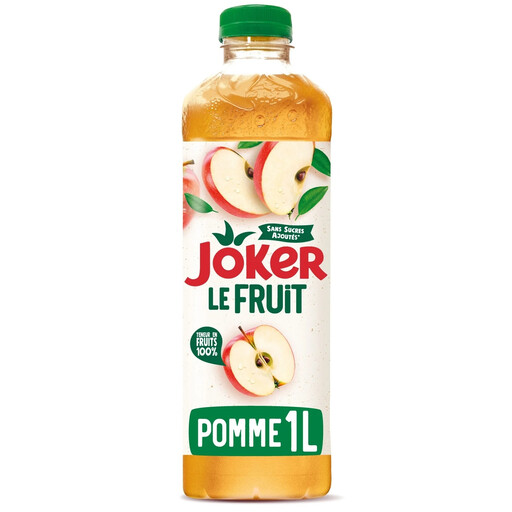 Image unavailable
To prepare a portion to take with you from this 1 L bottle, you’ll need a separate container. Before choosing it, compare the ‘of which sugars’ figure on the packaging and check the storage instructions for after opening.
No. The claim doesn’t remove the sugars that occur naturally in fruit. To find out how much sugar is in the portion for a lunchbox, check the ‘of which sugars’ figure per 100 ml and take the carton or container size into account.
No: the product name alone doesn’t tell you how much sugar it contains. Auchan lists 7.3 g of sugars per 100 ml for its organic apple nectar, while Carrefour lists 10 g of carbohydrates per 100 ml for its Extra pure juice. Check the ‘of which sugars’ figure on each product before comparing the exact sugar content.
A 20 cl carton makes it easy to know how much you’re packing, but juice doesn’t need to be a regular addition to a lunchbox. For children over 11, Manger Bouger recommends limiting fruit juice and other sugary drinks to no more than one glass a day and choosing whole fruit instead.
Follow the instructions for the product you choose, as storage times vary. For the carton juice featured here, Auchan says to keep it in the fridge and drink it within five days of opening, compared with two days for its organic nectar. Check the packaging before preparing a portion to take with you.