To serve apple juice straight from the bottle at the table during a Christmas drinks party, a pure juice in a 75 cl or 1 L glass bottle fits the bill. If you’re mainly looking for a sparkling soft drink, check the details of a specific sparkling product. For a group, choose a size that suits how you plan to serve it, then compare the product description, ingredients and sugar content per 100 ml. A glass bottle isn’t necessarily returnable.
Who is this choice for?
Hosts who want to make a thoughtful impression with a soft drink
You’d like to put apple juice on the Christmas table and serve it in small glasses. A 75 cl or 1 L glass bottle could work well for this; if reusing the bottle matters to you, also look for a deposit scheme or local return option.
Shoppers who pay close attention to ingredients
You want to tell the difference between pure juice, juice from concentrate and nectar. The product description and ingredients list help identify the recipe, while the nutrition information per 100 ml makes it easier to compare sugar content.
Hosts organising drinks for a group
You need to plan the right amount of soft drink for your guests. In that case, the bottle size and number of bottles matter just as much as how they look on the table.
Which criteria should you prioritise?
For a Christmas drinks party, start by thinking about what you want from the drink: a particular recipe, a bottle to show off on the table, a sparkling option or enough to go round. These priorities will help you decide what to check before you buy.
| Criterion |
What to check |
Who it matters to |
| Ingredients and sugars |
Read the product description and ingredients, then check the “of which sugars” figure per 100 ml. The DGCCRF distinguishes between the different descriptions used for juices and nectars, and presents nutrition information for drinks per 100 ml. |
If I want to choose a recipe made from apples, I need to be able to tell it apart from a nectar or juice from concentrate without relying on the packaging image alone. Around 31% of consumers put ingredients and sugar content first. |
| Glass bottle |
Check that the product is described as being in a glass bottle and confirm the size of the specific product you’ve chosen. Check separately for any information about a deposit scheme. |
If I want to put the drink on the table and serve it as it is, the packaging is an important part of my choice. Around 25% of consumers prioritise this presentation. |
| Sparkling drink |
Check that the specific product is sparkling and alcohol-free, then read its description and ingredients. |
If I want to offer a sparkling drink at a drinks party without serving alcohol, I can’t tell what’s in it or how it’s packaged just from the bubbles. Around 25% of consumers prioritise a sparkling option. |
| How much to serve |
Compare the bottle size with the number of guests and the other drinks you plan to serve. |
When I’m hosting several people, I want to have enough juice without cluttering the table with unnecessary bottles. Around 19% of consumers prioritise volume. |
Common mix-ups to avoid
-
Thinking “no added sugars” means “sugar-free”
Apple juice can contain sugars that are naturally present in fruit, even when the packaging says no sugars have been added.
Check the “of which sugars” figure per 100 ml in the nutrition information, and remember to offer water at your drinks party too.
-
Assuming every apple drink is pure juice
Fruit juice, juice from concentrate and nectar are distinct product descriptions, as the DGCCRF explains. An image of an apple isn’t enough to identify what’s in the drink.
Read the product description and ingredients list on the bottle you plan to serve.
-
Assuming every glass bottle is returnable
Reusing bottles requires an organised collection and washing system. The ADEME distinguishes a bottle collected through a deposit scheme from a single-use glass bottle.
Choose glass for its appearance if that’s important to you, but check the return arrangements before counting on being able to reuse it.
Brands to know when comparing products
COEUR DE POM'
Auchan product pages list pure apple juices in 75 cl and 1 L glass bottles.
- Auchan lists, among other products, a 75 cl organic option and a 1 L option whose ingredients list states 100% apples.
- These product pages let you compare sizes and recipes, but don’t tell you how the juices taste compared with others.
AUCHAN BIO
The Auchan product page lists a 1 L glass bottle of organic cloudy pure apple juice.
- The product page specifies the size and type of juice, which is useful when comparing bottles for serving.
- Once opened, follow the storage instructions for the product you’ve bought.
Joker
Joker’s Pure Apple Juice is made in Mâcon. It’s different from the 1 L product shown in the Joybuy selection below.
- Joker says its Pure Apple Juice is made from pressed apples.
- The brand name doesn’t guarantee a glass bottle: check the recipe and packaging of the specific product.
Carrefour
Carrefour’s range includes several types and sizes of apple drinks.
- The range makes it easy to find different sizes to suit the number of guests.
- Check the packaging material on the product page rather than assuming it from the category page.
Marque Repère / E.Leclerc
E.Leclerc product pages include Jafaden pure juice and a 75 cl bottle of Bio Village sparkling alcohol-free apple juice.
- These products let you consider still juice and a sparkling drink separately for your party.
- Bubbles alone don’t tell you what’s in the drink or what the bottle is made from.
Related Joybuy product
This 1 L product is an option for serving apple juice to several guests. It doesn’t meet the glass-bottle presentation criterion, so bear that in mind if the packaging is important for your Christmas table.
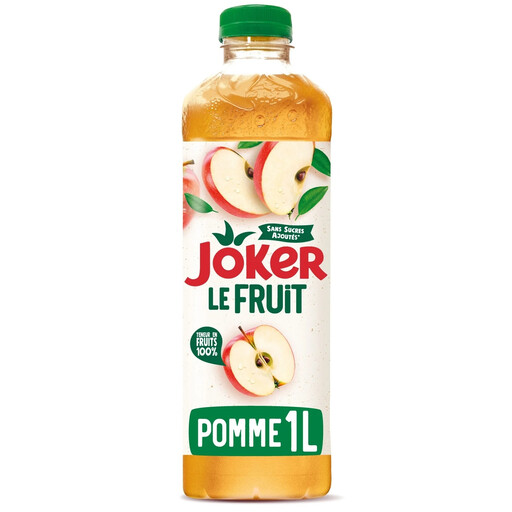 Image unavailable
JOKER apple juice 1 L, “no added sugars” product
The 1 L size could suit you if you’re serving several guests. This product is described as coming in an r-PET bottle, not a glass one. Check its product description and ingredients before choosing it instead of a pure juice. “No added sugars” doesn’t mean “sugar-free”.
Purchase link unavailable
Frequently asked questions
How can I tell pure juice, juice from concentrate and nectar apart?
Read the product description: the DGCCRF distinguishes between these drink categories. Then check the ingredients of the specific product rather than relying on a picture of fruit.
Does “no added sugars” mean sugar-free?
No: the juice may contain sugars that are naturally present in apples. To compare two products, check their “of which sugars” figures per 100 ml in the nutrition information.
What should I do with apple juice after opening?
Follow the instructions on the bottle you’ve chosen. For its 1 L organic cloudy pure juice, Auchan advises keeping it in the fridge after opening and drinking it within five days. Don’t automatically apply this guidance to other products.
Can every glass bottle be reused?
No: reuse requires a collection and washing system, as the ADEME explains. If this matters to you, check whether there’s a deposit scheme or find out about local return arrangements for the bottle in question.


