For an aperitif on the terrace, compare the nutritional values per 100 g when choosing nuts, then decide how much to serve. A no-added-salt option is not automatically lower in calories. The almonds and pistachios mentioned here exceed the threshold for a ‘low energy’ claim. If salt or allergens are also a consideration for your guests, check the relevant information on the packet separately.
Who will find these criteria useful?
Hosts keeping an eye on portion sizes
If the packet stays on the table throughout the aperitif, comparing kcal per 100 g is not enough: pour a measured amount into a bowl too. The almonds and pistachios reviewed do not meet the EU threshold for a ‘low energy’ claim, set at 40 kcal per 100 g for solid foods under the European regulation on nutrition claims.
Guests who prefer to cut down on salt
A plain or no-added-salt option may suit this preference. Manger Bouger recommends choosing unsalted nuts; check the nutritional information for each product to see its salt content.
Shoppers checking ingredients
If you’re sharing food, read the ingredients and allergen information on the packet you choose, including any ‘may contain’ warnings. The DGCCRF reminds shoppers that allergens present in the ingredients of prepacked foods must be clearly indicated.
What should you check before choosing?
When serving nuts with an aperitif, start with your main priority, then check the other details on the label before sharing the packet.
| Priority |
What to check |
Who is it for? |
| Energy content |
The kcal per 100 g for comparable products, and how much you put in the bowl. |
If the aperitif goes on for a while, I’d rather plan what I’m going to serve than leave the packet open; around 42% of consumers put managing their energy intake first. |
| Salt |
The ‘salt’ value per 100 g and whether salt has been added to the ingredients. |
To keep nuts on the aperitif menu while limiting salty foods, I look for a recipe that suits my needs; reducing salt is the priority for around 33% of consumers. |
| Ingredients and allergens |
The ingredients list, highlighted allergens and any ‘may contain’ warnings on the packet. |
If I’m sharing the packet with guests who have an allergy, the ingredients determine my choice before anything else; around 25% of consumers prioritise ingredients and allergens. |
Common misunderstandings to avoid
-
Assuming ‘no added salt’ means ‘low in calories’
The no-added-salt almonds featured by Carrefour and Auchan contain between 628 and 640 kcal per 100 g, depending on the product. Under the European regulation on nutrition claims, the ‘low energy’ claim is reserved for solid foods containing no more than 40 kcal per 100 g.
Use the salt claim to understand the salt content, then compare kcal per 100 g and the portion you plan to serve separately.
-
Looking only at calories per 100 g
The salted roasted pistachios featured by Carrefour Traiteur contain 590 kcal and 1.5 g of salt per 100 g. Their energy content alone therefore does not make them a good choice if your priority is to reduce salt.
Consider the energy, salt and the amount you plan to serve together.
-
Ignoring ‘may contain’ warnings because the recipe is simple
A product made mainly from almonds may also carry a warning that it may contain traces of other allergens. These warnings vary from product to product.
If a guest has an allergy, check the information on the specific packet you plan to serve.
-
Planning to buy a specific product without checking where it’s available
For its TOKAPI almonds, E.Leclerc advises shoppers to check availability at their chosen store or Drive location.
Check that the product is available at the collection point or through the delivery option you plan to use.
Brands to explore
Carrefour Original
The Carrefour Original product reviewed is a 200 g packet of roasted almonds with no added salt.
- Carrefour lists 628 kcal per 100 g for this product.
- The product information warns that it may contain traces of peanuts and other nuts.
Auchan
The product reviewed is a 200 g packet of roasted almonds with no added salt.
- Auchan lists almonds as the ingredient, less than 0.01 g of salt and 640 kcal per 100 g.
- Check the packet for ‘may contain’ warnings if they’re relevant to your guests.
Daco Bello
The product featured by Carrefour consists of shelled roasted almonds with no added salt.
- It’s an option if you’re looking for roasted almonds without added salt.
- Carrefour lists 629 kcal per 100 g: no added salt does not resolve the question of portion size.
Seeberger
The product reviewed consists of unsalted roasted almonds.
- The product information lists 0.02 g of salt per 100 g.
- Carrefour lists 653 kcal per 100 g for this product; compare energy content separately from salt.
TOKAPI
The product featured by E.Leclerc is a 200 g packet of unroasted almonds with no added salt.
- E.Leclerc lists shelled almonds as the ingredient, with 617 kcal and 0 g of salt per 100 g.
- Check availability at your chosen store or Drive location.
An option on Joybuy
For a change from the usual snacks on the terrace, this Joybuy selection features chestnuts in a packet. Compare their label with those of almonds and pistachios if you’re choosing based on energy, salt or allergens.
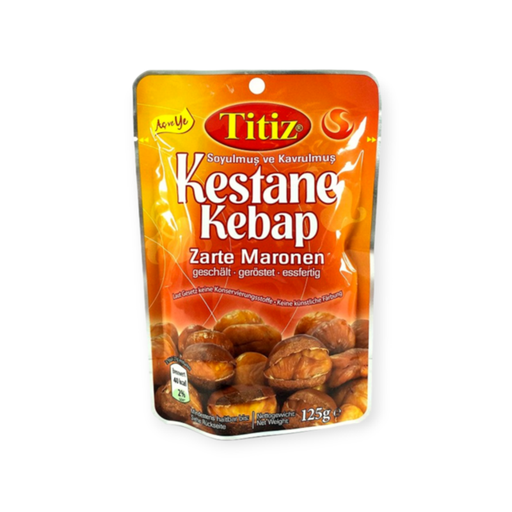 Image unavailable
Titiz Cooked Nuts Natura 125 g
To serve chestnuts with an aperitif, pour a measured amount into a bowl rather than leaving the packet on the table.
125 g pack. Before sharing, read the nutritional information and allergen details on the packaging.
View on Joybuy
Frequently asked questions
Are almonds and pistachios served with aperitifs ‘low in calories’?
Not the products mentioned here: Carrefour, Auchan and E.Leclerc list between 590 and 653 kcal per 100 g, depending on the product. For solid foods, the European regulation on nutrition claims sets the threshold for a ‘low energy’ claim at no more than 40 kcal per 100 g.
Are almonds with no added salt lower in calories?
Not necessarily: ‘no added salt’ describes the recipe, not its energy content. The no-added-salt almonds featured by Carrefour and Auchan contain between 628 and 640 kcal per 100 g, depending on the product; check the ‘energy’ and ‘salt’ values separately.
What should you check before serving nuts to someone with an allergy?
Check the ingredients, highlighted allergens and any ‘may contain’ warnings on the packet you’ve bought. The DGCCRF states that allergens present in the ingredients of prepacked foods must be highlighted; any ‘may contain’ warnings vary from product to product.
How should you store an opened packet of almonds?
Follow the storage instructions for the product you’ve bought. For its roasted almonds with no added salt, Auchan advises resealing the packet airtight and consuming the contents within 15 days of opening.


