
Livraison le jour même ou le lendemain

Qualité garantie

Débloquez vos offres de bienvenue: Livraison GRATUITE | Jusqu'à -80 % | 30 jours d'essai gratuits à JoyPlus
Téléchargez l'application
Choosing an Anycubic 3D printer resin can quickly become overwhelming given the vast selection. Between standard resins, water-washable ones, and technical versions like ABS-Like, it's easy to get lost. Each type of resin has its own specific properties that determine the quality, durability, and ease of post-processing for your prints.
As a product expert at Joybuy, I'm here to help you make sense of it all. This guide breaks down the different Anycubic resin ranges to help you choose the most suitable material for your projects, whether you're a figurine creator, a prototyping engineer, or a passionate maker.
Before diving into our selection, here are a few key points to consider to guide your decision.
The vast majority of consumer LCD 3D printers, including the famous Anycubic Photon series, use a UV light source to cure the resin. The market standard for this process is a wavelength of 405?nm. The good news is that all Anycubic resins are formulated for this wavelength, ensuring near-universal compatibility. Checking this specification is still a good practice, especially if you own hardware from another brand.
Post-processing is a mandatory step in resin 3D printing. On this point, the choice of resin is crucial:
The final application of your part dictates the required mechanical properties:
We have selected three flagship Anycubic resins for you, each meeting a specific need, from creative hobbies to the most technical applications.

Why It Stands Out
Anycubic Standard Resin is the gold standard for most users. It offers an ideal balance between printing speed, detail accuracy, and ease of use. Its formulation is optimised to work reliably on a wide range of LCD printers, making it a reliable choice for getting started.
Key Features
Who Is It For??
Ideal for beginners and hobbyists printing figurines, architectural models, or visual prototypes that won't be subjected to high mechanical stress. It's the best value for versatile use.

Why It Stands Out
This resin's main advantage is its simple post-processing. Being able to clean your prints with just water is a game-changer, especially for those working in a small space or wanting to avoid solvents. Its low odour also makes it much more pleasant to use on a daily basis.
Key Features
Who Is It For??
Perfect for users working at home, in schools, or in offices. It's suitable for makers who prioritise convenience and a healthier work environment, without sacrificing fine detail on their models.
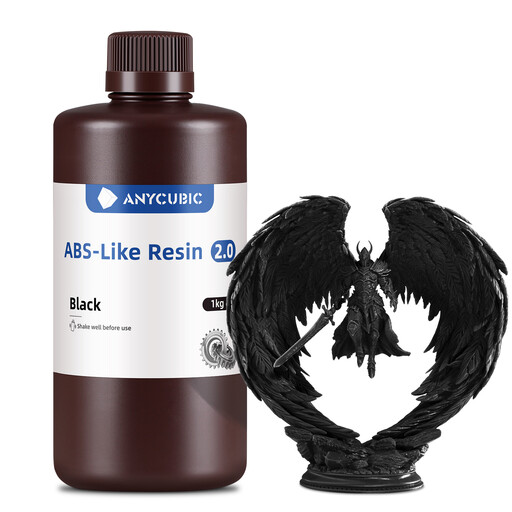
Why It Stands Out
The key word here is toughness. ABS-Like resin offers far superior toughness and impact resistance compared to a standard resin. It is less brittle and can withstand mechanical stress, making it a natural choice for creating functional parts.
Key Features
Who Is It For??
Aimed at engineers, designers, and advanced makers who need to create functional prototypes, jigs, fixtures, or end-use parts that need to be durable and strong.
The resins we've just covered cater to the most common uses, often in grey, black, or white. But if your project calls for a splash of colour, you should know that the range of possibilities is immense.
Discover our full range of coloured resin to bring your most creative projects to life.
The Anycubic Photon resin settings (layer exposure time, bottom layer exposure time, etc.) vary depending on the exact model of your printer and the type of resin used. Anycubic provides official settings charts for each machine/resin combination. You can usually find this information directly on the product pages or on the manufacturer's website. We recommend starting with these reference values and then fine-tuning them with calibration tests to achieve a perfect result.
Safety is not an option when handling resin. Here are the golden rules to follow:
This is a very bad idea. It is strongly advised not to mix resins of different types (e.g., a standard resin with a water-washable or ABS-Like resin). Each formula has its own unique chemistry and curing properties. Such a mixture would almost certainly lead to failed prints, unpredictable mechanical properties, and incomplete curing. For reliable and repeatable results, stick to a single resin per print.