
Livraison le jour même ou le lendemain

Qualité garantie

Débloquez vos offres de bienvenue: Livraison GRATUITE | Jusqu'à -80 % | 30 jours d'essai gratuits à JoyPlus
Téléchargez l'application
Choosing a resin for your 3D printer can quickly become a daunting task given the overwhelming number of options. Ultra-detailed miniatures, functional prototypes, or simple prints for fun?: every project has its own requirements, and therefore, its own resin.
As the Head of Product Recommendations at Joybuy, I'm here to guide you. This guide breaks down the different types of Anycubic 3D printer resin and helps you find the perfect material for your projects, without the unnecessary marketing jargon.
Before diving into our selection, let's review the key criteria that will guide your choice. There are three key points to consider to find the ideal resin for your project and work environment.
What will your print be used for? This is the first and most important question to ask.
Post-processing is a mandatory step in resin 3D printing. The choice of material can greatly simplify this process.
Most resins on the market are photopolymer resins designed to cure under a specific wavelength of light. Anycubic resins are optimized for a 405?nm (UV) wavelength, ensuring perfect compatibility with the brand's entire printer lineup (like the Anycubic Photon series) as well as with the majority of LCD/DLP 3D printers on the market.
To maximize your chances of success, always refer to the print settings recommended by the manufacturer for each resin/printer combination. These settings are often provided on the bottle or on the manufacturer's website in a chart format. Most resins are sold in 1?kg bottles, a convenient size for tackling multiple projects.
Here is our selection of three essential Anycubic resins that cover most needs, from beginners to advanced users.

Key Feature?: This resin shines with its ease of use. Cleaning with plain water makes post-processing simpler, safer, and more cost-effective. Its low-odour formula and low viscosity ensure a more pleasant working environment and faster prints.
Advantages:
Who is it for? Ideal for beginners, hobbyists, and anyone looking to simplify their post-processing workflow. It is perfectly suited for printing models and miniatures in an apartment or a poorly ventilated workshop.
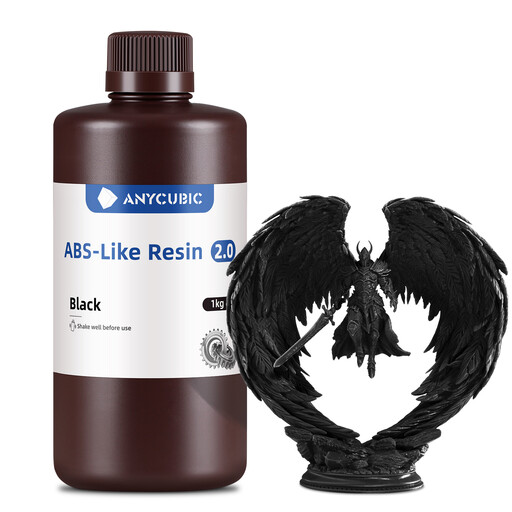
Key Feature?: ABS-Like Resin 2.0 is engineered for toughness. Its impact resistance and toughness are far superior to those of standard resins. According to the manufacturer's data, its Izod impact strength reaches 109?J/m. This allows you to create functional parts that can be drilled, tapped, and assembled without fear of breakage.
Advantages:
Who is it for? For engineers, designers, and makers who need to prototype mechanical parts or create durable objects. It's the logical choice for projects that demand strong mechanical performance.
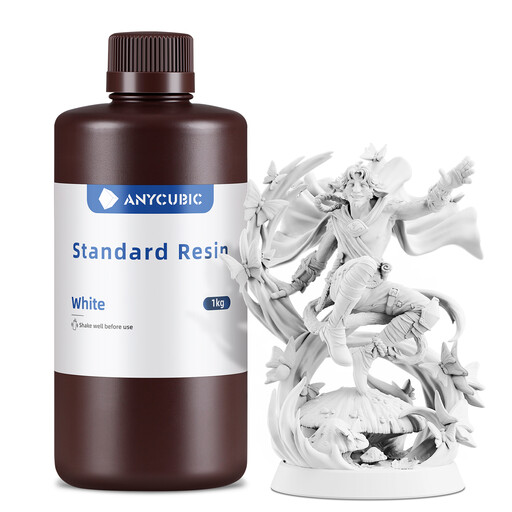
Key Feature?: This is the quintessential versatile and reliable resin. It offers an excellent balance between printing speed, precision, and cost. Its formula ensures good bed adhesion and faithful detail reproduction. A dependable choice for everyday printing.
Advantages:
Who is it for? Perfect for users of all levels looking for a "do-it-all" resin. Whether you're printing miniatures, board game pieces, or decorative objects, it delivers excellent results without requiring deep technical knowledge.
The Anycubic range is much more extensive and includes resins with even more specific properties, such as flexible resins, high-toughness resins (ABS-Like Pro), or resins optimized for the dental sector. If our selection doesn't precisely meet your needs, know that other solutions are available.
Explore our full catalogue to find the material that will bring your creations to life.
? Explore our full range of resin supplies
All printers in the Anycubic Photon series are designed to work with UV resins that cure at 405?nm. Therefore, the entire Anycubic resin range is compatible. We recommend using the brand's own resins with their printers: the print profiles are already optimized, which greatly simplifies setup and maximizes the success rate on the very first try.
The term "water-washable" refers only to the cleaning method. Be careful: the rinse water, which is contaminated with uncured resin, must never be poured down the drain. It is imperative to treat this wastewater: let it settle, then expose it to sunlight or a UV source to fully cure (polymerize) the resin. Once solidified, the resin can be disposed of with regular plastic waste.
For maximum precision, several factors must be controlled: