
Livraison le jour même ou le lendemain

Qualité garantie

Débloquez vos offres de bienvenue: Livraison GRATUITE | Jusqu'à -80 % | 30 jours d'essai gratuits à JoyPlus
Téléchargez l'application
Choosing a resin for your 3D printer can quickly become a daunting task given the vast number of options. Ultra-detailed miniatures, functional prototypes, mechanical parts… every project has its own requirements for precision, strength, and ease of use.
Our mission: to help you make sense of it all. This guide breaks down the different ranges of Anycubic 3D printer resin so you can choose the perfect material for your needs, without getting lost in technical jargon.
Before making a decision, keep these key points in mind—they will make all the difference in the quality of your prints.
The final application of your part is the number one criterion.
Not all resins are created equal. Most LCD/DLP printers work with a 405nm UV resin, which ensures very broad compatibility. Other properties are worth paying close attention to:
For perfect results right from the start, be sure to consult the Anycubic resin settings charts provided by the manufacturer. Available on the product pages, they specify the exposure times per layer, lift height, and other essential settings to avoid print failures.
Here are three essential Anycubic resins, each designed for a specific use. They are most often sold in a 1 kg bottle, a convenient size for tackling multiple projects.
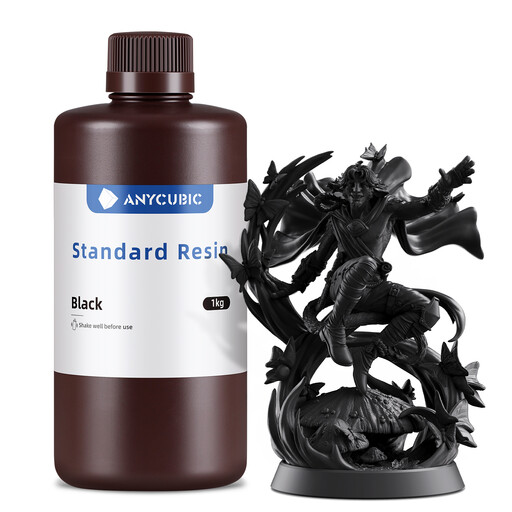
What sets it apart: This is the quintessential all-purpose resin. It offers a perfect balance between speed, detail accuracy, and reliability. Its formula ensures excellent bed adhesion while allowing for easy part removal once the print is finished.
Advantages:
Who is it for? For creators, hobbyists, and professionals looking for a reliable and cost-effective resin for everyday use. It's the ideal choice for beginners or for projects without special mechanical requirements.
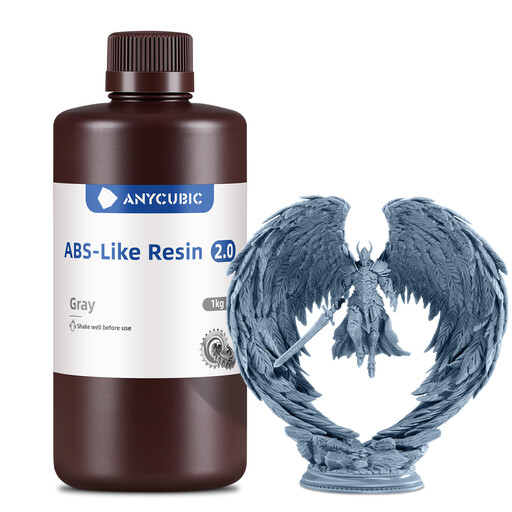
What sets it apart: Designed to mimic the mechanical properties of ABS plastic, this resin is much tougher and more impact-resistant than a standard resin. As a result, it is far less brittle and can even be carefully drilled or tapped.
Advantages:
Who is it for? For engineers, designers, and makers who create functional prototypes, assembly parts, or durable objects. If your standard resin prints are too brittle, switch to ABS-like: it's the solution.

What sets it apart: Its key feature? Incredibly simple post-processing. No more dealing with flammable and costly isopropyl alcohol: parts clean up simply with tap water. Its low viscosity is also a bonus, speeding up prints and cleanup.
Advantages:
Who is it for? For those who print at home, in a poorly ventilated space, or simply for anyone who wants quick, hassle-free cleanup. The choice for convenience, without sacrificing quality.
The Anycubic range is extensive and constantly expanding. If the resins in our selection don't perfectly match your project, or if you want to explore other brands and materials, feel free to browse our full catalog.
Discover our complete range of liquid resins to find the perfect material for every project.
For miniatures, Anycubic Standard Resin is an excellent starting point thanks to its high precision and smooth finish. Water-Washable Resin is also a great option: it offers similar detail quality with the advantage of much simpler cleanup, especially for small, complex parts.
The easiest and most reliable way is to consult the official Anycubic settings charts. You can find them on the product pages or on the manufacturer's website. They provide an excellent starting point, which you can then fine-tune with calibration prints (like the "R.E.R.F." test or other dedicated models).
Yes, absolutely. Nearly all 3D printers (LCD, DLP, SLA) on the market use a 405nm UV light source. Since Anycubic resins are designed for this wavelength (405nm UV resin), they are compatible with most machines from other brands (Elegoo, Creality, Phrozen, etc.). You'll just need to adjust the exposure times for your printer, starting with the recommended settings for a standard resin of a similar color.