
Livraison le jour même ou le lendemain

Qualité garantie

Débloquez vos offres de bienvenue: Livraison GRATUITE | Jusqu'à -80 % | 30 jours d'essai gratuits à JoyPlus
Téléchargez l'application
Choosing the right 3D printer resin can quickly become a daunting task given the vast selection available. Between Standard Resin for fine details, Water-Washable Resin for ease of use, and ABS-Like Resin for its toughness, finding the right material for your project is crucial. This guide breaks down the differences between the main Anycubic resin lines to help you make the right choice for your 3D prints, whether you're creating miniatures, prototypes, or functional parts.
Before diving into our top picks, let's review the key factors that should guide your decision.
What will your print be used for?? This is the first and most important question to ask.
Most LCD/DLP 3D printers, including the Anycubic Photon series, use a UV resin that cures at a 405nm wavelength. All Anycubic resins are designed for this standard, ensuring broad compatibility. However, each resin type has its own viscosity and reactivity characteristics. Therefore, be sure to check and adjust the Anycubic resin settings in your slicer software to achieve optimal results. The product data sheets usually provide recommended settings for different printer models.
Most resins are sold in 1?kg bottles, a cost-effective and practical size for the majority of projects. A simple but essential tip?: shake the bottle well before each use to homogenise the pigments and components. This is the secret to consistent print quality.
Here are three must-have options from the Anycubic range, each tailored to specific needs, from hobbyists to professionals.
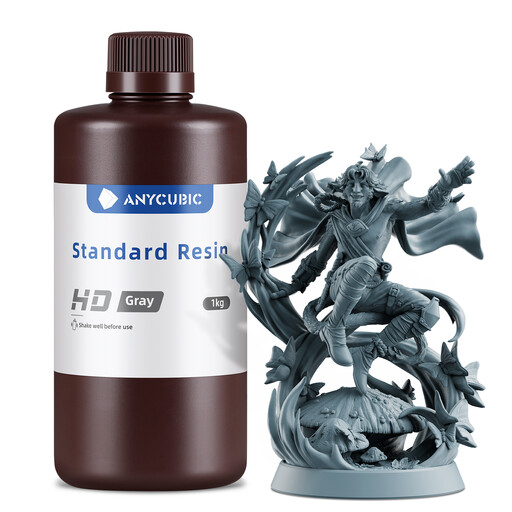
The Reliable Choice for Detail
This is the brand's classic: a versatile and reliable resin known for its ability to produce highly precise models with a flawless surface finish. It offers an excellent balance between printing speed and detail quality.
Highlights?:
Who is it for?? For hobbyists, model makers, and creators looking for a reliable material for primarily aesthetic prints with no special mechanical requirements.

Simplicity Above All
Its key advantage?: incredibly simple post-processing. No more need for isopropyl alcohol; parts can be cleaned directly with water. Anycubic also touts an improved 2.0 formula for reduced odour and viscosity.
Highlights?:
Who is it for?? For beginners, those who print at home, or anyone who wants simpler, faster post-processing with fewer chemicals.
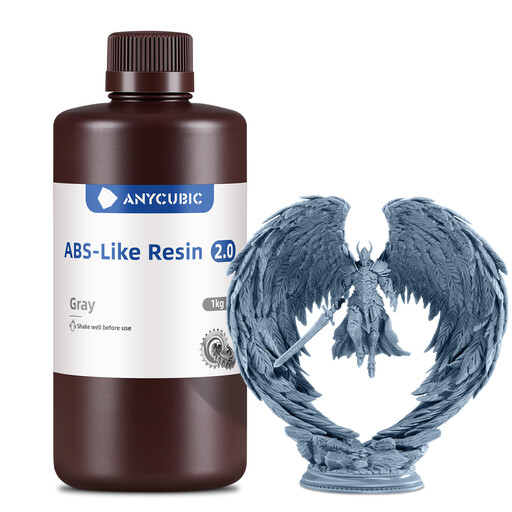
Toughness for Functional Parts
Here, it's all about strength. As its name suggests, this resin mimics the mechanical properties of ABS plastic, offering high toughness against bending and impacts. Less brittle than standard resins, it is perfect for parts that will be handled or assembled.
Highlights?:
Who is it for?? Essential for engineers, designers, and makers creating functional prototypes, enclosures, assembly parts, or any object that requires excellent durability.
The world of 3D printing resins is vast and constantly evolving. If our selection doesn't check all the boxes for your project, or if you're looking for specific colours, transparent effects, or even more technical materials, many other options are available.
To discover a wider range, feel free to explore our complete category of 3D printer consumables.
An unopened bottle of resin generally has a shelf life of one to two years. It's best to check the expiration date on the packaging. To preserve all its properties, store it in a cool place, away from direct sunlight.
This is strongly discouraged. Mixing different types of resins (e.g., Standard with ABS-Like) is a bad idea because their chemical compositions and curing times are not compatible. The result?? Failed prints, unpredictable mechanical properties, and a disappointing finish. Always use one type of resin per print.
No. The optimal Anycubic resin settings (layer exposure time, bottom layer exposure time, etc.) depend on your 3D printer model, its light source, and even the ambient temperature. Anycubic provides charts with recommended settings for its Photon printer series?: this is an excellent starting point, but fine-tuning is often necessary to achieve perfection.