
Livraison le jour même ou le lendemain

Qualité garantie

Débloquez vos offres de bienvenue: Livraison GRATUITE | Jusqu'à -80 % | 30 jours d'essai gratuits à JoyPlus
Téléchargez l'application
There's nothing more frustrating than a 3D print failing halfway through due to poor-quality filament. Clogged nozzles (clogging), poor layer adhesion, a disappointing finish... a promising project can quickly turn into a nightmare and a waste of material. That's why choosing the right 3D printer filament spool is a critical step.
This guide breaks down the essential criteria for selecting the Anycubic PLA filament that won't let you down. As product experts at Joybuy, our mission is to give you the keys to finding the perfect consumable for your needs, whether you're a seasoned maker or a complete beginner.
Before you check out, a few technical specifications deserve close attention. They are your guarantee of smooth printing and results that live up to your expectations.
Nearly all consumer-grade 3D printers, including Anycubic models, use 1.75 mm PLA filament. But what truly sets a good filament apart is its consistency. A very tight dimensional tolerance, around ±0.02 mm, ensures a perfectly constant flow of material through the extruder and nozzle. Too much variation can cause under-extrusion (not enough material), over-extrusion, and in the worst-case scenario, the dreaded nozzle clog.
PLA (Polylactic Acid) is a favourite among makers for its incredible ease of printing. It doesn't require a high-temperature heated bed and is not very prone to warping. Another major advantage is its low odour during printing, which makes it much more pleasant to use in an office or living space (provided, of course, that you ensure good ventilation). An easy-to-print PLA filament like the one from the Anycubic Basic line is ideal for getting started with 3D printing.
It may seem trivial, but the winding quality of a 1 kg PLA spool is crucial. A poorly wound filament will eventually create tangles, blocking the printer's feed and ruining your print while you're away. Anycubic filaments are known for their impeccable mechanical winding, which guarantees a continuous, snag-free feed from the first to the last metre of the spool.
Here are a few recommended options from the PLA Basic range, a proven choice for its reliability and versatility.
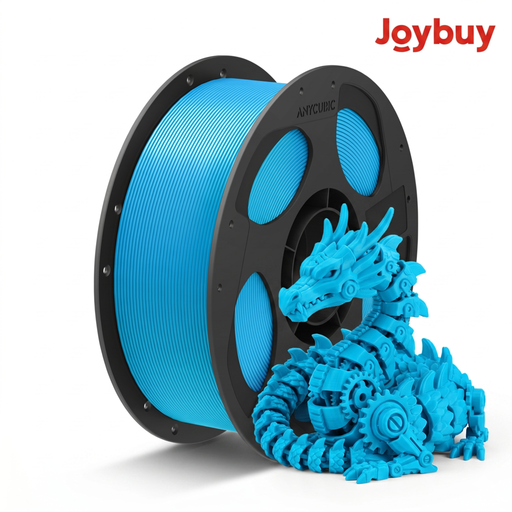
Why we love it: This filament stands out with its vibrant and uniform colour, perfect for decorative pieces or creations that need to be eye-catching. Its formula is optimised for stable, bubble-free extrusion, ensuring a smooth surface and precise details.
Advantages:
Who is it for? Ideal for makers and creatives who produce toys, decorative objects, or prototypes where colour plays a key role. Its ease of use also makes it very accessible for beginners.
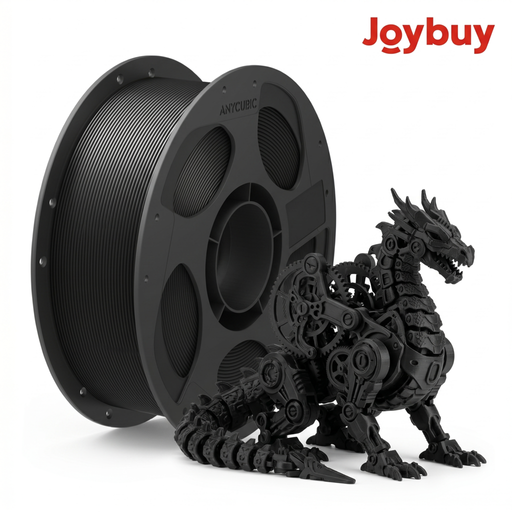
Why we love it: Black is a staple for prototyping and functional parts. This 3D printer filament offers perfect opacity and a matte finish that subtly hides layer lines for a more professional look.
Advantages:
Who is it for? The top choice for professionals, engineers, and experienced makers who need a reliable filament for functional parts, electronic enclosures, or prototypes that will be handled frequently.
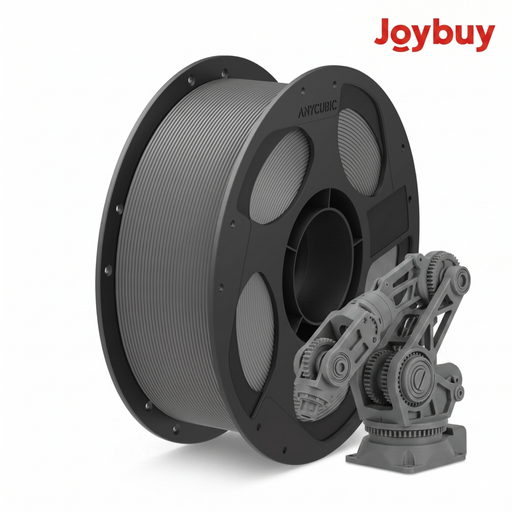
Why we love it: Grey is the quintessential prototyping colour. Its neutral tone perfectly highlights the shapes, details, and any potential surface flaws of a model. The Anycubic Basic PLA in grey offers a very clean finish and great printability.
Advantages:
Who is it for? A must-have for designers, architects, and students printing mock-ups and visual prototypes. It's a foundational colour to have in any workshop.
If classic colours are no longer enough for your creative ambitions, a myriad of specialty filaments await you. Silk effects, glow-in-the-dark materials, colour-changing filaments... the possibilities are endless for giving your projects a truly unique touch.
? Discover our selection of specialty filaments, like this glow-in-the-dark rainbow filament, for even more original creations.
The recommended temperature range for Anycubic's Basic PLA filament is generally between 190°C and 230°C for the nozzle. For the heated bed, a temperature of 55°C to 60°C is usually sufficient to ensure good adhesion. We recommend always printing a temperature tower first to find the optimal setting for your machine.
Yes, and it's highly recommended for achieving the best performance. PLA is a hygroscopic material, meaning it naturally absorbs moisture from the air. Wet filament can cause bubbles, sizzling sounds during extrusion, and a poor surface finish. The manufacturer recommends drying it at 45-50°C for 6 to 8 hours. Remember to always store your spools in an airtight bag with a desiccant packet.
Absolutely. With its standard 1.75 mm diameter, Anycubic PLA filament is compatible with the vast majority of FDM (Fused Deposition Modeling) 3D printers on the market, not just Anycubic machines. As long as your printer accepts 1.75 mm filament, you shouldn't have any issues.