
Livraison le jour même ou le lendemain

Qualité garantie

Débloquez vos offres de bienvenue: Livraison GRATUITE | Jusqu'à -80 % | 30 jours d'essai gratuits à JoyPlus
Téléchargez l'application
Choosing a new spool of filament for your 3D printer can quickly become a headache. Faced with an avalanche of options, the risk of making the wrong choice is high. The result? Failed prints, wasted time, and squandered plastic. A poor-quality filament, or one ill-suited for your project, can turn the promise of an exciting creation into a nightmare.
This guide breaks down the key points for choosing the right Anycubic filament and helps you avoid the two most common mistakes:
To ensure the quality and reliability of your creations, two technical parameters deserve your full attention. They are the foundation of a seamless 3D printing experience.
The number one technical criterion is the filament's dimensional tolerance. For a 1.75mm PLA filament or 1.75mm PETG, a tolerance of ±0.02mm is a hallmark of high quality.
In practical terms, this means the filament's diameter remains constant along the entire length of the spool. This regularity ensures a stable flow of material through the nozzle, which prevents the dreaded problems of under-extrusion (not enough material) or over-extrusion (too much material). A high-precision filament is simply essential for achieving uniform layers and crisp details.
The type of 3D printing material determines the properties of the final object. Anycubic primarily offers two types of filaments for FDM printers: PLA and PETG.
PLA (Polylactic Acid): This is the go-to material for beginners and for decorative prints. Anycubic PLA is valued for its ease of use, low risk of warping, and discreet odour. It is perfect for prototypes, figurines, and objects that will not be subjected to high mechanical or thermal stress. A 1kg PLA spool is the standard format for most projects.
PETG (Polyethylene Terephthalate Glycol): If your project demands durability, Anycubic PETG filament is the obvious choice. This durable 3D filament offers better resistance to impact, heat, and certain chemicals than PLA. It is therefore recommended for creating functional parts, electronic enclosures, or components intended for outdoor use. However, printing with it requires higher temperatures and a well-calibrated heated bed.
To help you make a clear choice, here are a few options from the Anycubic range tailored to specific needs.
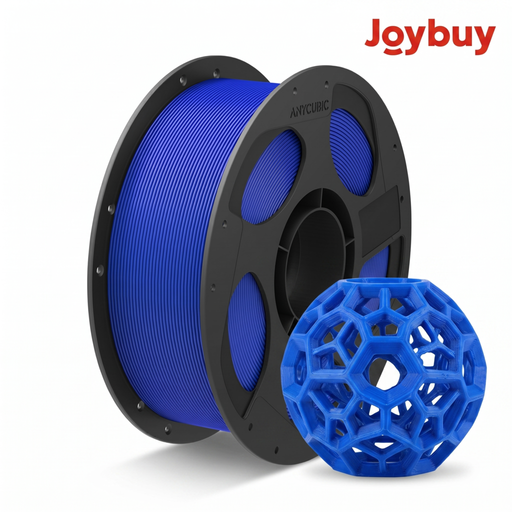
Why this choice: PLA is the easiest material to start with in 3D printing. It forgives minor setting errors and doesn't require a closed enclosure, making it compatible with the vast majority of 3D printers on the market.
Its strict dimensional tolerance of ±0.02mm prevents nozzle clogs, one of the most common and frustrating problems for beginners.
Easy to print with low warping, ensuring a high success rate for your first creations.
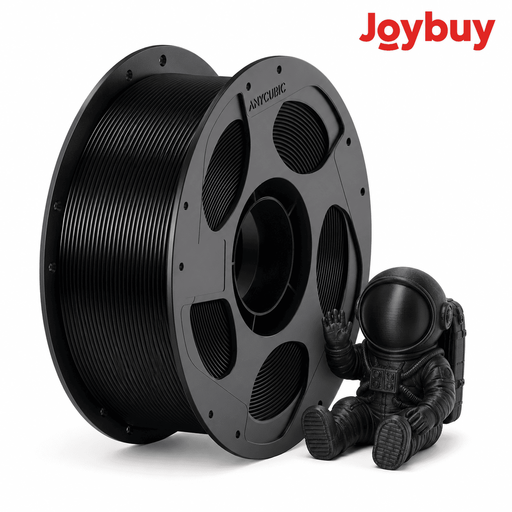
Why this choice: To create parts that need to withstand mechanical stress, heat, or moisture, PETG is the right material for the job. It is often used for brackets, gears, or protective cases.
It meets the need for durability where PLA would fail, preventing the disappointment of a part that breaks or deforms with use.
High impact resistance and good temperature stability, making it a functional and durable material.
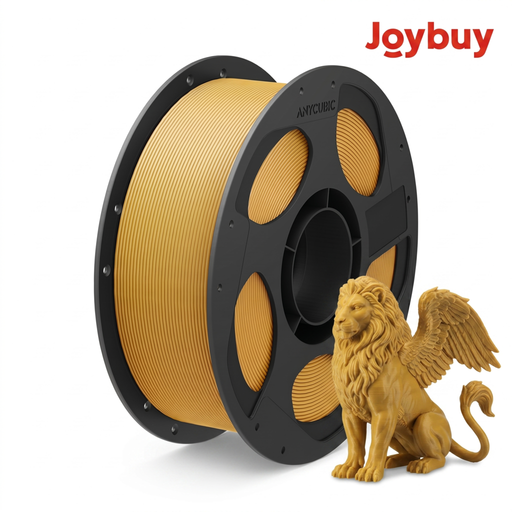
Why this choice: For projects where aesthetics are paramount, the quality and vibrancy of the **coloured 3D filament** are essential. This PLA offers a smooth finish and a vibrant look, ideal for decorative objects, jewellery, or display models.
The Anycubic range is known for its colour consistency between batches, avoiding shade variations in a multi-part project.
Rich colour rendering and a quality surface finish, combined with the printing ease of PLA.
Whether for your printer or your 3D pen, we've compiled a selection of products that meet our quality criteria.
The difference mainly comes down to their mechanical and thermal properties. PLA is more rigid but more brittle, and it deforms at low temperatures (around 60°C). It is very easy to print. PETG is more flexible, much more impact-resistant, and can withstand higher temperatures (around 80°C). It is also more resistant to water and chemicals, but printing it requires a bit more fine-tuning (higher temperature, controlled ventilation).
Filaments, especially PETG, are hygroscopic, meaning they absorb moisture from the air. A wet filament results in poor print quality (bubbles, rough surface, poor layer adhesion). Store your spools in an airtight container with desiccant packets (silica gel) to keep them dry. If a filament has absorbed moisture, it can be dried in a suitable oven or a dedicated filament dryer before use.
Yes, Anycubic filaments with a 1.75mm diameter are designed to be compatible with almost all FDM (Fused Deposition Modeling) 3D printers on the market that accept this standard, whether they are from Anycubic, Creality, Prusa, or others. Simply verify that your printer uses 1.75mm filament and not 2.85mm. Also, remember to adhere to the printing temperature ranges recommended by the filament manufacturer.