
Livraison le jour même ou le lendemain

Qualité garantie

Débloquez vos offres de bienvenue: Livraison GRATUITE | Jusqu'à -80 % | 30 jours d'essai gratuits à JoyPlus
Téléchargez l'application
My position as a Product Specialist at Joybuy gives me a unique perspective on feedback from 3D printer users. The conclusion is clear: the quality of a 3D print depends as much on the filament as it does on the printer. A multi-hour print ruined by a low-quality filament? It's a classic scenario. This guide is here to help you navigate the complex world of Anycubic filaments and other 3D printing materials, and most importantly, to avoid common rookie mistakes.
Choosing the wrong filament happens more often than you'd think. Here are the three most common pitfalls that lead to disappointment:
To avoid these traps, rely on objective technical data, not marketing slogans.
The consistency of your filament's diameter is absolutely crucial. For a 1.75 mm PLA filament, the current standard, a tolerance of ±0.02 mm is a true hallmark of quality. This precision ensures a smooth and steady extrusion, which translates to uniform layers and a near-zero risk of clogging. It's the essential starting point for a high-precision filament and professional-grade results.
The choice of material depends entirely on your project. There is no one-size-fits-all solution, just the right tool for the right job.
To keep it simple, here are our filament suggestions based on your needs.
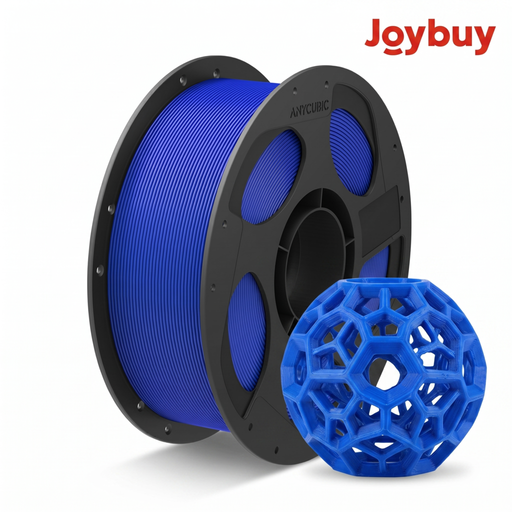
Why we recommend it: Ideal for getting started or for creative projects without high mechanical stress. Its ease of use, low odour, and broad compatibility make it a safe bet for prototypes, figurines, and decorative objects.
With its ±0.02 mm tolerance, it ends the nightmare of clogged nozzles caused by irregular filament. Its neat winding also prevents tangles.
Peace of mind. It's a reliable filament that lets you focus on your creations, not on machine maintenance.
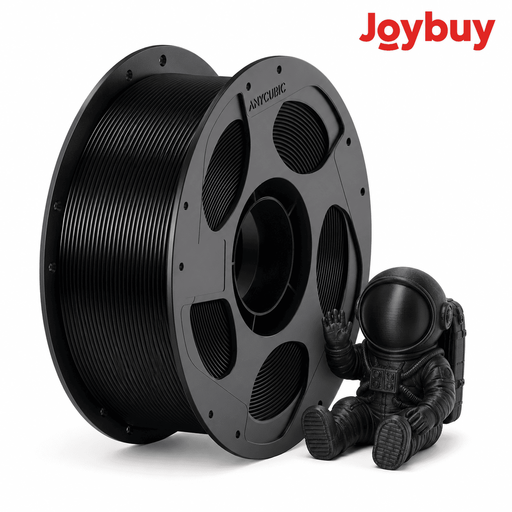
Why we recommend it: For makers looking to create truly robust parts. PETG offers much better resistance to impact, temperature, and chemicals than PLA, making it perfect for mechanical parts, jigs, or protective enclosures.
It helps you avoid the classic mistake: using a material that is too brittle for a functional part. Choosing PETG ensures that your creation will get the job done and stand the test of time.
Durability. PETG parts are much stronger and more resilient than those made from PLA, capable of withstanding high mechanical and thermal stress.

Why we recommend it: A must-have for resin 3D printer owners, it's formulated for models requiring surgical precision and good toughness. Perfect for figurines, jewellery prototypes, or detailed model parts.
Its low shrinkage formula tackles the warping problem that affects low-quality resins. The result: perfect fidelity between the final part and your 3D model.
The best of both worlds: extreme precision and enhanced toughness. The resulting parts are smooth and far less brittle than with a standard resin.
Explore our complete selection of consumables that meet our strictest criteria for quality and reliability.
Moisture: that's the number one enemy of PLA and PETG. A damp filament guarantees failed prints (bubbles, grainy surface, poor layer adhesion). The best practice: always store it in an airtight bag with silica gel packets (desiccant) when not in use.
PLA is indeed a bioplastic, derived from renewable resources like corn starch. However, be careful with this claim: it is only biodegradable under very specific industrial composting conditions (high temperature), which are impossible to replicate at home. In nature or your home compost, it will take as long to degrade as a conventional plastic. The best course of action is therefore to dispose of it in the appropriate recycling bin, according to your local guidelines.
In short: