
Livraison le jour même ou le lendemain

Qualité garantie

Débloquez vos offres de bienvenue: Livraison GRATUITE | Jusqu'à -80 % | 30 jours d'essai gratuits à JoyPlus
Téléchargez l'application
By the Joybuy Editorial Team, July 18, 2026
The shift to 14K resolution in resin 3D printing is a game-changer for professionals, prototyping workshops, and creators seeking an exceptional level of detail. However, with a range of products featuring advanced technical specifications, choosing the right equipment can quickly become a headache.
This article breaks down the Anycubic 14K resin 3D printer lineup to help you identify the model that precisely fits your needs, whether you prioritize absolute precision, sheer speed, or a fully automated workflow.
Before comparing models, let's review the criteria that distinguish a consumer-grade machine from a professional 3D printer. Here are the key points to consider.
The promise of a 14K screen is, of course, ultra-high-resolution 3D printing, with an XY resolution of around 16.8 × 24.8??m. This level of detail is essential for miniatures, jewelry, or dental prototypes. But the speed at which these details are produced is just as important. A fast 3D printer depends not only on its light source but also on its release film technology (ACF) and its compatibility with high-speed resins. Ask yourself the right question: do you need to produce ultra-detailed one-off pieces or high-volume batches for rapid prototyping?
A large build volume is an asset, but it's useless if the machine's structure can't keep up. For a large-volume 3D printer (typically around 6.5?L in this category), Z-axis stability is paramount. Dual linear rails are a hallmark of quality, but models equipped with an industrial-grade ball screw offer superior precision and repeatability, limiting oscillations (the wobble effect) on taller parts.
Smart features are no longer gimmicks. Automatic leveling, automated resin filling and removal, and vat temperature control are elements that drastically simplify daily operations. For intensive professional use, these automations reduce human error, ensure consistent results, and free up valuable time, thereby optimizing the return on investment.
We have analyzed three flagship models from the Anycubic 14K range based on their technical specifications and use cases.
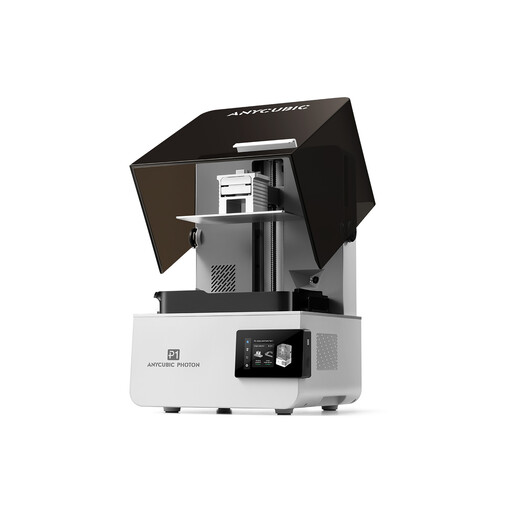
Why it stands out: The Anycubic Photon P1 focuses primarily on reliability and mechanical precision. What sets it apart is its industrial-grade ball screw system paired with dual rails, ensuring remarkable Z-axis stability. It is also designed for versatility, capable of handling ultra-viscous resins (up to 8000?cps) that other machines struggle to use.
Key features:
Who is it for? Engineers, product designers, and workshops that demand flawless mechanical precision and work with a wide range of technical resins, including the most complex ones. It's the ideal machine for functional prototyping and producing parts with tight tolerances.
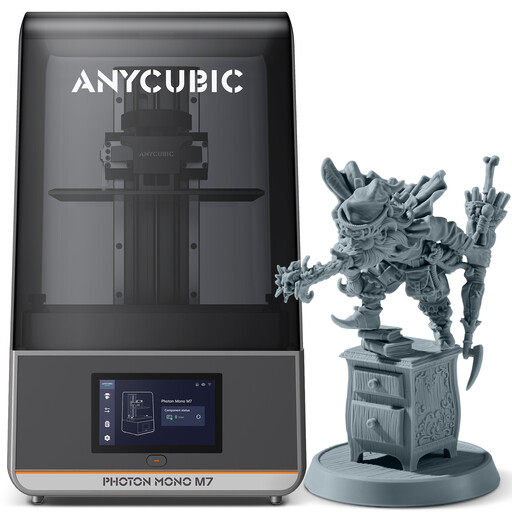
Why it stands out: The Anycubic Photon Mono M7 focuses on one goal: fast and high-performance 3D printing. According to the manufacturer's data, it can reach speeds of 150?mm/h with specific resins. It features the same 14K resolution and a comfortable 6.5?L build volume but forgoes advanced automation to offer a very competitive performance-to-price ratio.
Key features:
Who is it for? Miniature creators, model makers, and small businesses that need to produce high-quality parts quickly without needing full automation features. It's an excellent trade-off between speed, resolution, and cost.
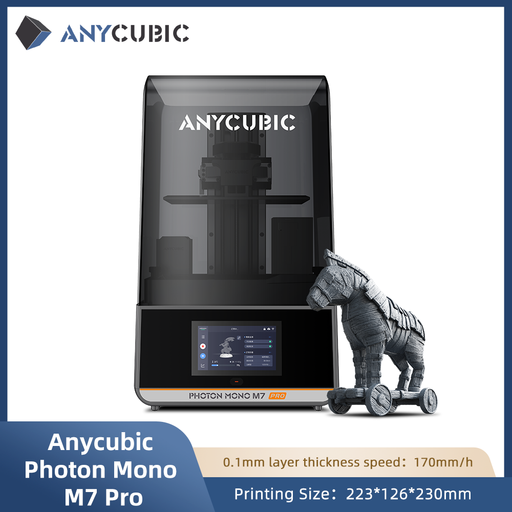
Why it stands out: The Anycubic Photon Mono M7 Pro is the flagship of the lineup, designed for maximum productivity with minimal human intervention. Its automation features, like adaptive temperature control and automatic resin filling/removal, clearly position it for a production environment. These systems ensure that prints run under optimal conditions, even during long print jobs.
Key features:
Who is it for? Labs (e.g., dental), SMBs, and professionals with serial production needs. If your goal is to run prints continuously while minimizing maintenance and monitoring, the Pro model is a necessary investment.
3D printing technology is evolving at a breakneck pace. If the models presented don't fully meet your expectations or if you want to explore other technologies and formats, our catalog offers a much wider selection.
Discover our full range of resin 3D printers
The difference lies in the pixel density of the LCD screen. A 14K resolution on a 10.1-inch screen, like on these Anycubic models, offers an XY resolution of approximately 16.8 × 24.8??m, compared to about 19 × 24??m for a 12K screen of the same size. This improvement translates to even finer surface details, more precise textures, and sharper edges—a benefit that is especially noticeable on small parts or models with complex geometries.
The maximum speeds (e.g., 170?mm/h) are typically achieved under very specific conditions: using the manufacturer's "high-speed" resin, with a thicker layer height (e.g., 0.1?mm), and on models with simple geometry. For standard prints with a conventional resin and a 0.05?mm layer height, the speed will be more moderate but will still be very high-performance thanks to the powerful light source and ACF film.
It all depends on your use case. For a passionate hobbyist or a professional who runs a few prints per week, manually managing resin and temperature is perfectly manageable. However, for a workshop that runs its machines continuously or needs to ensure absolute consistency between batches, automation is a major asset. Temperature control, for example, is crucial for the stability of the resin's properties and, therefore, for the repeatability of the results.