
Livraison le jour même ou le lendemain

Qualité garantie

Débloquez vos offres de bienvenue: Livraison GRATUITE | Jusqu'à -80 % | 30 jours d'essai gratuits à JoyPlus
Téléchargez l'application
A chair that slides, a wobbly table or a sofa that leaves marks on the floor: anti-slip furniture pads solve several everyday annoyances. However, choosing the right model is essential. An unsuitable pad may come unstuck quickly, provide insufficient stability or even cause new scratches.
Before placing your order, consider the type of flooring, the weight of the furniture, the fitting method and how often you move it. Here are the key criteria to check, along with a selection of models suited to different uses.
An adhesive pad can be fitted in just a few seconds, but how well it holds depends largely on the condition of the surface. Dust, moisture and grease residue significantly reduce adhesion. Adhesive pads for furniture feet are best suited to indoor furniture that is rarely moved, provided you clean and dry each foot thoroughly before fitting.
For furniture that is handled regularly, non-adhesive pads may be more practical: they slide underneath the feet and leave no residue. However, their dimensions must be suitable so that they stay firmly in place.
A pad that is too small distributes the weight poorly and may become compressed or shift position. Conversely, a model that is too large may extend beyond the foot and catch on the floor. Measure the diameter, or the length and width, of each foot, then check the total load supported by the set.
For a wardrobe, bed or heavy table, stability also depends on the number of support points. The load stated by the manufacturer should be treated as a guide: never exceed the recommended limit.
Anti-slip rubber pads generally provide good grip on smooth surfaces, but their performance may vary depending on whether they are placed on wood flooring, tiles, vinyl or laminate. Furniture protection felt pads make furniture easier to move and reduce noise, but they are not always designed to prevent it from sliding.
To protect delicate flooring, also check that the pad’s surface is clean and free from small grains of dirt. A single particle trapped underneath can leave a mark when the furniture is moved.
Natural rubber is suitable for many indoor applications, particularly beneath the feet of a bed or fixed piece of furniture. Polymer and plastic may be better suited to other situations, such as garden furniture or accessories exposed to changes in temperature.
A product intended for outdoor use should be clearly described as such. Screw-on pads for outdoor furniture are mechanically fixed and are generally more suitable for wooden tables and chairs than a simple adhesive pad.
Furniture foot caps can also protect the end of a metal or wooden foot. However, they must match its shape and diameter.
Round models are easy to align, while rectangular formats may cover certain chair feet more effectively. Whatever their shape, inspect your pads regularly: flattened rubber, a detached part or worn felt can reduce stability and compromise floor protection against scratches.
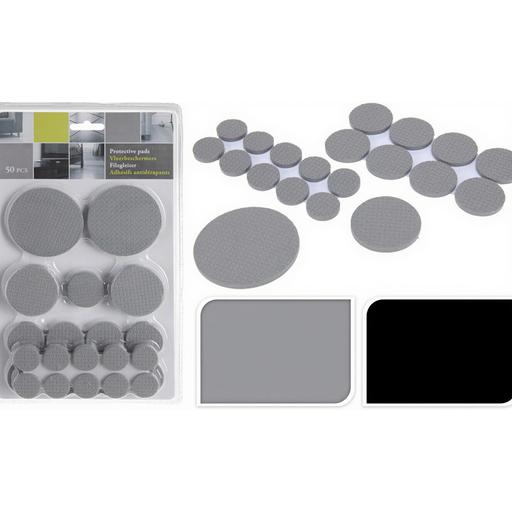
Why this choice suits this profile: With 50 pieces, this pack can be used for several chairs, tables or small appliances without having to place multiple orders. Colours are sent at random.
The adhesive design reduces the risk of the pad moving, provided each piece is applied to a clean, dry surface.
Pack of 50 discs, rubber described as heat-resistant according to the product listing, applied by peeling off the backing and pressing into place.
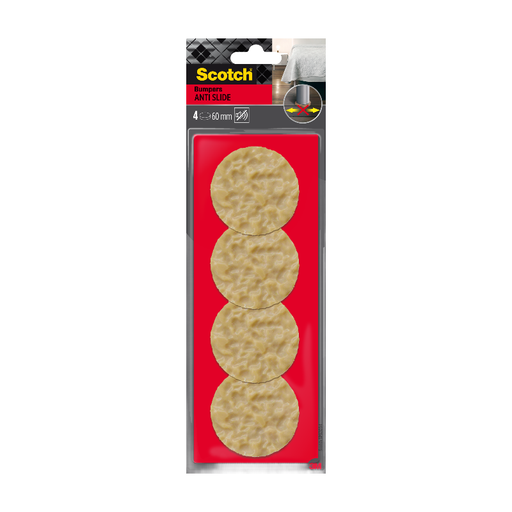
Why this choice suits this profile: This non-adhesive model is ideal for anyone who prefers a reversible installation beneath a bed or heavy piece of furniture.
As it does not use adhesive, it leaves no residue and allows you to check the positioning before putting the furniture back in place.
Natural rubber, 60 mm diameter and designed for use beneath furniture feet, particularly beds.
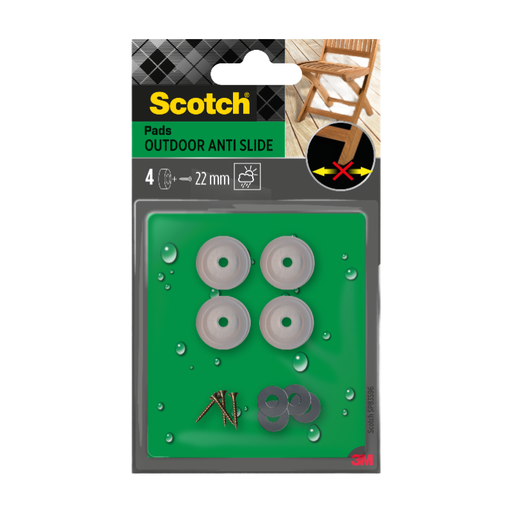
Why this choice suits this profile: Screw fixing is suitable for wooden furniture used outdoors, such as a garden table placed on a damp surface.
Screwing them into place limits the risk of adhesive coming unstuck when exposed to moisture or repeated movement.
Four transparent feet with a diameter of 22 mm, screw-on installation and a design described as suitable for outdoor furniture.
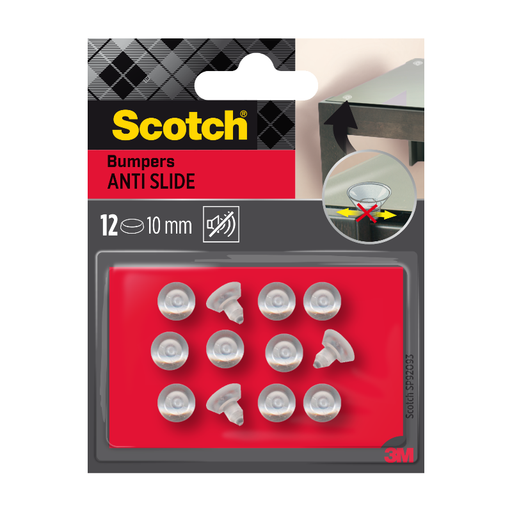
Why this choice suits this profile: These anti-slip suction cups for glass tables offer a discreet way to keep a table top in place indoors for static use.
The product listing specifies use on glass table tops and recommends checking that the fixing is secure before moving the furniture.
10 mm translucent format, discreet suction effect and a design intended to limit movement of a glass table top.
We have put together a comprehensive, regularly updated selection of products that meet these demanding criteria and European safety standards.
Anti-slip car accessories follow a different principle. A cup holder attached to an air vent must fit the shape of the slats without obstructing visibility or access to the controls. The model with EVA pads shown below comes with three pairs of clips, an adjustable holder and an opening advertised as extending up to 9.5 cm.
View the car cup holder with anti-slip EVA pads
Fit it while the vehicle is stationary, check that it stays secure with a closed container and avoid handling your drink while driving. Compatibility depends on the layout of the interior and the diameter of the container.
Clean the underside of the foot with a suitable product, leave it to dry, then remove the protective film without touching the adhesive side. Press firmly for a few seconds and allow the adhesive to set before moving the furniture. Do not apply the pad to a damp, greasy or dusty surface.
This varies according to the weight it supports, how often the furniture is moved, the temperature and the condition of the flooring. Check the pad regularly for wear, flattening and secure attachment. Replace it as soon as it becomes misshapen, comes unstuck or exposes an abrasive section.
They may be suitable, but check the manufacturer’s recommendations and keep their surface clean. Test them first in an inconspicuous area, particularly with oiled wood flooring or a delicate finish. For furniture that is moved frequently, a felt pad will make movement easier; rubber, on the other hand, generally prioritises stability.