
Livraison le jour même ou le lendemain

Qualité garantie

Débloquez vos offres de bienvenue: Livraison GRATUITE | Jusqu'à -80 % | 30 jours d'essai gratuits à JoyPlus
Téléchargez l'application
An anti-mite vacuum cleaner for mattresses can help remove dust, debris, pet hair and various particles from fabrics. However, marketing claims about UV light, vibrations or heat aren't enough to tell one model apart from another. The appliance's design, how easy it is to maintain and its measurable features matter far more.
Before you buy, three common pitfalls keep cropping up.
Values between 12 and 18 kPa give you a useful ballpark figure, but they don't allow you to compare two devices perfectly when the test conditions differ. A head that's well-designed for fabrics, a decent width and consistent contact with the mattress can matter just as much as the number on the spec sheet.
For use on bedding, make sure you check:
A device rated at 12 kPa can be perfectly adequate for regular maintenance of a mattress or sofa. Suction of 15 to 18 kPa can be more useful on carpets, rugs or heavily soiled fabrics, provided the head remains easy to manoeuvre.
Vibrations or the beating action of the head can loosen some particles from the fibres before they're sucked up. However, this doesn't guarantee complete mite removal.
For a UV mattress vacuum cleaner, it's best to think of the lamp as an extra feature. Claims about "sterilisation" or "bacteria elimination" should be understood as features claimed by the brand, not as a medical guarantee. A model's spec sheet might, for example, state a specific elimination rate: this claim belongs to the manufacturer and shouldn't be presented as a universal result.
Hot air drying can help reduce residual moisture on the fabric's surface. Again, a stated temperature of 55 or 65 °C doesn't guarantee even action throughout the entire thickness of a mattress. Always use the appliance according to its instruction manual and avoid treating a fabric that can't withstand heat.
A compact device, designed specifically for bedding, will generally be easier to pull out each week. On the other hand, a cleaner with a water tank can also be used to treat stains on sofas, carpets, rugs, car seats and some hard floors.
Before choosing a vacuum cleaner for sofas and bedding, look at:
In a home with pets, a head that resists hair tangling and an easy-to-empty dust cup are especially welcome. A powerful fabric vacuum cleaner doesn't replace proper washing, but it can effectively complement your regular dry-surface cleaning routine.
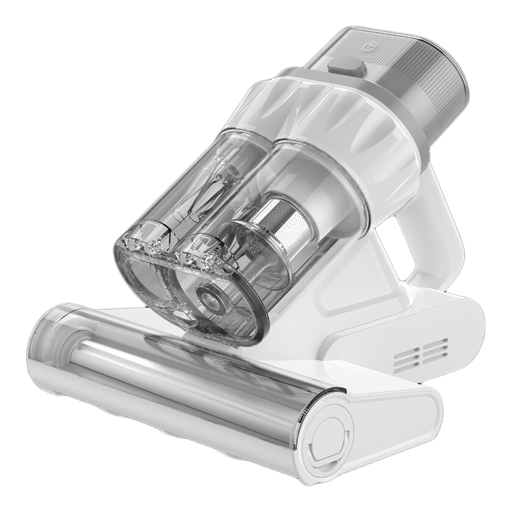
Why this choice suits this profile: With its 1.9 kg weight, 5-metre cord and 12 kPa suction, it's ideal for regular bedding maintenance without a host of complicated settings.
The spec sheet mentions a dual 300 ml dust cup to separate dust and mites, plus a hot air filter rated at 65 °C. Concrete data that lets you evaluate the features on offer, without stopping at the mere mention of UV.
300 W, 72,000 vibrations per minute according to the product sheet, 300 ml dust cup and stated suction of 12 kPa.
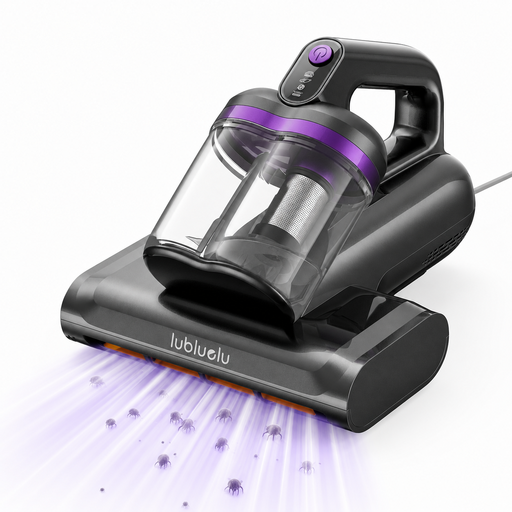
Why this choice suits this profile: It combines suction, stated ultrasonic vibrations, UV and hot air drying for those looking for a dedicated appliance for mattresses and upholstery fabrics.
The hot air temperature is stated at 55 °C and the suction power at 15 kPa. These specifications are easier to compare than a general sanitisation promise.
650 ml dust cup, stated suction of 15 kPa, rated power of 500 W and a 4-metre cord.

Why this choice suits this profile: This fabric cleaner is aimed at households that want to tackle stains and soiling on sofas, carpets, rugs, car seats and some hard floors.
Its combined tank for clean and dirty water simplifies preparation and avoids separate handling. This is a wet cleaning appliance, not to be confused with a UV mattress vacuum cleaner intended for dry cleaning.
Stated 600 W motor, stated suction up to 18,000 Pa, 14 cm brush and stated noise level of 75 dB.
We've put together a comprehensive, real-time updated selection of products that meet these demanding criteria and European safety standards.
First, remove the sheets and let the bedding air out. Then, run the appliance slowly, in even strips, over the entire surface of the mattress and along the seams. Avoid pressing too hard: the head should stay in contact with the fabric without blocking the airflow.
After each session:
Regular, moderate maintenance is generally easier to fit into your daily routine than one long, occasional session. Mattress covers, sheets and protectors should also be washed following the care instructions on their labels.
It all depends on your environment, whether you have pets and how much dust accumulates. A regular pass over mattresses, sofas and other fabrics can complement your usual cleaning routine. Follow the manufacturer's recommendations and don't see this appliance as a substitute for washing removable items.
The cost depends on the appliance's power and how long you use it. A 300 W model used for 15 minutes, for example, consumes around 0.075 kWh. A 600 W appliance used for the same amount of time consumes around 0.15 kWh. To find the exact cost, multiply this consumption by the rate shown on your electricity bill.
The mere presence of a UV function doesn't mean mites are completely eliminated. Results vary depending on the surface being treated, how fast you move the device, contact with the fabric and the condition of the filter. Think of UV, vibrations and hot air as features that complement suction and regular cleaning.