
Livraison le jour même ou le lendemain

Qualité garantie

Débloquez vos offres de bienvenue: Livraison GRATUITE | Jusqu'à -80 % | 30 jours d'essai gratuits à JoyPlus
Téléchargez l'application
An anti-cellulite massager can be a useful addition to your home massage routine, particularly for the thighs, legs, hips, buttocks, arms or stomach. However, the claims printed on the packaging are not enough to help you make the right choice. In everyday use, the massage feel, battery life, accessories and safety precautions often matter far more.
Before you buy, three common mistakes are worth avoiding:
A massage roller is suitable for regular mechanical action on the thighs, calves, arms or buttocks. Models fitted with several rollers cover a larger area, while a compact device allows you to target particular muscle tensions more precisely.
Take the time to check the permitted areas in the instructions. A body massager cannot be used indiscriminately on every part of the body. The face, eyes, genital areas, wounds, recent scars, skin rashes and bony areas are generally excluded. When massaging the arms or buttocks, manoeuvrability and the shape of the handle matter just as much as the number of massage heads.
The term draining massage sometimes appears in product listings. It generally refers to a gentle massage sensation focused on certain areas, rather than a guaranteed effect on circulation or cellulite.
Two intensity levels may be more than enough when you are starting gently. Higher speeds are not necessarily suitable for every user or every area of the body. Controls that are easy to reach during a session allow you to reduce the power quickly if your skin becomes sensitive.
Some devices highlight infrared heat. Check that this function is properly documented in the product listing and that the temperature can be controlled. Heat is not proof that the device is effective against cellulite: it may simply make the massage more comfortable.
Devices combining several techniques, such as kneading, vibration or rolling, can be adapted to different uses. On the other hand, the more functions there are, the more controls you will need to get used to and the more parts there are to maintain.
A rechargeable massager is convenient in a bedroom, bathroom or living room, even when there is no power socket nearby. Compare the stated charging time and battery life: a battery rated for several hours may sound reassuring, but actual battery life varies according to the intensity level and how often you use the device.
The IPX4 rating indicates protection against water splashes, not resistance to immersion. A device carrying this rating must therefore not be submerged or charged while wet. Only use the supplied charger or a certified compatible model.
Weight also deserves consideration. For the legs and thighs, a device weighing a few hundred grams will be easier to move around. A larger model may offer a steadier grip, but it could tire your wrist during a longer session.
The models below are aimed at different needs. The features mentioned correspond to the information available in their product listings; they do not constitute a promise of an aesthetic or medical result.
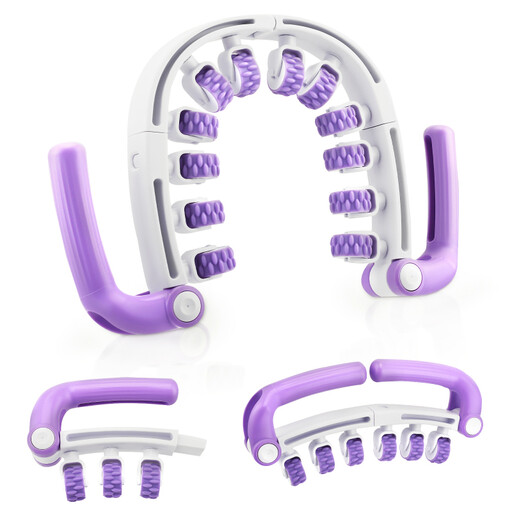
Why this choice suits this profile: Designed for the legs, thighs, buttocks and arms, it is suitable for people who want to discover body massage without buying several different devices.
The areas of use are clearly stated, reducing the risk of buying a model limited to just one part of the body.
360° rollers and intended use across several areas of the body.
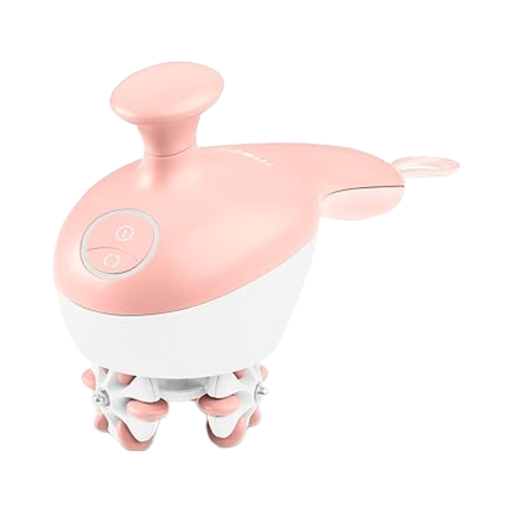
Why this choice suits this profile: This rechargeable model combines several attachments and settings to help structure a routine for the legs, hips, stomach and arms.
The listing specifies two levels, two rotation directions and three attachments, rather than a single intensity that can be difficult to adapt.
7.4 V, 2 200 mAh lithium-ion battery, stated battery life of up to 5 hours on level 1 and IPX4 water resistance.
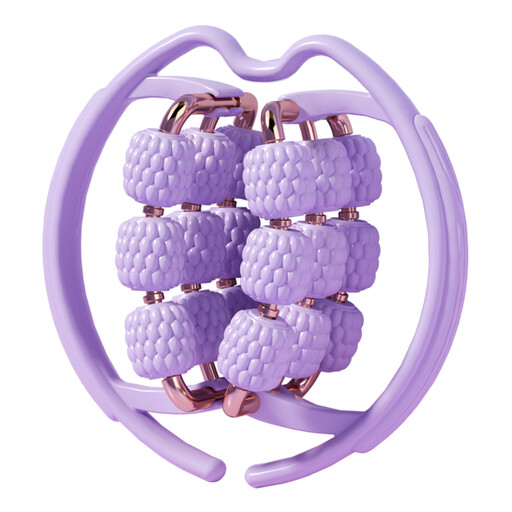
Why this choice suits this profile: With its 18-wheel design, this massager is aimed at people looking for a versatile manual massage for the arms, thighs and neck.
Its mechanical operation does not rely on a battery, removing the risk of running out of charge during a session.
18 massage wheels and a design intended for several areas, particularly the arms and thighs.
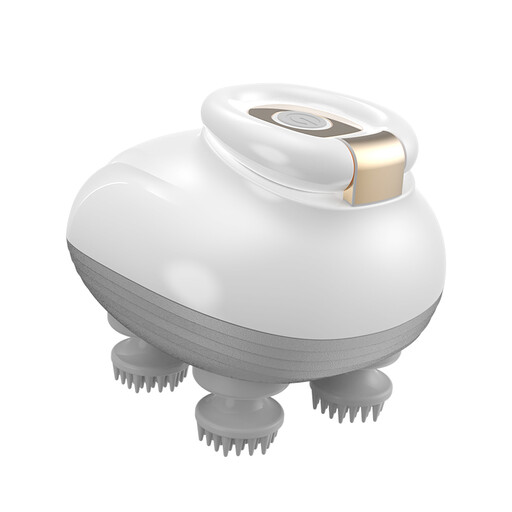
Why this choice suits this profile: With its stated weight of 210 g and USB-C charging, this multi-function massager may suit users who want to take it everywhere or use it regularly.
Its three intensity levels allow you to increase the power more gradually than with a model limited to a single setting.
Six stated massage techniques, 700 mAh battery, USB-C charging and an infrared heat function mentioned in the product name.
Start with the lowest setting and a short session to see how your skin reacts. Move the device across the skin without applying excessive pressure, and avoid leaving it in the same place for too long. Temporary redness may occur, but you should stop using the device if you experience persistent pain, significant bruising or any unusual discomfort.
Do not use this type of device on irritated skin or skin with an injury. The information for the Medisana AC 950 specifically advises against using it in cases of phlebitis, blood clots, pronounced varicose veins, skin infections, blood-clotting disorders or treatment with anticoagulants. If you are pregnant, have an implanted medical device or are experiencing unexplained pain, consult a doctor before use.
It depends on the model and your tolerance. It is better to choose a short, regular session carried out in accordance with the instructions than to apply prolonged pressure. Check the manufacturer's recommendations for the limits specific to your device.
Electricity consumption mainly depends on the battery capacity and how often it is recharged. For users, the most useful points to compare are the charging time, stated battery life and whether the cable or charger can be replaced if necessary.
Only if the instructions explicitly permit it. A certification such as IPX4 protects against water splashes, but does not mean the device can be submerged. Never charge it while showering and do not place it in water.