
Livraison le jour même ou le lendemain

Qualité garantie

Débloquez vos offres de bienvenue: Livraison GRATUITE | Jusqu'à -80 % | 30 jours d'essai gratuits à JoyPlus
Téléchargez l'application
More than just a way to get around, your car's interior is an extension of your personality. Customising it to reflect your style is no longer a luxury reserved for top-of-the-line models. A quality ambient lighting kit can completely transform the atmosphere inside, making it more modern, cosy, or even futuristic. But with options ranging from LED strips and fibre optics to starlight headliners, making the right choice can be daunting. Don't worry?— we'll guide you step-by-step to find the ideal system, helping you avoid common marketing traps.
Before you dive in, here are a few key factors to consider to find the system that best suits your needs and your vehicle.
The final look and installation difficulty vary dramatically depending on the technology.
Controlling your lighting atmosphere at your fingertips is essential.
Ensure the kit is compatible with your car's 12V circuit. Most simply plug into the cigarette lighter socket. For a cleaner installation, some can be hardwired directly to the vehicle's accessory (ACC) circuit. This is the best way to avoid draining the battery when the car is off, as the power cuts off with the ignition. Also, remember to measure your car's interior carefully to order strips or fibres of the correct length.
To help you move from idea to implementation, here are three kits that caught our eye, each with a distinct approach.

What sets it apart?: An ultra-comprehensive kit that uses acrylic strips for a softer, more uniform light diffusion than fibre optics. Its 18-in-1 approach allows you to light up the entire cabin (dashboard, doors, footwells, storage areas) for total immersion.
Key features?:
Who is it for?? For customisation enthusiasts who want a turnkey solution capable of transforming the entire cabin with spectacular visual effects.
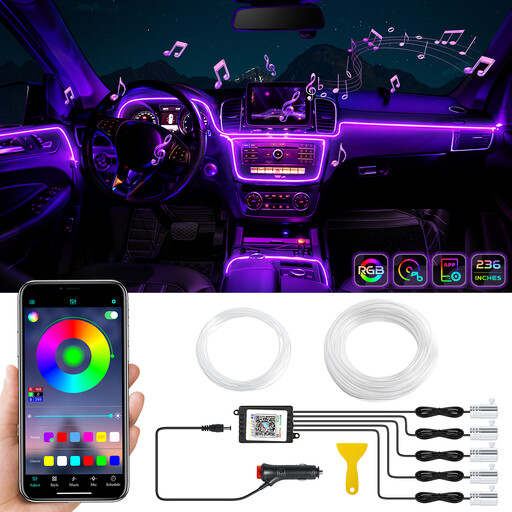
What sets it apart?: Elegance above all. This kit leverages the subtlety of fibre optics to accentuate the lines of the dashboard and door panels. With nearly 6 metres of fibre, it delivers a discreet and modern finish.
Key features?:
Who is it for?? For those looking to modernise their interior with a touch of refinement, echoing the ambient lighting offered as a factory option on high-end vehicles.

What sets it apart?: The dream of a Rolls-Royce-style starlight ceiling, but in your own car. This kit stands out with its "Split" design?— 4 independent light sources, controlled by a single box, allow you to create different colour zones on the headliner. The effect is even richer and more customisable.
Key features?:
Who is it for?? For passionate DIYers who aren't afraid to roll up their sleeves. It's an ambitious project, but the reward is a cabin with a truly unique and spectacular finish.
Our selection is just a taste of the endless possibilities for customising your car. Illuminated door sills, logo projectors, decorative accessories... There are hundreds of products to make your interior truly one-of-a-kind.
Discover our complete collection of car accessories and decorations and find that perfect item to transform your interior.
It all depends on the kit! LED strips and fibre optic console kits are generally very easy to install (plug-and-play)?— the biggest task is neatly hiding the wires. On the other hand, a starlight headliner is a project on another level. It requires removing the headliner and drilling hundreds of holes, an operation that demands time and precision.
Modern kits consume very little power and include built-in protections. The best way to avoid any unpleasant surprises is to wire the kit to a power source that cuts off with the ignition (the ACC circuit). Avoid connecting it to a constant power source, or you might risk being unable to start your car the next morning.
It's simple. A standard RGB light displays only one colour across the entire strip at any given moment. An RGBIC (also known as Dreamcolor) light is smarter?— it has integrated control (IC) chips along the strip. This allows each section to display a different colour simultaneously, enabling much more complex dynamic effects like rainbows, chasing lights, or smooth gradients.