
Livraison le jour même ou le lendemain

Qualité garantie

Débloquez vos offres de bienvenue: Livraison GRATUITE | Jusqu'à -80 % | 30 jours d'essai gratuits à JoyPlus
Téléchargez l'application
Replacing your vehicle's halogen bulbs with LED models is a classic upgrade to modernise your lighting. However, the process can quickly turn into a headache: which model should you choose? How do you avoid error messages on the on-board computer (OBC)? And most importantly, how can you be sure the new bulb will be a perfect fit?
If you're looking to replace your sidelights, dome light, or number plate light with an amber yellow W5W T10 LED bulb, this guide is for you. We'll break down the essential technical aspects and present a selection of reliable products, all without the unnecessary jargon.
Choosing the right bulb is about more than just colour. Here are a few technical criteria to consider for a successful purchase.
The main pitfall when switching to LEDs is often your car's diagnostic system. Since an LED bulb is far more energy-efficient than a halogen one, the vehicle's Canbus system can interpret this low power consumption as a burnt-out bulb and display an error message on the dashboard.
To avoid this issue, it's essential to choose a W5W T10 LED bulb specifically designed to be Canbus error-free (or OBC error-free). These models integrate a resistor that simulates the power draw of a standard bulb, which tricks the on-board computer and ensures warning-free operation.
The T10 base is a true automotive standard. It's known by several part numbers that actually refer to the same type of bulb: W5W, 194, or 168. Rest assured, they are all perfectly interchangeable.
Their versatility allows them to be used in numerous applications:
All these bulbs run on a standard 12V power supply, compatible with almost all passenger cars.
Opting for an amber yellow LED sidelight is often an aesthetic choice, aimed at giving a vehicle a unique look. Beyond the colour, the way the light is diffused is an equally crucial factor. Bulbs with multiple LED chips spread across their surface offer 360-degree illumination. This helps prevent "hotspots" (overly bright areas) and ensures even lighting, whether in a headlight housing or a car's LED dome light.
To help you make your choice, we've selected three options that meet our criteria for compatibility and performance.
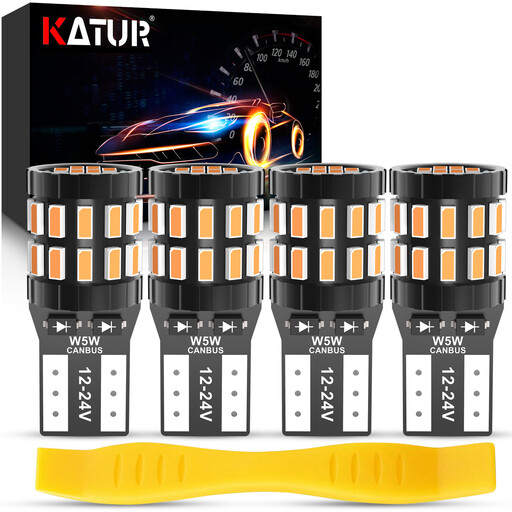
Standout Feature: This model stands out for its impressive number of LED chips (30 per bulb) and its wide voltage range (12-24V). This versatility makes it compatible with cars as well as some lorries and commercial vehicles.
Advantages:
Who is it for? For those seeking maximum light output and rock-solid compatibility, even on 24V vehicles.
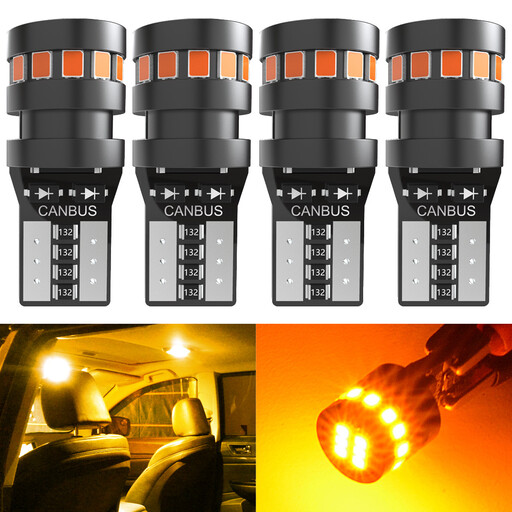
Standout Feature: This model focuses on durability with its full aluminium body. This material ensures excellent heat dissipation, a crucial factor for the lifespan of electronic components.
Advantages:
Who is it for? For drivers who prioritise long-term reliability, thanks to a design built to last.
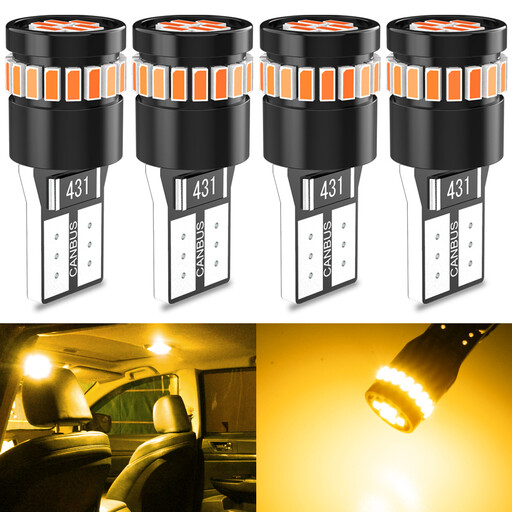
Standout Feature: Its key advantage? An ultra-compact form factor, true to the "1:1" design of the original bulb. Its dimensions, nearly identical to a standard W5W halogen bulb, guarantee an easy fit, even in the tightest housings.
Advantages:
Who is it for? The ideal option for those who worry about fitment issues and want a solution that installs in a snap.
Amber yellow is a bold style choice. If our selection doesn't meet your needs or if you want to explore other shades (like cool white or blue), feel free to browse our full catalogue. There you'll discover a much wider range of solutions to customise your vehicle's lighting.
? Discover Our Full Range of Amber Lighting
1. Is it difficult to install a W5W T10 LED bulb? No, the installation is a breeze. It's a "plug-and-play" system: you remove the old halogen bulb, clip the new LED in its place, and that's it. No wiring modifications are required.
2. What exactly does "Canbus error-free" mean? It means the bulb includes a built-in resistor that mimics the power consumption of a standard bulb. This "tricks" the on-board computer (OBC) so it doesn't register the bulb as being burnt out. Say goodbye to the error message on your dashboard, a common problem when switching to LEDs!
3. Can I use an amber yellow W5W bulb for my number plate? Technically, yes, the bulb will fit without any issues. However, be careful: vehicle lighting regulations in most countries are very clear and require the rear number plate to be illuminated by a white light. Using an amber yellow bulb in this location is therefore illegal. It's best to reserve them for your sidelights or interior lighting.