People who prepare their own snacks
If you have lunch on the go, you can portion out a pack of whole almonds into a small container at home. That way, you can choose how much to take without treating the whole pack as one serving.


To round off a quick lunch, plain or roasted almonds with no added salt are a good choice if you want a simple ingredient list. Flavoured almonds are better if you fancy a stronger taste, but check the ingredients first. Then decide how much to take with you: a 125 g or 200 g pack isn’t automatically a single serving.
If you have lunch on the go, you can portion out a pack of whole almonds into a small container at home. That way, you can choose how much to take without treating the whole pack as one serving.
You prefer roasted almonds, but don’t want a salted or flavoured version. Carrefour and E.Leclerc list roasted almonds with no added salt; check the pack size of the one you choose.
If you fancy a smoky or flavoured snack, check the ingredients and the amount of salt per 100 g to see how it compares with plain almonds.
Start with the ingredients, then consider how much you can realistically carry and store.
| What to consider | What to check | Who is it for? |
|---|---|---|
| Ingredients and salt | Check the ingredients and the “salt” line in the nutritional information per 100 g. | To go with my lunch, I want almonds without added seasoning. Around 36% of consumers say a simple ingredient list is their top priority. |
| Portability and quantity | Check the net weight and whether the pack contains separate portions. If not, bring a small, sealable container. | When I eat away from home, I want to take just the amount I plan to eat, rather than the whole pack. Around 29% of consumers say ease of carrying is their main priority. |
| Pack size and storage | Choose a pack you can portion out and store away from heat and moisture. | If I’ll be using the pack for several snack breaks, I mainly want to use the contents without the rest going off. Around 21% of consumers prioritise managing the quantity they buy. |
| Flavoured varieties | For a smoky or seasoned version, check the added ingredients and the salt per 100 g. | I’m mainly looking for a stronger taste and am happy to compare recipes before choosing. Around 14% of consumers say flavour is their top priority. |
A 125 g or 200 g pack is still a pack to portion out, unless it clearly says that it contains separate servings. Manger Bouger recommends a small handful of unsalted, unsweetened nuts with no chocolate, not a whole pack.
Check the packaging details, then prepare the amount you want to take with you.
The TOKAPI smoky-flavour almonds listed by E.Leclerc contain ingredients including oil, salt, dextrose and caramelised sugar, and have 1.2 g of salt per 100 g.
Compare the ingredients and salt per 100 g with the plain or no-added-salt option you’re considering.
A flavoured product may contain ingredients other than almonds. The DGCCRF states that allergens must be highlighted in the ingredients list of prepacked foods.
Check the label on the product you choose, even if you’re switching to a different recipe or pack size.
Carrefour lists 200 g packs of blanched almonds, as well as roasted almonds with no added salt.
The COULEURS VIVES range includes 200 g packs of blanched almonds and 250 g packs of roasted almonds with no added salt.
Auchan’s almond range includes 125 g, 200 g and 400 g packs, with plain and roasted options with no added salt.
Monoprix lists a 125 g pack of blanched almonds, with blanched almonds shown in the ingredients.
Lidl lists Alesto natural almonds in its nuts and dried fruit range.
ALDI has listed TRADER JOE'S blanched almonds with no added salt in a 200 g pack.
This pick is a small pack of flavoured almond snacks, for anyone who prioritises taste and a compact size.
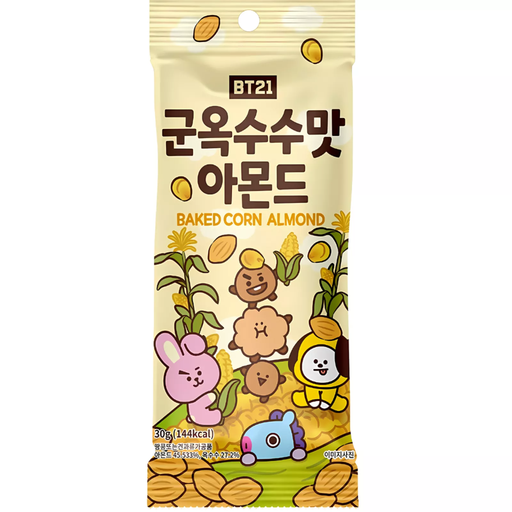 Image unavailable
The 30 g pack is a good choice if you’re after a compact almond snack with a corn flavour, rather than plain almonds. The listed ingredients include sugar, syrup, honey and salt; it isn’t confirmed as being divided into separate portions. The product information mentions soya and milk, as well as possible traces of other allergens. Check the label if this applies to you.
Plain or roasted almonds with no added salt are a good choice if you want a simple ingredient list. Manger Bouger recommends a small daily handful of unsalted, unsweetened nuts with no chocolate; choose separately how much to take with you.
Look for a clear statement that the pack contains separate bags or portions, rather than relying on the pack weight alone. A 125 g, 200 g or 250 g pack of whole almonds isn’t a single serving just because it’s easy to carry.
Read the ingredients and compare the salt content on the same per-100 g basis. E.Leclerc gives its TOKAPI smoky-flavour almonds a salt content of 1.2 g per 100 g, compared with 0.0 g per 100 g for its COULEURS VIVES roasted almonds with no added salt. These figures apply to these two specific products.
For prepacked almonds sold in France, check details including the product name, ingredients, highlighted allergens, net quantity and the date applicable to the product. The DGCCRF also says that the nutritional information lets you check details such as fat, sugars and salt.
Store the almonds away from heat and moisture, as indicated on the product listing for the Seeberger plain almonds sold by Carrefour. When you’re heading out, take the amount you need and put it in a clean, sealed container.