What should you check?
Start by choosing a form that’s suitable for your child’s age and checking the rules where the snack will be eaten. Then look at the ingredients and nutritional information on the pack you’ve chosen.
| Criteria |
What to check |
Who is it for? |
| Form for the child’s age |
For children under 6, look for ground almonds to mix into a recipe, in line with recommendations from Manger Bouger and ameli.fr. |
If my child is under 6, I’m looking for a form I can add to their snack rather than a bag of whole almonds; around 29% of consumers prioritise choosing a form that’s suitable for the child’s age. |
| Allergies and school |
Read the allergen and ‘may contain’ information on the exact pack. Check the school’s rules and, where applicable, the child’s PAI. |
For a snack taken to school, I need to consider the child’s allergies and any relevant rules; this is the main concern for around 29% of consumers. |
| Protein content |
Compare the nutritional values per 100 g and, if provided, per portion. Don’t assume that protein content alone will aid post-exercise recovery. |
After an activity, I want to understand what the snack provides without relying on a ‘high protein’ claim; around 24% of consumers put comparing protein first. |
| Ingredients and storage |
Check the ingredients, salt content and storage instructions for the pack you’ve chosen. |
When preparing snacks at home, I look for ingredients that meet my criteria and a format I can store according to the instructions; ingredients and storage are the top priorities for around 18% of consumers. |
An almond option on Joybuy
This selection features a 180g bag of strawberry-flavoured almond snacks. Before choosing it for a child’s snack, check the form, allergens and nutritional information.
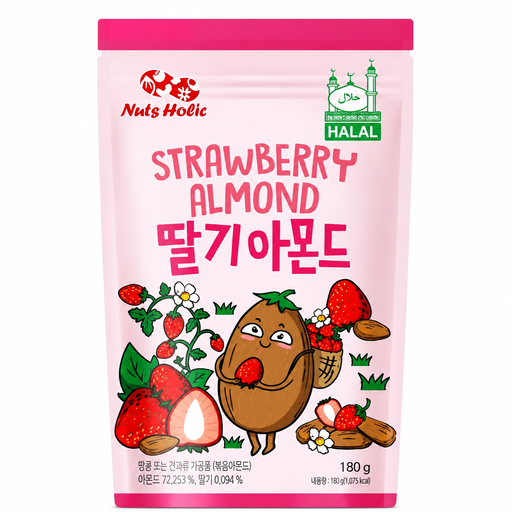 Image unavailable
Nutsholic strawberry-flavoured almonds 180g
This bag may appeal to families comparing flavoured almond snacks for snack time. Before serving it, check the form of the almonds, allergens and nutritional values per 100 g and per portion on the label. For children under 6, Manger Bouger and ameli.fr recommend using ground nuts mixed into a recipe.
View on Joybuy
Frequently asked questions
Can children have whole almonds as a snack?
Not before the age of 6. Manger Bouger and ameli.fr recommend not giving children whole nuts at this age because of the risk of choking, and advise mixing ground nuts into a recipe instead. For older children, also check for allergies and the rules where the snack will be eaten.
Is protein content enough to help you choose almonds after exercise?
No. The Auchan, Monoprix and Seeberger product listings cited here state that products contain between 26 and 29 g of protein per 100 g, depending on the product. These values are useful for comparing products, but they don’t tell you the portion eaten or indicate any effect on post-exercise recovery.
What should you check before bringing almonds to school?
Ask about the class or school’s rules and check the child’s allergies. The French Ministry of National Education says a PAI can set out adjustments for a pupil with a food allergy; follow any instructions that apply to the child.
Are ‘may contain’ allergen warnings the same on every bag?
Check the exact pack. Auchan’s listing for one product of roasted almonds with no added salt mentions possible traces of peanuts, other nuts, gluten, soya, sesame and sulphites. Don’t assume that this list applies to other products.
How should you store almonds after opening?
Follow the instructions on the pack you’ve chosen. For its 200 g and 400 g products of roasted almonds with no added salt, Auchan says to reseal the bag tightly and consume its contents within 15 days of opening.


