What to look for
When choosing almonds to share, start with what matters most to you: portion size, salt, ingredients or allergens. None of these factors replaces the others.
| Factor |
What to check |
Who it matters to |
| Calories and portion size |
Compare the kcal per 100 g, then decide how much to put in the bowls. |
When the bag is being passed around, I’d rather decide how many almonds to serve than rely on a ‘low calorie’ claim; around 33% of consumers prioritise portion control. |
| Added salt |
Look for ‘no added salt’ or ‘unsalted’, then check the amount of salt per 100 g. |
If my guests prefer an unsalted recipe, the classic savoury flavour comes second; reducing salt would be a priority for around 27% of consumers. |
| Ingredients |
Read the ingredients list to distinguish plain almonds from recipes containing oil or salt. |
When I’m putting together drinks and nibbles with a simple recipe, I want to know what else is in with the almonds; around 20% of consumers would choose based on ingredients first. |
| Allergens and traces |
Check the ingredients and any ‘may contain’ warnings on the bag you’re actually serving. |
If I’m hosting someone who tells me they have an allergy, I need to be able to check the label before offering them almonds; allergens would be the main concern for around 20% of consumers. |
Brands to know
These products provide useful points of comparison for ingredients, salt and nutritional values. Each detail applies to the product mentioned, not the brand as a whole.
Carrefour Original
200 g bag of roasted almonds with no added salt.
- The Carrefour listing shows 628 kcal per 100 g.
- Check the ‘may contain’ warnings, particularly for peanuts and other nuts, on the packaging you choose.
Auchan
Roasted almonds with no added salt, including a 200 g pack.
- The 200 g bag’s listing names almonds as the ingredient and shows 640 kcal and less than 0.01 g of salt per 100 g.
- The same listing warns that other allergens may be present. Check the packaging before serving.
TOKAPI / Marque Repère E.Leclerc
150 g bag of roasted and salted almonds.
- The E.Leclerc listing shows 626 kcal per 100 g and a recipe made up of 94.5% almonds.
- The recipe also contains 4.5% sunflower oil and 1% salt.
Monoprix
75 g bag of whole roasted and salted almonds.
- The small bag makes it easier to decide how much to put on the table.
- The Monoprix listing shows 649 kcal and 0.64 g of salt per 100 g: the bag size doesn’t change these figures per 100 g.
Seeberger
150 g bag of unsalted roasted almonds.
- The ingredients list shown by Carrefour names almonds.
- The listing shows 653 kcal per 100 g: ‘unsalted’ does not mean ‘low in calories’.
An option on Joybuy
If you’re looking for an almond snack in a small pack to serve, you could consider this flavoured option. If you want plain almonds or ones with no added salt, check the ingredients before choosing it.
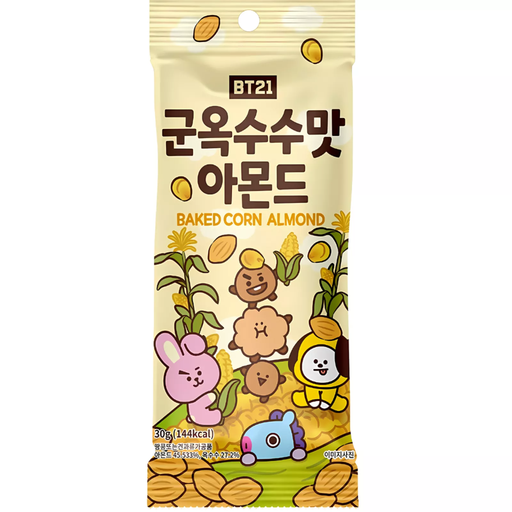 Image unavailable
BT21 Baked Corn Flavor Almond 30g
The 30 g bag can help you control how much you serve with drinks. It’s a roasted corn-flavoured almond snack, not plain almonds, so check the ingredients, nutritional information and allergens on the packaging before serving.
View on Joybuy
Frequently asked questions
Can almonds served with drinks be described as ‘low calorie’?
Not the products reviewed: their listings show 626 to 653 kcal per 100 g. Regulation (EC) No 1924/2006 sets the threshold for a ‘low energy’ claim on solid foods at no more than 40 kcal per 100 g. For your gathering, it’s better to focus on the portion you serve.
Are almonds with no added salt lower in calories?
Not necessarily. The Carrefour Original product mentioned here with no added salt shows 628 kcal per 100 g, while Auchan shows 640 kcal per 100 g. Compare the energy and salt figures separately, using the same 100 g basis.
How many almonds should I allow per person?
Manger Bouger recommends a small handful of unsalted nuts each day. For drinks and nibbles, you can prepare a small bowl for each person instead of leaving the whole bag out, without mistaking this portion guide for a sign that almonds are ‘light’.
What should I check if a guest tells me they have an allergy?
Read the ingredients list and any ‘may contain’ warnings on the bag you’re planning to serve, then speak to the guest before offering them the product. The Directorate-General for Competition Policy, Consumer Affairs and Fraud Control reminds food businesses that allergens must be highlighted on the labels of prepacked foods.


