For a back-to-school snack, choosing plain almonds won’t necessarily reduce the energy content: the Vico Natur’ & Bon product information on Monoprix lists 640 kcal per 100 g. If you’re looking for a simple recipe, compare the ingredients and prepare the amount you want, rather than relying on the size of the packet alone. Manger Bouger advises against giving whole nuts to children under 6.
Who is this option for?
Parents preparing a small snack
You want to choose the ingredients and serving size before heading out. A recipe made solely with almonds may meet the first requirement, but it’s still high in energy: the Vico Natur’ & Bon product information published by Monoprix lists 640 kcal per 100 g.
Families with a child under 6
Format matters more than comparing calories. Manger Bouger advises against giving whole nuts to children under 6 because of the risk of choking; ground almonds can be added to a preparation with a texture suitable for the child.
Anyone choosing between plain and flavoured
The word ‘almonds’ doesn’t tell you everything about a recipe. Compare the ingredients list and nutritional information for the specific product, especially if you’re considering a roasted or flavoured version.
What should you look for?
For a school snack, first check that the format is suitable for the child’s age and complies with the school’s rules. Then compare the ingredients and the energy listed per 100 g before deciding how much to serve.
| What matters |
What to check |
Who is it for? |
| Quantity and energy |
Energy per 100 g and the amount actually served, which is different from the packet weight. |
When preparing a snack to take out, I want to choose the portion without using the whole packet as a serving; around 40% of consumers put managing energy intake first. |
| Ingredients |
The ingredients list, followed by the sugars and salt in the nutritional information for the specific product. |
If I’m looking for uncoated almonds, the recipe matters more to me than the flavour advertised on the packet; around 30% of consumers prioritise a simple ingredients list. |
| Children and school |
No whole nuts for children under 6, according to Manger Bouger; also check allergens and the school’s rules. |
With a young child or class rules to follow, I need to make sure the format and snack are suitable first; around 30% of consumers prioritise safety and school requirements. |
Mistakes to avoid
-
Assuming ‘plain’ means ‘low in calories’
The Vico Natur’ & Bon product information on Monoprix lists 640 kcal per 100 g for unroasted, unsalted almonds. The same retailer lists 653 kcal per 100 g for Seeberger roasted, unsalted almonds. So the word ‘roasted’ alone doesn’t mean they’re lower in energy either.
Compare the per-100 g values for the products you’re considering, then choose how much to serve.
-
Relying on the word ‘almonds’ alone
A flavoured recipe may contain other ingredients. Joybuy’s product information for BT21 honey and butter almonds lists sugar, starch syrup, oil and sweetened condensed milk, among other ingredients. This recipe shouldn’t be confused with plain almonds.
Read the ingredients and nutritional information for each variety, and don’t assume one flavour has the same ingredients as another.
-
Giving whole almonds to a young child
According to Manger Bouger, whole nuts pose a choking risk for children under 6.
For a child under 6, consider using ground almonds in a preparation with a suitable texture instead.
-
Forgetting about allergens and school rules
Almonds are an allergen; some products also warn that they may contain traces of peanuts or other nuts. A short ingredients list doesn’t mean you can skip this check.
Read the information on the packet you buy and check the rules at your child’s school or after-school club before packing the snack.
Brands to consider by format
Vico Natur’ & Bon
The unroasted, unsalted almonds listed by Monoprix are a good fit if you’re looking for a short ingredients list.
- The Monoprix product information lists ‘almonds’ as the sole ingredient in this product.
- It lists 640 kcal per 100 g and identifies almonds as an allergen, with possible traces of peanuts and other nuts.
Seeberger
The roasted, unsalted almonds listed by Monoprix are for anyone who prefers this texture.
- The product information lists 0.02 g of salt per 100 g.
- It also lists 653 kcal per 100 g, so roasting alone doesn’t mean it’s a lower-calorie snack.
Carrefour Bio
This 100 g packet of organic ground almonds is intended to be added to a recipe, rather than eaten as whole almonds.
- The ground format lets you choose a different texture for a recipe.
- Carrefour lists 640 kcal per 100 g; check the allergen information on the packet too.
Auchan Bio
This 100 g product of organic ground almonds is designed for cooking, not as a packet of whole almonds to take with you.
- Auchan’s product information lists organic almonds as an ingredient.
- It lists 644 kcal per 100 g and advises storing the product in a cool, dry place, then using it within 15 days of opening.
A flavoured option on Joybuy
This selection features a small packet of roasted corn-flavoured almonds. Compare it with plain almonds if a simple recipe is your main priority.
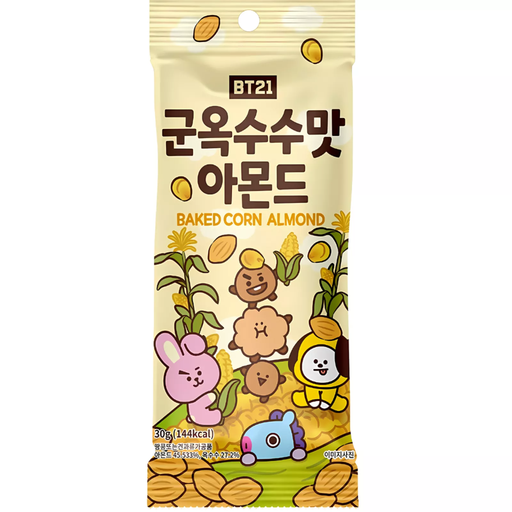 Image unavailable
BT21 roasted corn-flavoured almonds, 30 g
The 30 g packet is a handy small size to take with you, with a roasted corn flavour rather than a plain recipe.
Before packing it for school, compare its ingredients and nutritional information with those of plain almonds, then check the allergens and school rules. For a child under 6, don’t give them whole nuts, in line with Manger Bouger’s recommendation.
View on Joybuy
Frequently asked questions
Are plain almonds low in calories?
The word ‘plain’ doesn’t guarantee that: the Vico Natur’ & Bon product information on Monoprix lists 640 kcal per 100 g for unroasted, unsalted almonds. When choosing a snack, compare the values per 100 g and decide separately how much to serve.
Are roasted almonds lower in calories?
Roasting alone doesn’t tell you that. Monoprix lists 653 kcal per 100 g for Seeberger roasted, unsalted almonds; compare the labels of the specific products you’re interested in.
Can children take whole almonds to school?
Not before the age of 6: Manger Bouger advises against whole nuts at this age because of the risk of choking. For an older child, check allergens and the school’s rules before preparing the snack.
What should you check on a packet of flavoured almonds?
Read the ingredients list, allergen information and nutritional details for the specific flavour, particularly the energy per 100 g, sugars and salt. You can’t work out what’s in a flavoured variety from the word ‘almonds’ alone, or from the ingredients in another variety.


