Festival-goers who want to portion their snacks
If you want to take almonds with you without accidentally finishing the whole bag, compare the calorie information and set aside the amount you plan to eat before you leave.


When you’re camping or at a festival, the simplest way to keep track of the calories in an almond snack is to prepare the amount you’re taking with you, rather than eating from a large bag. Plain almonds and those with no added salt aren’t necessarily low in calories, though. Compare the nutritional information for the product you choose, then check its ingredients, allergens and storage instructions.
If you want to take almonds with you without accidentally finishing the whole bag, compare the calorie information and set aside the amount you plan to eat before you leave.
For a snack to take on the journey or keep in your tent, read the ingredients list and check the “salt” line. A recipe with no added salt isn’t necessarily lower in calories.
Almonds are tree nuts and a potential allergen. Before sharing a bag, check its label and bear in mind that whole almonds can pose a choking risk for young children.
| What to check | Look for | Who is this useful for? |
|---|---|---|
| Calories per portion | Compare the kcal per 100 g and, if shown on the pack, the calories per portion. Then decide how much to take with you. | When I’m planning several snacks for the festival, I want to know how much I’ll eat during each break. Around 36% of consumers put having clearly defined portions first. |
| Salt and ingredients | Check the ingredients list and the “salt” line to tell plain almonds apart from seasoned varieties. | If I’m looking for a simple recipe to take away, I don’t want to mistake plain almonds for salted ones. Avoiding added salt is the top priority for around 29% of consumers. |
| Transport and storage | Check the pack size and the storage and resealing instructions for after opening. | For a bag I’ll be using over several days, I need an amount that’s easy to portion out and a container I can keep closed. Around 21% of consumers put convenience first. |
| Allergens and sharing | Read the allergen information and any “may contain” warnings on the exact product; consider the age of the people you’ll be sharing it with. | Before offering almonds to the group, I need to know who they’re for and whether the form is suitable for younger children. Around 14% of consumers put safety when sharing first. |
These descriptions don’t tell you how many calories the snack contains. Auchan and E.Leclerc also list unsalted almonds, whose energy value needs to be considered in relation to the portion you eat.
Compare the kcal per 100 g on the pack and prepare your portion before you leave.
The roasted and salted almonds listed by Monoprix contain sunflower oil and salt. Their ingredients therefore differ from those of a product with no added salt.
If this matters to you, check the ingredients list and the “salt” line on the pack you choose.
The instructions for the Auchan products reviewed say to keep the almonds away from heat and moisture, and to reseal the bag properly after opening.
If you’re portioning out the almonds, use a clean, sealed container, then follow the instructions on your product.
According to EFSA, almonds are among the tree nuts that can cause allergies. A pack may also carry “may contain” warnings that are important for people with allergies; whole almonds can pose a choking risk for young children.
Show the label before sharing, and don’t offer whole almonds to a young child.
The product listed by Auchan is a 180 g bag of unroasted, unsalted almonds.
The products reviewed include a 400 g bag of roasted almonds with no added salt and a 125 g bag of unsalted POUCE almonds.
The product listed by E.Leclerc is a 100 g bag of organic roasted almonds with no added salt.
The product reviewed is a 75 g bag of whole roasted and salted almonds.
This 30 g pack is a handy, pre-portioned option for flavoured almonds on the go. It’s not the same as the plain or no-added-salt almonds mentioned above.
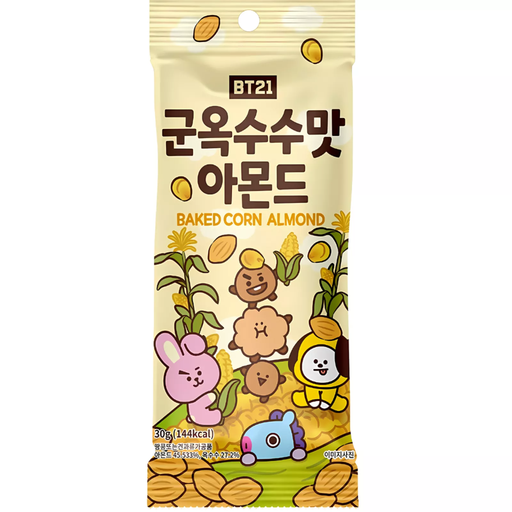 Image unavailable
The 30 g pack gives you a set amount to enjoy during a festival break, but that doesn’t mean it’s a low-calorie snack. The corn flavour sets this product apart from plain almonds, so check the ingredients and allergen information on the pack before sharing. If you plan to keep it after opening, check that the pack can be resealed securely.
A small portion limits the calories you consume, but almonds don’t become low in calories just because they’re plain. The products listed by Auchan, E.Leclerc and Monoprix contain between 585 and 649 kcal per 100 g; check the information on the bag you buy.
Set aside a specific amount before you leave, rather than dipping into a large bag. Manger Bouger recommends a small handful of unsalted nuts a day; as an example of how to read the label, Auchan states that 25 g of its roasted almonds with no added salt contains 158 kcal. This portion value applies to that product only.
Keep them away from heat and moisture, and close the container after use. For its POUCE product, Auchan advises sealing the bag tightly after opening and eating the almonds within 15 days; follow the instructions on the pack you take with you.
Read the ingredients list, allergen information and any “may contain” warnings on the exact product. According to Your Europe, the European Union’s official website, allergen information is part of the mandatory labelling for prepacked food; EFSA classifies almonds as a tree nut allergen. Don’t offer whole almonds to a young child, as they can pose a choking risk.