Parents looking for an organic recipe with no added sugars
For breakfast or family recipes, you want to keep track of the ingredients and tell the difference between a recipe with no added sugars and one containing cane sugar.


To choose an organic almond drink for the family, compare the ingredients list and sugars per 100 ml. Neither the ‘organic’ label nor a name suggesting sweetness tells you everything about the recipe or its taste. A recipe with a higher almond content may also contain cane sugar. According to Anses, standard plant-based drinks are not a substitute for breast milk or infant formula for babies.
For breakfast or family recipes, you want to keep track of the ingredients and tell the difference between a recipe with no added sugars and one containing cane sugar.
If your child is a baby, the choice is not between standard almond drinks: Anses states that these are not a substitute for breast milk or infant formula.
You compare the proportion of almonds in different recipes, while checking sweetening ingredients and nutritional values separately.
When choosing an almond drink for the family, first check your child’s age, then compare the ingredients and nutritional values with the recipe you prefer. You can’t tell how sweet it will taste from these details alone.
| Criteria | What to check | Who is it for? |
|---|---|---|
| Added sugars and organic status | Check the organic labelling, then read the ingredients list and the ‘sugars’ line per 100 ml. | For family meals, I want an organic recipe with no added sugar in the ingredients. Around 42% of consumers would put this first. |
| Child’s age | If your child is a baby, don’t choose a standard plant-based drink as a substitute for breast milk or infant formula, in line with Anses guidance. | With a baby, I need to distinguish a standard drink from nutrition suited to their age. Age-related safety would be the priority for around 33% of consumers. |
| Almond intensity | Compare the proportion of almonds and the presence of sweetening ingredients in each recipe. | If almond flavour matters in a recipe, I check its ingredients without assuming that a higher almond content means no added sugar. Around 25% of consumers would prioritise this intensity. |
The organic Bjorg Amande and Carrefour Bio Amande Intense recipes featured by Carrefour France contain cane sugar.
To tell the recipes apart, read the ingredients and check the ‘sugars’ line using the same 100 ml basis.
According to Anses, a standard plant-based drink does not meet a baby’s specific needs and is not a substitute for breast milk or infant formula.
If you have questions about feeding a baby, ask a healthcare professional for advice rather than choosing a standard drink as a substitute.
Carrefour France states that its Carrefour Bio Amande Intense recipe contains 7% almonds and cane sugar. So the proportion of almonds alone does not tell you whether sugar has been added.
Check both details separately before choosing a more intense recipe.
The ingredients and nutritional values help you compare recipes, but they can’t tell you whether your child will find one sweet-tasting.
Once you’ve checked the ingredients that matter to you, try one carton before choosing a product for the family.
These examples show how almond drinks can vary in composition; their features don’t apply to every recipe from each brand.
Two recipes to compare if you’re choosing between no added sugars and a higher proportion of almonds.
An organic recipe to consider if you’re happy to choose an almond drink with added sugar.
A recipe to compare if you’re looking for a short ingredients list in an almond drink.
This Bjorg Intense variant gives you the chance to consider an almond drink for family recipes. If you’re looking for an organic recipe with no added sugars, check both details on the packaging before choosing.
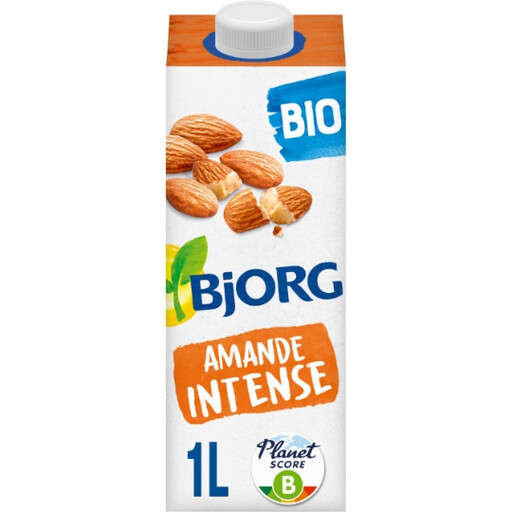 Image unavailable
If you’re considering the Intense variant for family recipes, compare its ingredients and sugars with those of a recipe containing no added sugars.
Pack size: 1 L. Check the organic label on the carton; according to Anses, a standard almond drink is not a substitute for breast milk or infant formula for babies.
No. According to Anses, standard drinks of plant or animal origin are not a substitute for breast milk or infant formula for babies. If your baby has specific dietary needs, ask a healthcare professional for advice.
Check the organic statements and logo on the carton you’ve chosen. The French Ministry of Agriculture explains that organic certification is governed by European regulations; this information alone doesn’t tell you how much sugar the recipe contains.
Compare the ‘sugars’ line on the same 100 ml basis, then read the ingredients to spot any added sugar. The DGCCRF states that nutritional information is given per 100 g or 100 ml, so check the unit before comparing two figures.
Don’t choose a drink that contains almonds, and check the label every time you buy it, particularly if the recipe changes. The DGCCRF states that allergenic ingredients must be highlighted in the ingredients list.